Topological Evolution of Time in Unimodular Gravity
Explore the concept of topological evolution of time within the framework of Unimodular Gravity, as presented by Sayyed Rassouli from the University of Nottingham.
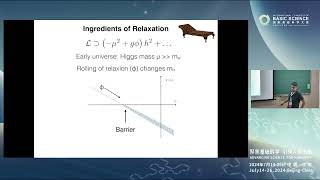
Cosmological Relaxation of the Electroweak Scale
Explore a novel approach to the electroweak hierarchy problem through cosmological evolution, challenging traditional solutions and expanding our understanding of early Universe dynamics.
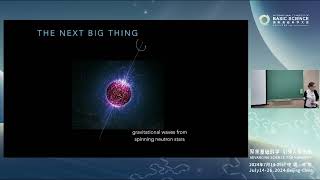
The Next Big Gravitational Wave Discovery - Continuous Sources
Explore the future of gravitational wave astronomy, focusing on continuous sources and their potential for groundbreaking discoveries in the field.
The Second Data Release from the European Pulsar Timing Array - Search for Gravitational Wave Signals
Explore the latest findings from the European Pulsar Timing Array's second data release and its implications for gravitational wave detection.
Non-linearities and Gravitational Signals from Black Hole Spacetimes
Explore non-linear behavior of perturbed black holes and its implications for gravitational wave detection and new physics in mergers.
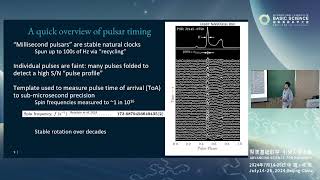
The Parkes Pulsar Timing Array Third Data Release: Overview and Search for an Isotropic Gravitational-wave Background
Explore the Parkes Pulsar Timing Array's latest data release, focusing on gravitational wave detection techniques and results from isotropic stochastic background searches.
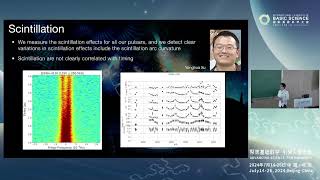
Searching for Gravitational Wave Background with Chinese Pulsar Timing Array Data Release I
Explore gravitational wave detection using Chinese Pulsar Timing Array data. Learn about millisecond pulsar observations, data analysis techniques, and key findings in the search for nanohertz gravitational wave backgrounds.
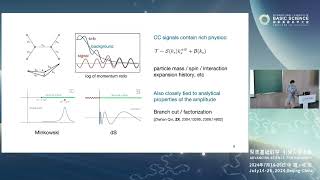
Family Tree Decomposition of Cosmological Correlators
Explore analytical methods for computing cosmological correlators, including family tree decomposition for nested time integrals in dS and FRW universes.
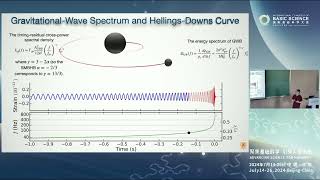
Search for Gravitational-Wave Background in Pulsar Timing Array
Explore recent pulsar timing array observations and their implications for gravitational wave detection, including evidence for scalar transverse polarization modes and challenges in confirming gravitational waves.
Testing Gravity Theories with Radio Pulsar Timing
Explore radio pulsar timing techniques and their application in testing alternative gravity theories using binary pulsars.
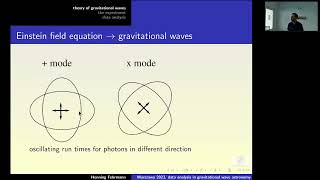
Data Analysis in Gravitational Wave Research
Explore data analysis methods for detecting gravitational waves from various cosmic sources, including mergers and continuous waves, with insights into the Atlas data analysis facility.
Statistical Analysis in Cosmology: Goodness-of-Fit and Model Selection - Part 2
Explore advanced statistical methods in cosmology, including model selection, MCMC, chi-square, and p-value analysis for robust data interpretation.
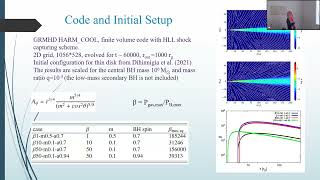
Gas-Rich Environment Effect on Low-Frequency Gravitational Waves from Supermassive Black Hole Binaries
Explore how gas-rich environments impact low-frequency gravitational waves from supermassive black hole binaries, focusing on LISA's potential to detect these effects and inform AGN accretion disk physics.
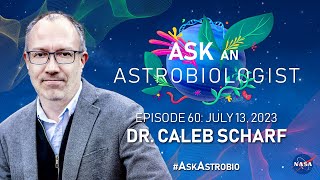
The Zoomable Universe and Understanding Worlds Beyond Earth
Explore the universe and exoplanets with NASA astrobiologist Dr. Caleb Scharf. Dive into astrobiology, information theory, and the search for extraterrestrial life in this engaging discussion.
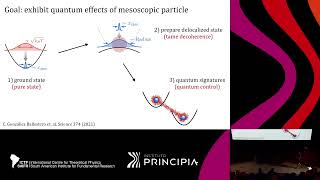
Can We Detect the Quantum Nature of Gravity?
Explore the possibility of detecting quantum gravity in laboratory settings, examining cutting-edge research and experimental approaches in this fascinating field of physics.
Darkness Falls: Cosmological Tension Rises - Old and New Dark Energy Mysteries
Explore cosmological tensions and dark energy mysteries with Dr Yasaman Yazdi in this intriguing Samhain agus Science 2023 presentation.
The Physical Processes Governing Structure Formation in Our Universe
Explore the physical processes shaping cosmic structures, from large-scale web formations to galaxy and star evolution, examining gravitational forces, hydrodynamics, and radiative effects.
Null Shells: Abstract Formulation of Junction Conditions and Particularization
Explore abstract formulation of junction conditions for matching spacetimes, focusing on null shells and their gravitational/matter content. Analyze multiple matchings and cut-and-paste scenarios.
Massive Waves Gravitationally Bound to Static Bodies
Explore massive waves bound to static bodies in astrophysical spacetimes. Discover standing wave solutions and their implications for Klein-Gordon equations on asymptotically conic manifolds.
Infrared Finite Scattering Theory in QFT and Quantum Gravity
Explore infrared finite scattering theory in QFT and quantum gravity, addressing IR divergences, memory effects, and challenges in constructing IR-finite S-matrices across various theories.
Elements of General Relativity - Lecture 3
Explore advanced concepts in general relativity, focusing on geometry beyond Riemann and examining curvature and rigidity in spacetime.