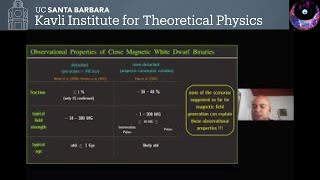
Formation and Evolution of Close Magnetic White Dwarf Binaries - Diogo Belloni
Explore the formation and evolution of close magnetic white dwarf binaries, their impact on astrophysics, and implications for stellar remnants and galactic populations.
Quantum Gravity and Cosmology - Eva Silverstein (Stanford)
Explore quantum gravity and cosmology with Stanford's Eva Silverstein in this Snowmass Theory Frontier Conference talk, covering recent advances and future opportunities in high-energy physics theory.
The Cosmic Web as a Probe of Inflationary Physics - Nathan Carlson
Explore how the cosmic web structure can provide insights into inflationary physics and early universe dynamics, presented by Nathan Carlson from CITA.
The Transport of Beyond the Standard Model Cosmic Superweb Information to Correlated Lensed Websky Observables
Explore cosmic superweb information transport and its impact on lensed websky observables, delving into beyond-standard-model physics and correlated phenomena in the universe.
Splitting the Cosmic Web for More Information - Yan-Chuan Cai
Explore the cosmic web's impact on galaxy formation and evolution, connecting galactic properties to cosmology through innovative analysis techniques and observational data.
How Do Cosmic Web Structures Affect Galaxy Quenching Across Cosmic Time? - Farhan Hasan
Explore the impact of cosmic web structures on galaxy quenching throughout the universe's history. Gain insights into the complex relationship between large-scale structures and galactic evolution.
Caught in the Cosmic Web - Framing the Big Picture of the Slow Quenching of Massive Galaxies
Explore the cosmic web's influence on galaxy evolution, focusing on the slow quenching of massive galaxies and its connection to large-scale structures in the universe.
Beyond Halo Mass - The Role of Vorticity-Rich Filaments in Quenching Galaxy Mass Assembly
Explore the impact of vorticity-rich filaments on galaxy mass assembly quenching, going beyond traditional halo mass considerations in cosmic web evolution and galaxy formation.
Pre-Processing of Galaxies in Galaxy Cluster Outskirts - Ulrike Kuchner
Explore galaxy pre-processing in cluster outskirts, examining how environment shapes galaxy evolution before entering dense cluster cores. Insights into cosmic web's influence on galaxy properties.
Voids and Void Galaxies in the TNG300 Simulation - Olivia Curtis
Explore voids and void galaxies in the TNG300 simulation, examining their properties and implications for cosmic structure formation and galaxy evolution.
Ex Uno Plures - Direct Measure of the Impact of the Cosmic Web on Individual Objects to Shed Light on Their Population Statistics
Explore the cosmic web's influence on individual objects and population statistics, shedding light on galaxy formation and evolution in the universe's large-scale structure.
The Faint Lyman-Alpha Cosmic Web in TNG50 - Chris Byrohl
Explore the faint Lyman-alpha cosmic web in TNG50 simulation, examining its structure, properties, and implications for galaxy formation and evolution in the early universe.
Constraining the Cosmic Partition of IGM and CGM Baryons with FRB Foreground Mapping - KG Lee
Explore cosmic baryon distribution using Fast Radio Burst foreground mapping to constrain the partition between intergalactic and circumgalactic mediums, advancing our understanding of cosmic structure.
Impact of Small-Scale Structure on Reionization - Hyunbae Park
Explores the influence of small-scale cosmic structures on the reionization process, examining how early galaxies and quasars interact with the cosmic web to shape the universe's evolution.
Massive Galaxies at Cosmic Dawn - Cold Streams & Feedback-Free Starbursts
Explore massive galaxies in the early universe, focusing on cold streams and intense star formation periods without feedback, as presented by Avishai Dekel from Hebrew University.
Single-Dish Line-Intensity Mapping - Observational and Theoretical Outlook
Explores single-dish line-intensity mapping for observing the Epoch of Reionization, discussing observational techniques and theoretical perspectives to study early universe structure formation.
The Importance of the Tracers in Extracting Filaments - Dark Matter and Galaxy Particles
Exploración de la importancia de los trazadores en la extracción de filamentos de materia oscura y partículas galácticas en la estructura del universo a gran escala.
Dissecting the Cosmic Web With Caustics - Job Feldbrugge
Explore the cosmic web's structure and its role in galaxy formation through caustics analysis. Gain insights into the universe's large-scale structure and its impact on cosmic evolution.
Early Results from Cosmicflows-4 - Brent Tully
Explore early findings from Cosmicflows-4 project, examining cosmic web structure and galaxy distribution. Gain insights into large-scale universe mapping and implications for cosmology.
Indicator Power Spectra- Surgical Excision of Non-linearities and Covariance Matrices for Counts in Cells
Explore indicator power spectra for cosmic web analysis, focusing on non-linearity removal and covariance matrices in cell count studies to enhance understanding of large-scale structures.
Optimal Transport Reconstruction and Peaks Theory for Energy - Ravi Sheth
Explore optimal transport reconstruction and peaks theory for energy in cosmic web evolution, connecting galaxy properties to cosmology and structure formation.