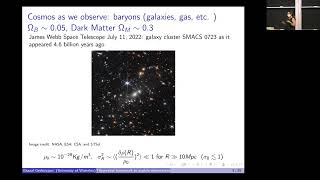
Introduction to Cosmological Perturbation Theory
Explore the foundations of cosmological perturbation theory, examining how small fluctuations in the early universe evolved into large-scale structures we observe today.

The Inexplicable Universe - Exploring Cosmic Mysteries
Explore the universe's mysteries with Neil deGrasse Tyson, from quarks to galaxies. Discover modern scientific approaches to cosmic enigmas and potential future breakthroughs in astronomy and physics.

What is Time? Can We Travel Through It? - Exploring Time and Relativity
Explore the nature of time with experts, discussing its evolution from Newton to Einstein, time dilation, and the possibility of time travel, offering insights into our understanding of the universe.
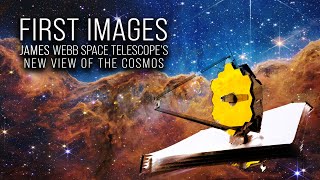
First Images - James Webb Space Telescope's New View of the Cosmos
Explore the groundbreaking first images from the James Webb Space Telescope with Nobel laureate John Mather and leading scientists, discussing their impact on our understanding of the universe's origins and evolution.

Black Holes - Seeing the Unseeable
Explore groundbreaking observations of black holes with Brian Greene and Shep Doeleman, discussing the Event Horizon Telescope's achievements and the first image of our galaxy's supermassive black hole.

Einstein and the Quantum - Entanglement and Emergence
Explore the potential connection between Einstein's relativity and quantum mechanics, examining how quantum threads might stitch spacetime fabric. Experts discuss implications for unifying laws of the large and small.
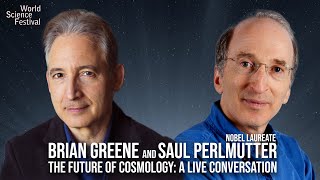
The Future of Cosmology - Space Telescopes and Cosmic Understanding
Nobel laureate Saul Perlmutter and Brian Greene explore revolutionary space telescopes and their potential impact on our understanding of the cosmos in this engaging scientific discussion.
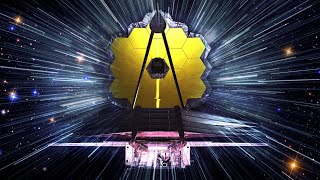
Things We've Never Seen - The James Webb Space Telescope Explores the Cosmos
Explore the universe's mysteries with leading scientists as they discuss the James Webb Space Telescope's potential to revolutionize our understanding of cosmic origins, planet formation, and the search for extraterrestrial life.
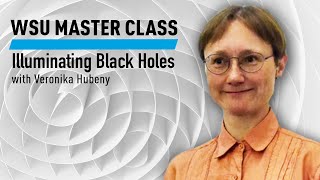
Illuminating Black Holes - Understanding Spacetime and Quantum Information Theory
Explore spacetime, black holes, and quantum information theory with physicist Veronika Hubeny. Delve into gauge/gravity duality to uncover the fundamental nature of our universe.
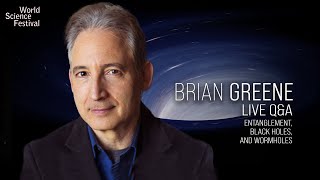
Entanglement, Black Holes, and Wormholes - An Informal Discussion
Explore groundbreaking advances in black hole physics, quantum entanglement, and wormholes with renowned physicist Brian Greene in this engaging year-end science discussion.
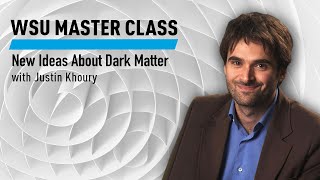
New Ideas About Dark Matter - Quantum Effects and Non-Newtonian Gravity
Explore quantum effects in dark matter and their potential impact on galactic structure with physicist Justin Khoury, offering new perspectives on the universe's formation.

Gravitational Waves and Particle Physics: From Detection to Future Prospects - Lecture
Explore gravitational waves and particle physics with Nobel Laureate Barry Barish and Brian Greene, discussing LIGO, detections, future prospects, and the intersection of these cutting-edge fields.
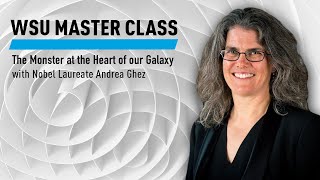
The Monster at the Heart of Our Galaxy - Master Class
Nobel Laureate Andrea Ghez explores the supermassive black hole at the Milky Way's center, discussing its role in galaxy formation and evolution in this captivating astrophysics lecture.
The Dark Side of the Universe - Exploring Dark Energy and Cosmology
Explore the mysteries of dark energy and dark matter with renowned cosmologist Michael Turner, delving into the universe's origin, evolution, and the cutting-edge research shaping our understanding of cosmic phenomena.
Shedding New Light on Dark Matter
Explore groundbreaking insights on dark matter with physicists Brian Greene and Priyamvada Natarajan, discussing new research, mapping techniques, and the future of cosmic simulations.
Discovering Gravitational Waves - LIGO's Latest Massive Source
Explore the latest gravitational wave discoveries with physicists Brian Greene and Gabriela González, discussing LIGO's groundbreaking findings and their implications for our understanding of the cosmos.
100 Years of Gravitational Waves - From Einstein to LIGO
Nobel laureate Rai Weiss explores the history of LIGO, from Einstein's theories to the groundbreaking detection of gravitational waves, highlighting the technology and challenges behind this remarkable scientific achievement.

Entropy and the Arrow of Time - Your Daily Equation Episode 32
Explore entropy, the second law of thermodynamics, and their connection to the arrow of time. Discover why events happen in one direction and how these concepts relate to the Big Bang and our understanding of the universe.
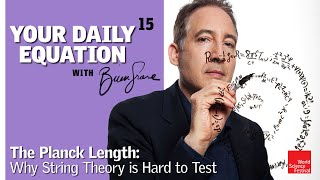
The Planck Length and String Theory Testing Challenges - Your Daily Equation 15
Explore the Planck scale with Brian Greene, understanding its significance in quantum mechanics and gravity, and its implications for testing string theory.
Testing the Limits of Cosmology
Leading physicists explore cutting-edge experiments and theories pushing the boundaries of cosmology, from recreating the Big Bang to searching for multiverses, challenging our understanding of the universe's origins and nature.
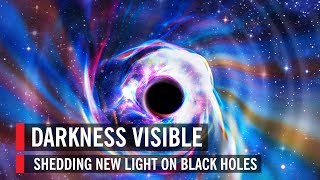
Darkness Visible - Shedding New Light on Black Holes
Explore cutting-edge techniques to observe and understand black holes, including radio telescope arrays and mathematical models. Learn how these methods reveal fundamental truths about the universe and bridge general relativity with quantum mechanics.