Dispatches from the Ends of the Stability Manifold - Part II
Explores noncommutative minimal model program, stability manifolds, and multi-scale decompositions in triangulated categories. Discusses augmented stability conditions and their potential implications for moduli spaces.

Computational Mathematics: Dynamics, Geometry, and Algebra in Numerical Integration
Explore computational mathematics at the intersection of dynamics, geometry, and algebra, focusing on geometric numerical integration and structure-preserving discretization of differential equations.
Stability of the Lyapunov Exponents Under Random Noise
Explore stability of Lyapunov exponents under random noise in dynamical systems. Gain insights from expert Silvius Klein at this international mathematics conference celebrating Marcelo Viana's 60th birthday.
Beautiful Pairs Revisited
Explore the concept of beautiful pairs in model theory, revisiting key ideas and applications in valued fields.
Intrinsic Flat Stability of the Positive Mass Theorem for Graphical Manifolds
Explore intrinsic flat stability of positive mass theorem for graphical manifolds, focusing on asymptotically flat and hyperbolic cases. Gain insights into rigidity, stability, and ongoing research.
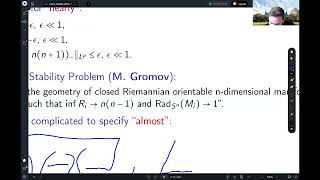
Stability of Llarull's Theorem in All Dimensions
Explore stability of Llarull's theorem in all dimensions using spin geometry, with results in intrinsic flat and C^0-convergence outside small sets.

Stability of Sobolev Inequalities - ICBS 2024
Explore quantitative stability of Sobolev inequalities, focusing on Struwe's decomposition and recent advancements in dimensional-dependent estimates for multiple bubbles in various dimensions.

Complex Analysis, Thick Sets, and Spectral Inequalities
Explorez l'analyse complexe, les ensembles épais et les inégalités spectrales appliqués à la théorie du contrôle et à la géométrie spectrale. Découvrez des techniques analytiques complexes pour les domaines et opérateurs.

Sharp Stability for the Brunn-Minkowski Inequality for Arbitrary Sets
Explore sharp stability in the Brunn-Minkowski inequality for arbitrary sets, delving into combinatorics and its connections with metric geometry and analysis.
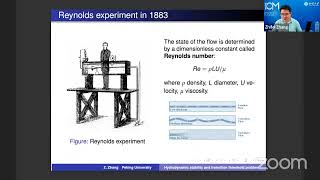
Hydrodynamic Stability at High Reynolds Number and Transition Threshold Problem
Explores hydrodynamic stability theory, focusing on laminar flow instability and turbulence transition at high Reynolds numbers. Discusses key physical effects and recent progress in linear inviscid damping and enhanced dissipation for shear flows.
Active Fluctuations and Microphase Separation in the Cell Nucleus by Jacques Prost
Explores active fluctuations and microphase separation in cell nuclei, discussing recent developments in active matter research and its applications to biological systems.
Impact of Inertia and Reciprocity in Active Matter by Debashish Chaudhuri
Explore the effects of inertia and reciprocity on active matter systems, examining their influence on collective behavior and dynamics in non-equilibrium environments.
Turbulence and Multifractality in Some Models for Active Fluids by Rahul Pandit
Explore turbulence and multifractality in active fluid models, examining complex dynamics and patterns in non-equilibrium systems with energy dissipation at the individual unit level.
Yielding Behavior of Active Amorphous Solids by Srikanth Sastry
Explores yielding behavior in active amorphous solids, examining nonequilibrium dynamics and energy dissipation at the individual unit level within the context of active matter systems.
Enhanced Order in Two-Temperature Models of Scalar Activity by Chandan Dasgupta
Explores enhanced order in two-temperature models of scalar activity, discussing recent progress and applications in active matter systems like cellular dynamics and collective animal behavior.
Contractile Microtubules Generate Active Membranes and Foams by Zvonimir Dogic
Explore how contractile microtubules create dynamic membranes and foams, revealing insights into active matter and its applications in biological systems and beyond.

Stability of Twisting of Hamiltonian Flows and Applications
Explore Hamiltonian flow stability, twisting phenomena, and their applications in fluid dynamics with insights from Duke University researcher Tarek Elgindi.
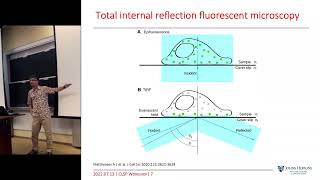
Coupled Excitable Systems: How Cells Migrate
Explore cell migration through excitable systems theory. Discover how spontaneous and directed cell movement can be explained using a comprehensive model based on wave propagation and molecular regulators.
Adaptive Internal Models in Systems Neuroscience
Explore the cerebellum's role in motor control through adaptive internal models. Gain insights into disturbance rejection and its implications for control theory in neuroscience.
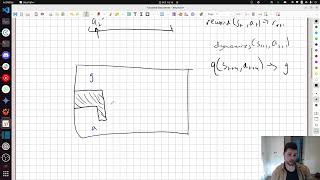
Temporal Difference Model Predictive Control (TD-MPC) Explained - Part 1
Dive into the fundamentals of TD-MPC, exploring problem formulation, optimization horizons, and Cross-Entropy Method (CEM) through clear explanations and practical physics examples.

Mean-Field Control for Restless Bandits and Weakly Coupled MDPs
Explore optimization methods and stochastic models for large-scale system control, focusing on mean-field approaches to overcome dimensionality challenges in reinforcement learning and resource allocation.