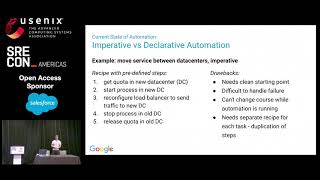
Sublinear Scaling in Practice - The 1k SRE Project
Explore Google's SRE team's approach to sublinear scaling, automation, and cultural shifts for managing 1000+ services efficiently without increasing staff.
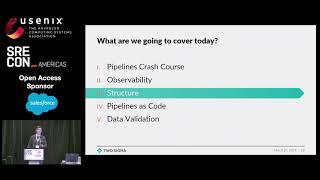
Designing Resilient Data Pipelines
Strategies for resilient data pipelines: observability, immutable inputs, declarative pipelines, and data validation. Reduce operational complexity, update risks, and accuracy concerns in complex systems.

Pragmatic Automation
Explore pragmatic automation strategies for reducing toil in cloud operations, drawing insights from a large public cloud provider's experiences and applicable to various work environments.

Tackling Kafka with a Small Team
Explore scaling Kafka with limited resources, covering challenges, failures, and tactical approaches for managing complex distributed systems in a fast-growing business environment.
Creating a Code Review Culture
Explore best practices for implementing and improving code review processes, focusing on organizational culture, author communication, and reviewer strategies for high-quality software development.
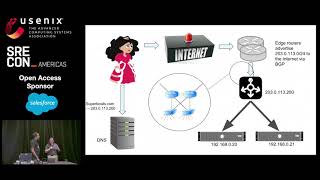
Keeping the Balance - Internet-Scale Load Balancing Demystified
Comprehensive overview of load balancing techniques across network layers, exploring technologies and tradeoffs for fast, reliable multi-region services at Internet scale.
Zero to SRE
Transforming junior engineers into SREs: creating a supportive environment, fostering a 'Culture of Error', encouraging mentorship, and prioritizing skill development for successful transitions and career growth.
SRE Classroom - How to Design a Distributed System in 3 Hours
Interactive workshop on designing distributed systems, covering scaling, failure handling, reliability, and consistency. Participants apply concepts to real-world scenarios using cloud components.

What Breaks Our Systems - A Taxonomy of Black Swans
Explore categories of unforeseen, catastrophic system failures and strategies to fortify against them, including capacity testing, incident management, and communication.
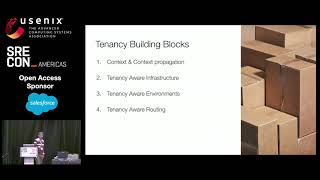
Testing in Production at Scale
Explore real-world insights on implementing testing in production for large-scale microservices, focusing on architecture, capacity planning, and infrastructure components.
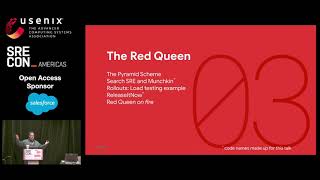
The Curse of SRE Autonomy and How to Manage It
Explores challenges of SRE autonomy, tool diversity, and development duplication. Presents solutions using a widely-adopted internal tool's history, addressing selection autonomy and automation strategies.

Complexity - The Crucial Ingredient in Your Kitchen
Explore how software engineering can learn from NASA's Challenger incident, drawing parallels to modern reliability challenges and navigating complexity in system architecture.
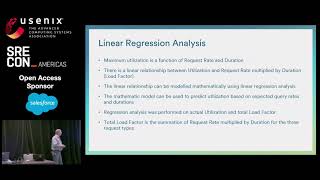
Capacity Prediction in External Services
Learn to predict resource exhaustion in external systems using linear regression, enabling proactive planning and sizing for improved application performance.
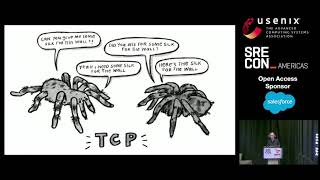
Optimizing for Learning
Explore cognitive science techniques to enhance SRE learning, incident response, and team collaboration. Optimize human observability for better system understanding and problem-solving.
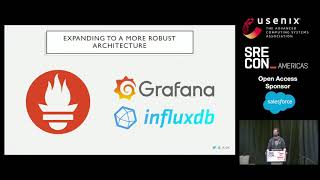
Lessons Learned in Black Box Monitoring 25,000 Endpoints
Explore black box monitoring of 25,000 government endpoints, learning strategies to monitor resistant systems and improve digital services across the US government.
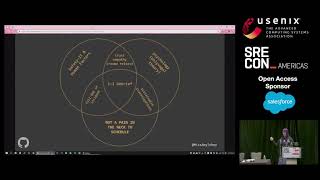
One on One SRE
Explore GitHub's innovative 1:1 SRE outreach and incident debrief programs, designed to foster a culture of resilience through empathy and psychological safety, enhancing organizational reliability.
The Storage Architecture of Intel's Data Management Platform
Intel's DMP storage architecture employs Ethernet-based fabric, disaggregated storage, and Kubernetes management. It offers NVMe-oF remote volumes and local Optane DCPM volumes, optimized for different I/O patterns and managed by LINBIT's storage orchest…
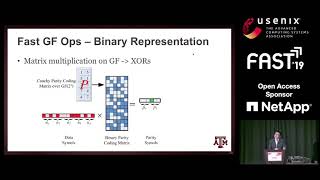
Fast Erasure Coding for Data Storage - A Comprehensive Study of the Acceleration Techniques
Comprehensive study on accelerating erasure coding for data storage, exploring optimization techniques, bitmatrix design, and vectorization to improve computation efficiency and performance in various scenarios.
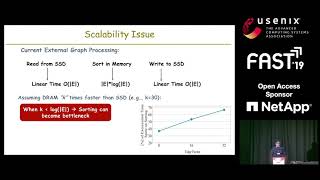
Large-Scale Graph Processing on Emerging Storage Devices
Explores efficient graph processing on emerging storage devices, proposing a new partitioning framework that leverages improved random access capabilities for 2X better performance than state-of-the-art solutions.
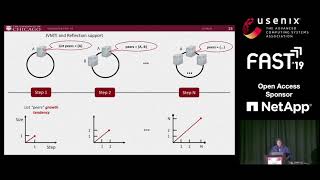
ScaleCheck - A Single-Machine Approach for Discovering Scalability Bugs in Large Distributed Systems
ScaleCheck: A novel approach for finding scalability bugs in large distributed systems using program analysis and colocation techniques, enabling testing at scale on a single commodity PC.
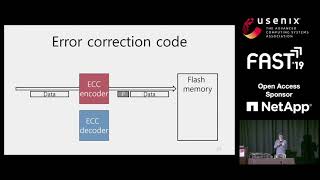
Design Tradeoffs for SSD Reliability
Explores design tradeoffs in SSD reliability techniques, proposing a holistic management scheme for balancing performance, reliability, and lifetime across various workloads and wear states.