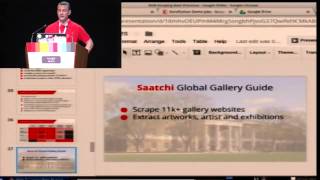
Web Scraping Best Practices
Explore advanced web scraping techniques in Python, covering automated extraction, rendering pages, proxy management, and scalable crawl architecture for challenging real-world projects.
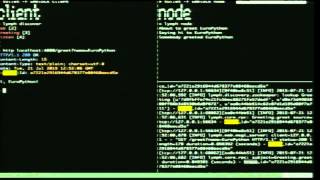
Stop Trying to Glue Your Services Together - Import Lymph
Discover lymph: a Python framework for effortless service development. Focus on functionality, not infrastructure, with pluggable service discovery and messaging. Simplify your microservices architecture and boost development speed.

Nameko for Microservices
Explore microservices architecture and Nameko framework for building scalable, independently deployable services with clean code and well-defined boundaries. Learn design principles and practical implementation.
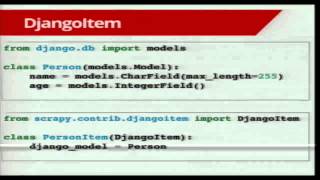
Dive into Scrapy
Explore advanced Scrapy techniques for web scraping, including project structure, interactive shell, item handling, and deployment strategies. Learn to avoid bans and optimize data extraction.

Designed for Education - A Python Solution
Exploring Python's potential as the premier language for teaching computer science, addressing barriers and proposing solutions to enhance its educational impact.
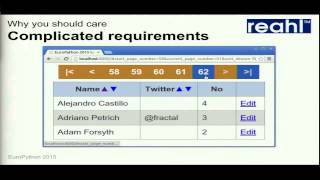
Reahl - The Python-Only Web Framework
Discover Reahl, a unique web framework that allows development solely in Python, abstracting away HTML, JavaScript, and CSS for a streamlined, goal-focused approach to web application creation.
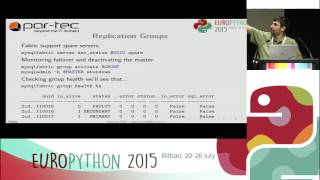
Scaling MySQL with Python
Learn to scale MySQL using Python tools for replication, management, and failover. Discover how to create resilient configurations and implement high availability infrastructures with mysql-fabric.
Yak Shaving a Good Place to Eat Using Non Negative Matrix Factorization
Explore data handling techniques to analyze restaurant reviews, group users with similar tastes, and find personalized dining recommendations using non-negative matrix factorization.
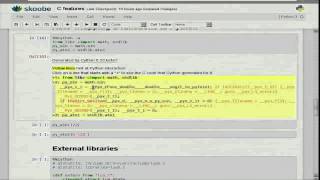
Get Native with Cython
Explore Cython's power to speed up Python code and interface with C/C++. Learn about static typing, native code integration, and recent enhancements for fast, portable extensions.
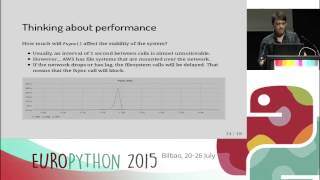
Use Python to Process 12 Million Events per Minute and Still Keep It Simple
Learn to build a high-performance, scalable event processing system using Python 3 and open-source tools. Discover techniques for handling massive throughput, data aggregation, and failsafe mechanisms in production environments.
Building a Multi-Purpose Platform for Bulk Data Using SQLAlchemy
Learn to build a scalable platform for processing bulk data across multiple business domains using SQLAlchemy, with insights on optimizing performance and maintaining flexibility.

Python Not Recommended
Explore Python's role in a Ruby-centric environment, discussing its strengths, challenges, and evolving usage patterns in high-concurrency situations and data science applications.

MkDocs - Documenting Projects with Markdown
Learn about MkDocs, a Python library for creating documentation with Markdown. Explore its features, benefits, and how it compares to Sphinx for simplifying project documentation.
Using Scikit-Learn's Interface for Turning Spaghetti Data Science into Maintainable Software
Learn to structure data science code using Scikit-Learn's estimator and meta-estimator interfaces. Discover how to transform spaghetti code into maintainable, testable, and reusable machine learning models.
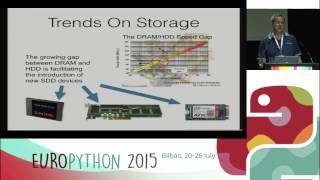
New Trends in Storing Large Data Silos with Python
Explore emerging technologies for handling Big Data in Python, focusing on efficient storage solutions and leveraging modern architectures, with insights on future trends and practical examples.
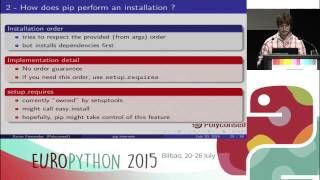
PIP Internals
Explore PIP's inner workings, including installation processes, dependency resolution, and package selection mechanisms for Python ecosystem management.

To the Clouds - Why You Should Deploy to the Cloud Even If You Don't Want To
Explore cloud deployment benefits for Python services, including scalability and automated testing. Learn about service orchestration and flexible infrastructure management using Python.
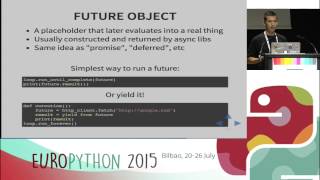
Better Asynchronous Code with Tornado and Python 3
Explore asynchronous programming with Tornado and Python 3.4's asyncio module. Learn about coroutines, futures, and ioloop concepts for efficient concurrent event-driven code in web development.
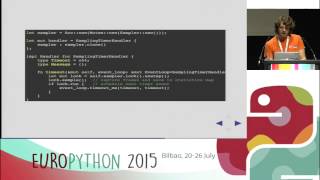
Can Rust Make Python Shine?
Explore how Rust can enhance Python's performance through a case study of a statistical profiler, showcasing Rust's speed, safety, and beauty as a complementary language for Python developers.
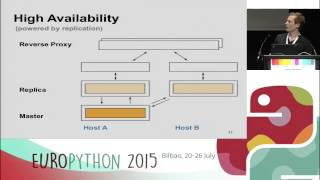
Release Management with Devpi
Explore Devpi's versatile features for efficient Python package management, including sharing across teams, deploying binaries, and integrating open-source with proprietary packages.

What Dojos Are and How We Run Them at PyBCN
Explore coding dojos: effective knowledge-sharing events that unite beginners and experts. Learn from pyBCN's experience in organizing inclusive and engaging programming sessions.