The Tension Between Expediency and Correctness
Explore tradeoffs between expediency and correctness in programming, discussing their implications for software development and introducing Elixir's advantages in building robust systems.

Getting Realtime with Akka.NET, React and Redux
Introduction to actor model for building reactive, scalable systems. Demonstrates Akka.NET backend with ASP.NET Core, React+Redux frontend, and real-time updates using distributed actors, including on Raspberry Pis.

Easy Eventual Consistency with Actor Models + Amazon Web Services
Discover how to achieve strong eventual consistency in distributed systems using actor models and AWS, sidestepping the CAP theorem with simple rules and proven mathematical principles.
Effective Eventual Consistency with Actor Models + Amazon Web Services
Discover how to achieve strong eventual consistency in distributed systems using actor models and AWS. Learn practical techniques to sidestep the CAP theorem and ensure data integrity.

Concurrent Programming in C++
Explore C++ concurrency API, learn to create and manage threads, avoid race conditions and deadlocks, and utilize async operations and futures for efficient concurrent programming.

Good Code - What, Why, and How to Get There
Explore techniques for writing readable, concise, and navigable code. Learn why good code is crucial for project success and how to improve your coding practices.

Actors in Clusters - Why, When and How
Explore actor model clustering in Akka.NET: benefits, timing, implementation challenges, and lessons learned from Norwegian Broadcasting Corporation's experience scaling their system.
Introduction to Lock-Free Programming
Explore challenges and intricacies of lock-free programming, including CPU behavior, common pitfalls, and examples of simple lock-free structures. Gain insights to approach this complex topic with caution.
CUDA Kernels with C++
Explore CUDA for C/C++ with practical examples, focusing on using C++ features to enhance kernel code safety without compromising performance in GPU programming.

Using Kotlin Coroutines for Asynchronous and Concurrent Programming
Explore Kotlin coroutines for efficient asynchronous and concurrent programming, covering suspending functions, structured concurrency, and thread management in HTTP APIs and microservices.
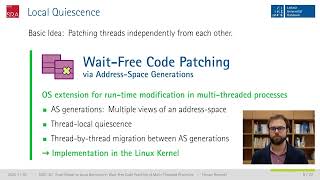
From Global to Local Quiescence: Wait-Free Code Patching of Multi-Threaded Processes
Explore wait-free code patching for multi-threaded processes, enabling gradual application of updates without disrupting service. Learn about WfPatch's implementation and its impact on system performance.
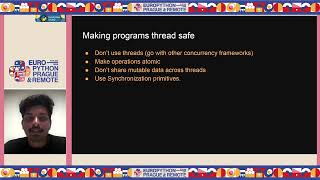
Tackling Thread Safety in Python
Explore thread safety challenges in Python, understand race conditions, GIL's impact on multithreading, and learn to fix unsafe code using synchronization primitives.
BLASPhemy - Improving BLAS Handling in Enzyme.jl
Optimizing BLAS and Lapack routines for Enzyme.jl, improving performance and reliability in numerical computations and machine learning applications within the Julia ecosystem.

Responsive Parallelism with Synchronization
Explore a novel approach combining static and dynamic techniques to prevent priority inversion in concurrent programs using mutexes and condition variables, enhancing responsiveness and efficiency.
Efficient Parallel Functional Programming with Effects
Explore techniques for efficient parallel functional programming with unrestricted effects, improving performance while maintaining safety benefits through innovative memory management.

Go Performance Unleashed - Optimizing Runtime and Memory
Unlock Go's performance potential through runtime scheduler insights, memory optimization techniques, and benchmarking best practices for efficient code execution.
Building a Lock-Free STM for OCaml - OCaML'23
Explore lock-free software transactional memory in OCaml with kcas library. Learn about composable transactions, modular blocking, and lock-free data structures for efficient concurrent programming.
Towards Mailbox Typing for Erlang - Lightning Talk
Explore mailbox typing for Erlang: a new technique to detect concurrency errors in actor-based languages, complementing existing tools like Concuerror model checker.
Runtime Detection of Data Races in OCaml with ThreadSanitizer
Explore runtime detection of data races in OCaml using ThreadSanitizer. Learn core principles, challenges, adaptations, and practical application for reliable parallel code development.

SSRD: Shapes and Summaries for Race Detection in Concurrent Data Structures
Explore a novel approach for detecting data races in concurrent data structures using summarization-guided concolic testing, enhancing efficiency in exploring dynamic shapes and exposing hidden races.
BatchIt: Optimizing Message-Passing Allocators for Producer-Consumer Workloads
Optimize message-passing allocators for producer-consumer workloads with BatchIt. Learn about this novel approach that improves performance by batching remote deallocations, reducing contention and enhancing scalability.