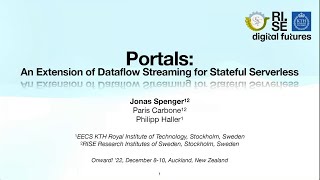
Portals: An Extension of Dataflow Streaming for Stateful Serverless
Explore serverless distributed programming with Portals, blending dataflow streaming and actor frameworks for scalable, atomic processing in decentralized applications.
A Semantics of Core Erlang with Handling of Signals
Explore a small step semantics for Core Erlang's monitoring and signal systems, aimed at enabling causal explanations for property violations in concurrent programs.
GHC Plugin for Setting Breakpoints in Concurrent Programs
Explore a GHC plugin for improved breakpoint functionality in concurrent programs, addressing limitations in GHCi's built-in debugger.

Dependent Session Protocols in Separation Logic from First Principles - Functional Pearl
Explore dependent session protocols in concurrent separation logic, building from mutable references to channels. Simplify verification using basic mechanisms for one-shot protocols and extend to dependent session protocols.
An Exceptional Actor System in Haskell - Functional Pearl
Explore a hidden actor framework in GHC's runtime system, demonstrating its power through distributed systems examples and discussing implications for feature constraints.
Parallel Sequences in Multicore OCaml
Explore parallel sequences in Multicore OCaml 5.0.0, enabling efficient parallelization of large tasks without low-level implementation complexities.

Degrees of Separation: A Flexible Type System for Data Race Prevention
Explore a flexible type system for data race prevention in parallel programming, allowing aliasing while controlling it to prevent data races. Implemented as a Scala 3 compiler extension.
Actix-Telepathy: Distributed Actor Programming in Rust
Explore Actix-Telepathy, an extension for Rust's Actix library enabling remote messaging and clustering support for distributed applications using the actor programming model.
Why Languages Should Preserve Load-Store Order
Explore the complexities of memory models and load-store reordering in programming languages, examining their impact on code optimization and reasoning.
What We Learned from C++ Atomics and Memory Model Standardization
Explore insights from C++ atomics and memory model standardization, covering usage patterns, performance implications, implementation challenges, and lessons learned in language design.
Automatic Parallelism Management - POPL 2024
Explore techniques for automatic parallelism management in high-level languages, combining static and runtime approaches to optimize performance without manual tuning.
ChoRus: Library-Level Choreographic Programming in Rust
Explore ChoRus, a Rust framework for choreographic programming. Learn about endpoint projection and its implementation for distributed systems using library-level techniques.
A Family of Fast and Memory Efficient Lock- and Wait-Free Reclamation - PLDI 2024
Explore Crystalline, a novel family of non-blocking memory reclamation schemes addressing high performance, memory efficiency, and wait-freedom challenges in concurrent programming.
Zero-Overhead Parallel Scans for Multi-Core CPUs - ARRAY 2024
Explore efficient parallel scans for multi-core CPUs, achieving zero overhead and improved single-threaded performance in array languages.
Work Assisting - Linking Task-Parallel Work Stealing with Data-Parallel Self Scheduling
Explore a novel scheduling strategy for mixing data and task parallelism, preserving data parallelism structure while enabling flexible thread distribution and self-scheduling for improved performance.

Embedding Generic Monadic Transformer into Scala
Explore dotty-cps-async for embedding monadic expressions in Scala using async/await, supporting generic monads and high-order function transformations for enhanced concurrent programming.
Comparing the Actor Model and CSP Concurrency with Elixir and Clojure
Explore the Actor Model and CSP concurrency paradigms, comparing BEAM VM and JVM implementations through Elixir and Clojure. Gain insights into their unique features, strengths, and approaches to concurrency challenges.
Mria - An Eventually Consistent Mnesia
Explore Mria, an extension of Mnesia database offering eventual consistency for improved horizontal scalability. Learn advanced Erlang techniques and testing methods used in EMQX message broker development.
The Actor Model as a Load Testing Framework - Lambda Days 2023
Explore scalability and load testing using the actor model. Learn to ensure software reliability under extreme conditions and discover a ready-to-use library for implementation.
Debugging Multithreaded Code with GDB - Thread Names
Learn to debug threading issues using GDB's powerful functionality, with practical examples and techniques for efficient multithreaded code troubleshooting.

Web Workers: Handling Heavy Processing on the Client Side
Explore Web Workers for efficient client-side heavy processing. Learn implementation techniques, see code examples, and watch a live demo to enhance web application performance.