
Classical Shadows of Quantum States - Quantum Colloquium
Explore quantum state representation, shadow tomography, and machine learning applications in quantum many-body problems with John Preskill's insightful lecture on classical shadows.

Turbulence Closure Models - Reynolds Averaged Navier Stokes and Large Eddy Simulations
Explore turbulence closure models, focusing on RANS and LES approaches for approximating complex fluid dynamics. Learn key concepts and applications in scientific computing.

What Is Turbulence? - Turbulent Fluid Dynamics Are Everywhere
Explore the fundamental characteristics of turbulent fluid dynamics, their prevalence in nature and engineering, and the role of Reynolds number in controlling complexity.
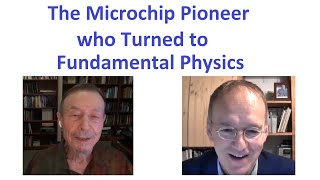
Real Physics Talk - Carver Mead
Explore fundamental physics with Carver Mead, covering gravity, quantum theory, and technological advancements. Gain insights on scientific progress, innovative thinking, and the future of physics and technology.
Does the Neocortex Use Grid Cell-Like Mechanisms to Learn the Structure of Objects?
Explore how the neocortex might use grid cell-like mechanisms to learn object structure, drawing parallels between spatial navigation and object recognition in the brain.
The Prefrontal Cortex as a Meta-Reinforcement Learning System
Explore the prefrontal cortex's role in meta-reinforcement learning, connecting neuroscience and AI through recurrent neural networks and cognitive tasks like Harlow's experiment.
Automated Reconstruction of Synaptic-Resolution Neural Wiring Diagrams
Explore automated reconstruction of neural wiring diagrams using advanced techniques like generative adversarial networks and crowdsourcing, with applications in connectomics and targeted brain data discovery.
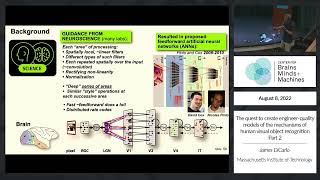
The Quest to Create Engineer-Quality Models of the Mechanisms of Human Visual Object Recognition - Part 2
Explore advanced neural models and mechanisms of human visual object recognition, including linear decoders, adversarial attacks, and individual variability in visual processing.
Faces
Explore primate face recognition, from neural substrates to computational principles, examining face cells, processing systems, and recognition architectures in this comprehensive overview.
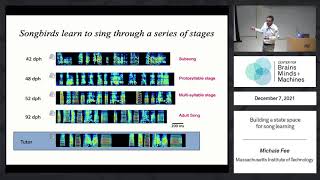
Building a State Space for Song Learning
Explore how songbirds develop neural sequences for vocalizations, examining the role of auditory memory in shaping motor circuits and facilitating song learning through reinforcement mechanisms.
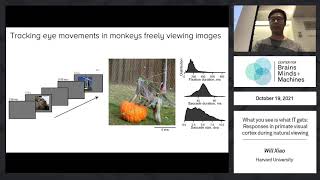
What You See Is What IT Gets - Responses in Primate Visual Cortex During Natural Viewing
Explores primate visual cortex responses during natural viewing, revealing how neurons in the interior temporal cortex react to faces and repeated fixations, providing insights into our stable visual perception.
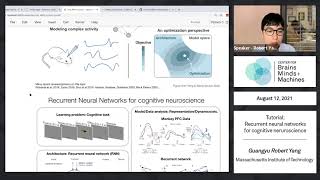
Recurrent Neural Networks for Cognitive Neuroscience
Hands-on tutorial exploring RNNs in cognitive neuroscience through coding exercises. Learn to train and analyze RNNs for various tasks, with lecture and workshop components using Google Colab Notebooks.
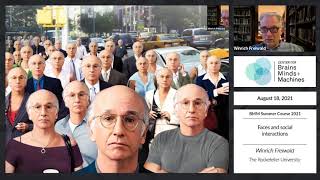
Faces and Social Interactions
Explore primate social intelligence, face perception, and neural mechanisms behind facial recognition and social interactions.
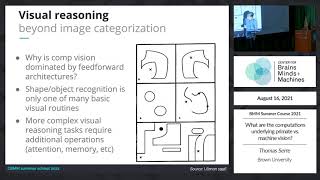
What Are the Computations Underlying Primate vs. Machine Vision?
Explore primate and machine vision computations, comparing face recognition, image processing, and neural networks. Gain insights into computational neuroscience and visual perception illusions.
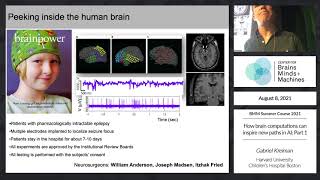
How Brain Computations Can Inspire New Paths in AI - Part 1
Explore how brain computations inspire AI advancements, covering visual illusions, neural connectivity, and deep learning networks to uncover new paths in artificial intelligence research.
The Neural Circuits for Face Recognition
Explore neural circuits for face recognition, including a newly discovered temporal pole region. Learn about face processing systems, computational principles, and their implications for visual intelligence.
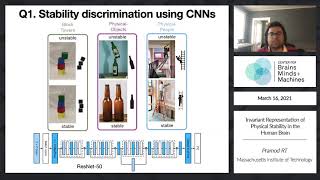
Invariant Representation of Physical Stability in the Human Brain
Explore how the human brain represents physical stability, from infant intuition to neural computations, and its applications in robotics and computer vision.
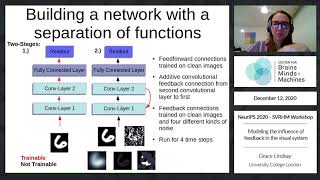
Modeling the Influence of Feedback in the Visual System
Explore how feedback influences visual processing, using masking studies and network modeling to understand its impact on classification accuracy and neural activity.
Computing Partition Functions, Part I
Explore computational techniques for partition functions in statistical physics, focusing on spin systems, phase transitions, and algorithmic approaches like Markov Chain Monte Carlo.
Introduction to Quantum Chemistry
Explore quantum chemistry fundamentals, electronic structure problems, and quantum computing applications in this comprehensive introduction by Bryan O'Gorman.

Functional Specificity in the Human Brain - What, Whether, and Why?
Explore the functional specificity of the human brain, examining key questions, methodologies, and findings in cognitive neuroscience with MIT researcher Nancy Kanwisher.