
Gibbs Free Energy - Entropy, Enthalpy & Equilibrium Constant K
Comprehensive introduction to Gibbs Free Energy, covering entropy, enthalpy, and equilibrium constants. Learn to calculate and apply these concepts in chemical reactions and thermodynamics.

How Your Brain Organizes Information
Explore cognitive maps and how the brain organizes information for flexible behavior. Learn about hippocampal neurons, non-spatial mapping, graph theory, latent spaces, and factorized representations in neuroscience.
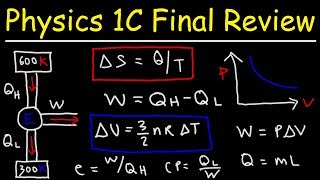
Physics 1C Final Exam Review - Entropy, Thermodynamics, Gas Laws, Specific Heat & Calorimetry
Comprehensive review of advanced physics concepts including thermodynamics, gas laws, heat transfer, and entropy. Covers theoretical principles and practical problem-solving techniques for final exam preparation.
Karl Friston – Deep Inference
Karl Friston explores the connection between perceptual inference and decision-making in cognitive neuroscience, examining whether these seemingly different processes share underlying information theoretic principles.
Awareness - An Operational Theoretical Approach
Exploring awareness as a form of information using operational probabilistic theory, examining its private nature and potential connection to quantum coherence, with implications for cognitive sciences.
Chasing Memories
Exploring synaptic dynamics in memory formation, focusing on competitive mechanisms that lead to long-term memory emergence in neural networks and their implications for understanding human memory.
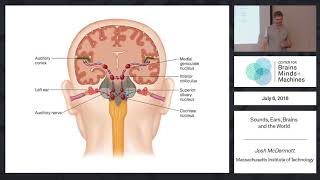
Sound, Ears, Brains and the World
Explore auditory processing, sound perception, and the brain's ability to distinguish multiple sound sources. Learn about computational modeling and the "Cocktail Party problem" in this insightful lecture by MIT Professor Josh McDermott.
Differences Between Neural Networks and the Brain
Explore the similarities and differences between neural networks and the brain in this panel debate featuring leading experts in neuroscience and artificial intelligence.
Explore MIT Today - Reverse Engineering the Mind - Brain and Cognitive Sciences
Panel discussion exploring brain science, AI, and human intelligence, covering neural processing, learning, robotics, brain-computer interfaces, and ethical considerations in cognitive research.
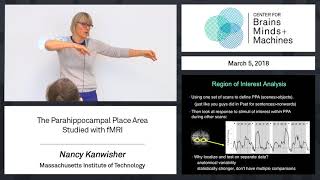
The Parahippocampal Place Area Studied with fMRI
Explores the parahippocampal place area's role in scene recognition using fMRI, discussing methodological considerations and replication in cognitive neuroscience research.
How Can We Study the Human Mind and Brain? - Marr's Levels of Analysis
Explore Marr's levels of analysis for studying the human mind and brain, focusing on computational theory and its application to color vision and other cognitive processes.
Predicting and Perceiving Degraded Speech
Explore speech perception challenges, cochlear implants, and predictive coding in this talk on improving speech understanding and perceptual learning for degraded speech signals.
Building Machines that Learn and Think Like People
Explore computational neuroscience and AI inspired by human cognition, covering intuitive theories, compositionality, and learning to learn for more human-like artificial intelligence.
Learning with Symmetry and Invariance for Speech Perception
Explore symmetry and invariance in speech perception, focusing on acoustic variability, feedforward models, and invariant representations. Learn about word orbits, phone representations, and acoustic modeling techniques.

Nancy Kanwisher: History of Neuroimaging Research on Face Recognition
Explore the evolution of neuroimaging research on face recognition, from early studies to modern fMRI techniques, and discover key findings in this fascinating field of cognitive neuroscience.
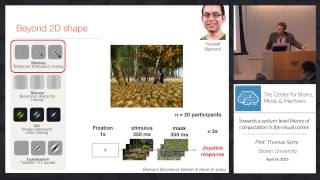
Towards a System-Level Theory of Computation in the Visual Cortex
Explore computational models of visual processing in primate cortex, combining neuroscience and AI to understand perception and develop advanced computer vision systems.
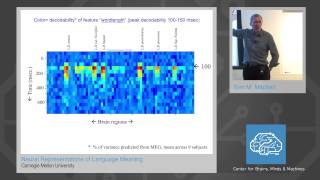
Neural Representations of Language Meaning
Explore neural representations of language meaning through fMRI and MEG brain imaging, machine learning, and experiments on word and sentence comprehension in the human brain.
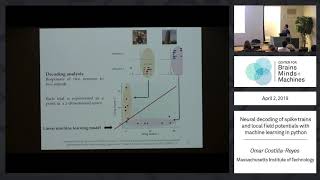
Neural Decoding of Spike Trains and Local Field Potentials with Machine Learning in Python
Learn Python-based machine learning techniques for neural decoding, focusing on preprocessing, model selection, and optimization for spike trains and local field potentials from macaque cortical areas.
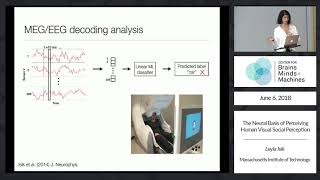
The Neural Basis of Perceiving Human Visual Social Perception
Explore neural mechanisms of visual object recognition and social perception using MEG, fMRI, and computational modeling. Discover how the brain processes visual scenes, objects, and social interactions over time.
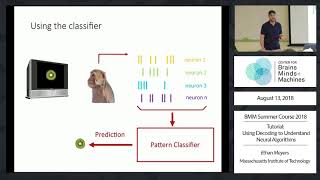
Using Decoding to Understand Neural Algorithms
Explore neural decoding techniques to uncover algorithms in the brain's visual processing, focusing on information representation, invariance, and attention in neural networks.
Black Holes and the Quantum-Extended Church-Turing Thesis - Quantum Colloquium
Explore black holes' impact on quantum computing, featuring insights from renowned physicists on horizon properties, information extraction, and the quantum-extended Church-Turing thesis.