Architectures of Rotating Star-Planet Systems - Rafael Garcia
Explores rotating star-planet system architectures using data analysis, machine learning, and modeling techniques. Covers hot stars, masking, decision trees, random forests, and orbital period observations.
Debiasing Coarse-Scale Climate Models Using Statistically Consistent Neural Networks
Explores using neural networks to improve coarse-scale climate models, addressing unresolved scales and enhancing predictions. Discusses framework, wavelet analysis, and multi-model architecture for more accurate climate simulations.
A Deep Learning Parameterization of Gravity Wave Drag Coupled to an Atmospheric Global Climate Model - Aditi Sheshadri
Explores deep learning parameterization of gravity wave drag in climate models, demonstrating improved predictions of atmospheric phenomena like the QBO and potential for generalizing to future climate scenarios.
Earth System Emulation - Duncan Watson-Parris #CLIMATE-C21
Explore Earth system emulation for climate projections, uncertainty analysis, and machine learning applications in weather and climate science. Gain insights into advanced modeling techniques and data-driven approaches.
Contained Chaos - Ensemble Consistency Testing for the Community Earth System Model
Explore ensemble consistency testing for climate models, focusing on the Community Earth System Model. Learn about statistical methods to evaluate model changes and ensure software quality in climate simulations.
Data-Driven and Data-Assisted Modeling for Applications in Fluid Dynamics and Geophysics
Explores data-driven and data-assisted modeling techniques for fluid dynamics and geophysics, focusing on machine learning applications in climate science and high-resolution forecasting.
Post Processing and Mock Observations - Shane Davis, Philipp Moesta
Explore post-processing techniques and mock observations for binary systems, focusing on circumbinary gas evolution, observational signatures, and numerical modeling advancements.
Stellar Mass Binaries in AGN - Hui Li - Barry Mc Kernan
Explore stellar mass binaries in AGN, their formation, evolution, and interactions with circumbinary gas. Gain insights into numerical modeling and observational signatures of these systems.
Observations II - Daryl Haggard, Chengcheng Xin
Explore circumbinary gas evolution, observational signatures, and numerical modeling techniques in stellar and black hole binary systems across astrophysical scales.
The Characteristics, Origin, and Evolution of Multiplicity in the Protostellar - John Tobin
Explore protostellar multiplicity characteristics, origins, and evolution. Discover insights on binary systems, circumbinary gas, and observational signatures across stellar and black hole scales.
Missing Physics I - Ondrej Pejcha - Charles Univ.
Explore circumbinary gas evolution, observational signatures, and numerical modeling techniques in stellar and black hole binary systems. Gain insights into astrophysical phenomena across varied scales.
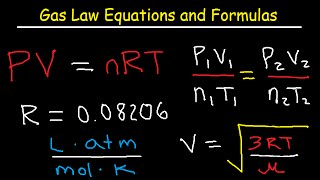
Gas Laws - Equations and Formulas
Comprehensive overview of gas laws, equations, and formulas in chemistry, covering pressure, temperature, volume relationships, kinetic energy, and molecular behavior of gases.
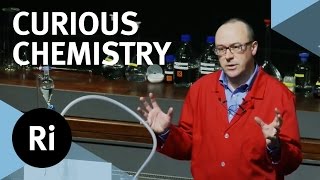
Chemical Curiosities - Surprising Science and Dramatic Demonstrations
Explore the fascinating world of chemistry through spectacular demonstrations, from color-changing reactions to explosive experiments, led by Professor Chris Bishop in this engaging lecture.
Lucien Hardy on Quantum Gravity and Apparent Paradoxes
Explore quantum gravity with physicist Lucien Hardy as he discusses paradoxes, operational approaches to quantum puzzles, and his quest for a unifying theory bridging general relativity and quantum mechanics.
Carlo Rovelli on Physics and Philosophy
Explore quantum gravity, unlearning outdated ideas, and the intersection of physics and philosophy with Carlo Rovelli in this thought-provoking conversation about the nature of reality and scientific discovery.
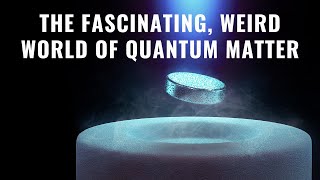
The Fascinating, Weird World of Quantum Matter - Karen Hallberg Public Lecture
Explore quantum matter's fascinating world, emergent phenomena like superconductivity, and quantum information's role in tackling complex problems with expert Karen Hallberg.

Surviving the Century
Exploring humanity's future: biotech, cyber, robotics, and space advancements offer promise, but also pose risks. Sir Martin Rees examines societal challenges and potential solutions.
Erik Verlinde Public Lecture - A New View on Gravity and the Dark Side of the Cosmos
Explore emergent gravity and its implications for understanding the universe, from particles to cosmos, with Dr. Erik Verlinde's groundbreaking research on dark matter and black holes.

Spacetime Atoms and the Unity of Physics - Perimeter Public Lecture
Explore black hole thermodynamics and the concept of spacetime atoms in this lecture by Fay Dowker. Discover how this theory unifies physics and suggests a granular structure of spacetime at microscopic scales.

The Big Picture - From the Big Bang to the Meaning of Life - with Sean Carroll
Sean Carroll explores the cosmos, from the Big Bang to consciousness, tying fundamental physics to human experience and addressing life's big questions in this thought-provoking talk on the nature of reality and existence.

Carnot Heat Engines, Efficiency, Refrigerators, Pumps, Entropy, Thermodynamics - Second Law, Physics
Comprehensive tutorial on thermodynamics, covering heat engines, efficiency, refrigerators, and entropy. Includes numerous examples and practice problems for in-depth understanding.