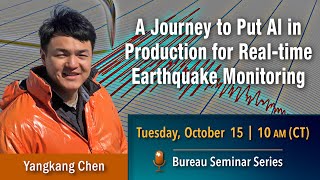
AI-Facilitated Real-Time Earthquake Monitoring - From Development to Production
Discover how AI-driven seismological monitoring revolutionizes earthquake detection through advanced deep learning techniques, focusing on real-time implementation in Texas's seismic network for improved accuracy and efficiency.
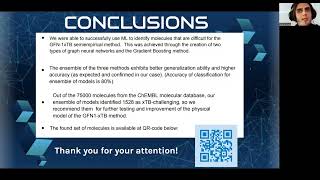
Revealing Inaccuracies of the GFN1-xTB Semi-Empirical Method with Machine-Learning Toolset
Explore machine learning applications in identifying limitations of GFN1-xTB semi-empirical calculations for computational chemistry and molecular modeling.
AI's Environmental Storage Problem - Distributed Solutions for Sustainable Cloud Storage
Explore how distributed storage solutions can reduce cloud computing's environmental impact while enhancing security, performance, and sustainability through innovative disk drive utilization and global node networks.
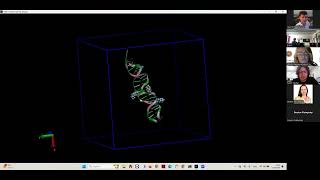
Using ChatGPT in Molecular Dynamics Simulations - Applications to Nucleic Acids
Discover how to leverage ChatGPT for molecular dynamics simulations, focusing on nucleic acids analysis and computational physics applications in DNA research.
Signal-Processing Phase Estimation Against Time-dependent Errors
Discover advanced quantum metrology algorithms for phase estimation, addressing decoherence and time-dependent errors in two-level unitary gate measurements while achieving Heisenberg-limited sensitivity.
Limits of Noisy Quantum Metrology with Restricted Quantum Controls
Delve into quantum metrological limits, exploring how restricted quantum controls affect parameter estimation precision and the achievability of Heisenberg and standard quantum limits in noisy systems.
Efficient Algorithms for All Port-Based Teleportation Protocols
Discover groundbreaking algorithms for port-based teleportation protocols, offering exponential improvements in ancilla requirements and enhanced gate complexity for quantum information systems.
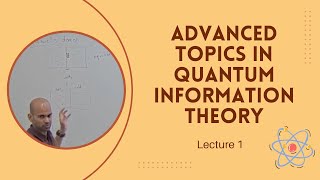
Introduction to Quantum Thermodynamics - Advanced Topics in Quantum Information Theory 2023 - Lecture 1
Dive into quantum thermodynamics fundamentals, exploring thermal states and virtual qubits while mastering advanced quantum information theory concepts with expert guidance.
Probing Sign Structure Using Measurement-Induced Entanglement - Timothy Hsieh
Exploring measurement-induced entanglement to probe sign structure in quantum systems, with applications to hybrid circuits, spin systems, and critical models. Novel insights into quantum information and condensed matter physics.
Few-Body Universality - What Do We Mean by This and Why Do We Care?
Explore few-body universality in physics, its significance, and applications. Uncover unitary interactions, scaling laws, and universal numbers in quantum systems across different fields.
Boson Droplets Close to the Unitary Limit - Mario Gattobigio
Explore Boson droplets near unitarity, examining free-body parameters, effective range expansion, binding energy, and related concepts in few-body physics. Insights from atomic and nuclear physics perspectives.
Bosons and Multi-Component Fermions Near Unitarity - Ubirajara van Kolck
Explore bosons and multi-component fermions near unitarity, focusing on few-body physics challenges in atomic and nuclear systems, with insights on universality and organizing principles.
Circumbinary Disks Across Different Scales - Roman Rafikov
Explores circumbinary disks across stellar and black hole binary systems, discussing gas evolution, observational signatures, and numerical modeling techniques to understand these complex astrophysical phenomena.
Rare & Precision Processes Frontier - Alexey Petrov at Wayne State Snowmass
Explores rare and precision processes in particle physics, covering theoretical tools, experimental results, and future directions in areas like charged leptons, dark sectors, and anomalies.
Beyond Effective Field Theory - Isabel Garcia Garcia
Exploring theoretical physics beyond Effective Field Theory, discussing 't Hooft naturalness, global symmetries, Weak Gravity Conjecture, and the Cosmological Constant problem in particle physics and cosmology.
Theoretical Aspects of Scattering Amplitudes - Nima Arkani-Hamed
Explore theoretical aspects of scattering amplitudes with Nima Arkani-Hamed, covering topics like virtual particles, positive geometries, and loop integrals. Gain insights into cutting-edge particle physics research.
Parton Distribution Functions - Huey-Wen Lin
Explore parton distribution functions with Huey-Wen Lin, covering traditional methods, recent calculations, and challenges in particle physics. Gain insights into the latest developments and future directions in this field.
ML for the Theory Frontier - Jesse Thaler
Explore machine learning applications in theoretical physics, from lattice field theory to collider geometry, and its potential impact on various aspects of high-energy physics research.
Physics in a Diverse World - Howard Georgi - Harvard
Explore diverse perspectives in physics, addressing societal obstacles and expanding opportunities in theoretical physics and cosmology. Gain insights from Howard Georgi's talk at the Snowmass Theory Frontier Conference.
Supersymmetry Overview - Clay Cordova
Comprehensive overview of supersymmetry in particle physics, exploring major themes, classification problems, and recent developments in various dimensions, with insights into moduli spaces and connections to non-supersymmetric dynamics.
Oceans in a Warming Climate - Understanding Sea Level Rise and Climate Projections
Explore ocean physics in climate change, focusing on sea level patterns and improving climate simulations through machine learning and physics integration for more accurate projections.