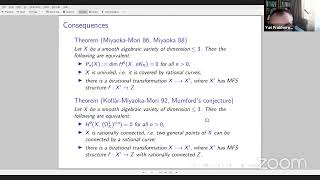
Yuri Prokhorov - Effective Results in the Three-Dimensional Minimal Model Program
Explore recent developments in 3D minimal model program, covering basic operations, terminal singularities, classification strategies, and effective boundedness of Q-Fano 3-folds.

Georges Gonthier - Computer Proofs - Teaching Computers Mathematics, and Conversely
Explore computer-assisted mathematical proofs, from the four-color puzzle to homotopy type theory. Learn how computer science methods enhance mathematical language, leading to new insights and advancements in formal proofs.
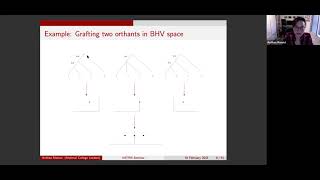
Tropical Geometry of Phylogenetic Tree Spaces
Explore tropical geometry's application to phylogenetic tree spaces, examining BHV space, tropical Grassmannians, and their implications for computational biology and statistics.
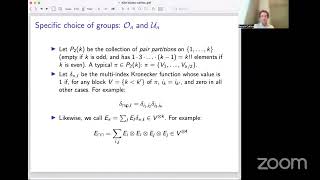
Weingarten Calculus and Its Applications
Explore Weingarten calculus and its applications in compact groups, quantum probability, and random matrix theory, with insights on theoretical properties and recent developments.
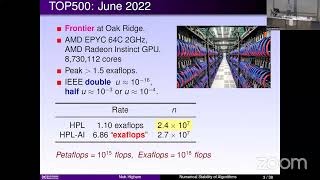
Numerical Stability of Algorithms at Extreme Scale and Low Precisions
Explore numerical stability in extreme-scale computing and low-precision arithmetic, focusing on error bounds, blocked algorithms, and probabilistic analysis for matrix computations.
Thomas Vidick - Connes Embedding Problem, Tsirelson’s Problem, and MIP* = RE
Explore the connections between operator algebras, quantum correlations, and computational complexity in this advanced mathematical lecture on recent breakthroughs in theoretical physics and computer science.
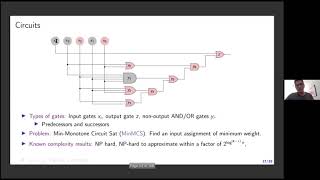
Hardness Results in Discrete Morse Theory for 2-Complexes
Explore inapproximability and parameterized complexity in discrete Morse theory for 2-complexes, focusing on minimizing critical simplices and presenting new hardness results and an approximation algorithm.
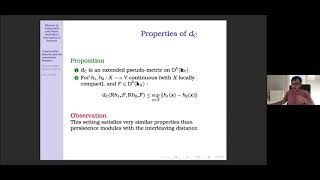
Sheaves as Computable and Stable Topological Invariants for Datasets
Explores sheaf theory in topological data analysis, connecting level-sets persistence with derived sheaves. Presents functorial equivalences, stability theorems, and barcode decompositions for continuous data analysis.
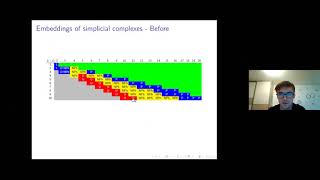
Embeddings and Tverberg-Type Problems: New Algorithms and Undecidability Results
Explore computational topology: algorithmic embeddability, undecidability in higher dimensions, and polynomial-time decidability of r-Tverberg problem in metastable range.
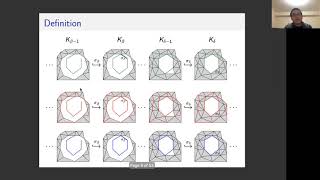
Computing Minimal Persistent Cycles - Polynomial and Hard Cases
Explores computing minimal persistent cycles in algebraic topology, discussing polynomial and NP-hard cases, and presenting algorithms for weak pseudomanifolds with applications to scientific data analysis.
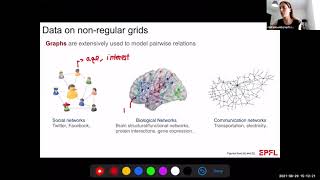
Simplicial Neural Networks
Explore simplicial neural networks, a generalization of graph neural networks for multi-dimensional data, and their applications in imputing missing data on coauthorship complexes.
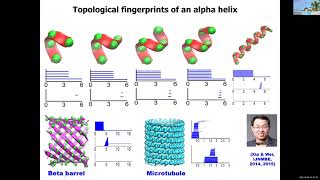
How Math and AI Are Revolutionizing Biosciences
Exploring how mathematics and AI revolutionize biosciences, focusing on tackling challenges in biological data complexity, dimensionality, and nonlinearity to enhance AI's capabilities in drug design and viral mutation prediction.
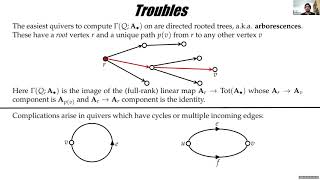
Vidit Nanda - Principal Components Along Quiver Representations
Principal components analysis for quiver representations: dimensionality reduction, comparison, and optimization techniques for vector-space valued representations across pure and applied mathematics.
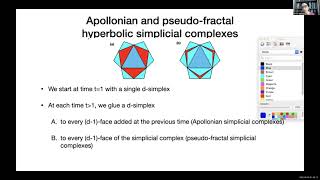
The Topological Dirac Operator and the Dynamics of Topological Signals
Explore topological signals, higher-order Laplacians, and the Dirac operator in network science. Learn about spectral properties, diffusion dynamics, and topological synchronization in simplicial complexes and multiplex networks.
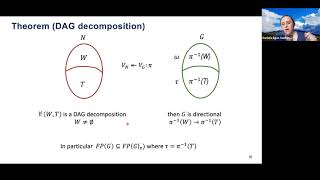
Nerve Theorems for Fixed Points of Neural Networks
Explore how network connectivity shapes neural activity using combinatorial threshold-linear networks. Learn about nerve theorems and their application in understanding fixed points of large neural networks.
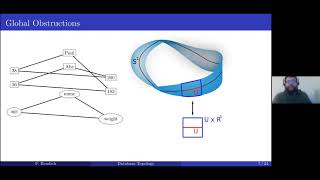
Data Complexes, Obstructions, Persistent Data Merging
Explore data complexes, topological obstructions in database JOIN operations, and persistence levels in data alignment. Learn about measure theory, homotopy, and homology in the context of data integration.
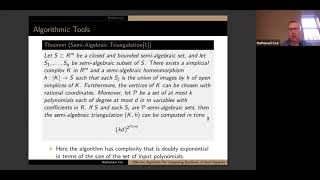
Nathanael Cox - Effective Algorithms for Quotients of Semi-Algebraic Equivalence Relations
Explore efficient algorithms for computing quotients of semi-algebraic equivalence relations, focusing on complexity, tools, and key results in applied algebraic topology.
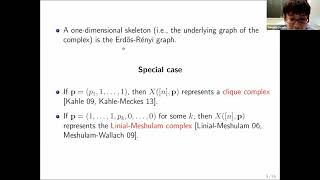
Takashi Owada - Limit Theorems for Topological Invariants of the Dynamic Multi-Parameter Simplicial Complex
Explore topological invariants in dynamic multi-parameter simplicial complexes, covering connectivity, probability, and limiting processes in applied algebraic topology.
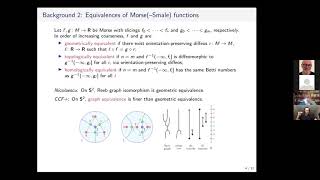
Moduli Spaces of Morse Functions for Persistence
Exploring Morse functions on surfaces, focusing on decomposition, elementary moves, and embeddings. Insights into persistence barcodes and the inverse problem through nesting posets of level sets.
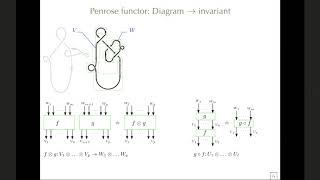
Parameterized Complexity of Quantum Invariants of Knots
Explore quantum invariants of knots, their parameterized complexity, and efficient algorithms for computation using graphical calculus and tree embeddings.
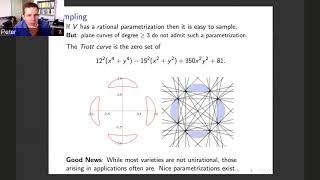
Bernd Sturmfels - Learning Algebraic Varieties from Samples
Explore algebraic varieties through sampling, focusing on topology and geometry. Learn algorithms for determining dimensions and polynomials, with practical applications in Julia.