Pawel Dlotko - A Few Simple Stories on Topology in Action
Explore practical applications of computational topology in material science, dynamical systems, and brain research. Learn how theory and algorithms work together to solve real-world problems.
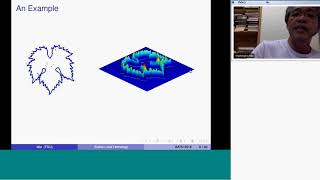
Washington Mio - Stable Homology of Metric Measure Spaces
Explore stable homology in metric measure spaces, covering Wasserstein distance, local homology stability, and applications in data analysis and taxonomic classification.
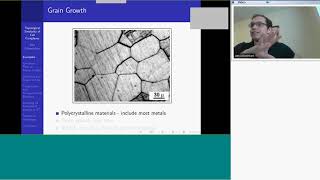
Benjamin Schweinhart - Statistical Topology of Random Cell Complexes, and Applications
Explore statistical topology of random cell complexes, covering curvature flow, grain growth, graph limits, and computational evidence for steady state hypothesis.
Harry Altman- Lower Sets in Products of Well Ordered Sets
Explore well partial orders, lower sets in products of ordinals, and weakly decreasing sequences. Gain insights into maximum linearizations and the surreal exponential.
A Fibrational Framework for Modal Dependent Type Theories
Explore modal extensions of homotopy type theory, their frameworks, and applications in real-cohesive and differential-cohesive HoTT. Gain insights into fibrational frameworks for modal type theories.
Peter Dybjer - Intuitionistic Type Theory - Lecture I
Explore intuitionistic type theory's foundations, historical context, and applications in mathematics and computer science with Prof. Peter Dybjer's comprehensive lecture.
Emergent Network Geometry
Explore emergent network geometry, from complex networks to quantum spacetime, revealing hidden structures and applications in diverse fields like neuroscience and collaboration networks.
Chad Giusti - Topology, Convexity, and Neural Networks
Explore topology in neuroscience, focusing on receptive fields, neuron convexity, and geometric features. Discover connections between neural networks and mathematical concepts.
High Dimensional Expanders
Explore high-dimensional expanders, their mathematical properties, and applications in theoretical computer science. Learn about coboundary and spectral expansion, and their implications for complex structures.
Convergent Semi-Lagrangian Methods for the Monge-Ampère Equation on Unstructured Grids
Explores semi-Lagrangian discretisation of Monge-Ampère operator on P1 finite element spaces, discussing challenges and solutions for numerical methods in solving Monge-Ampère equations, with applications in inverse reflector problems.
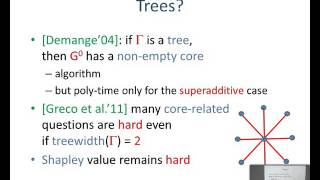
Edith Elkind- Coalitional Games on Sparse Social Networks
Explore coalitional games on social networks, analyzing graph structures, computational complexity, and solution concepts for connected subsets of agents.
Involutions of a Cubic Fourfold
Explore involutions of cubic fourfolds, covering hyperkähler manifolds, period domains, and evolution types. Delve into geometry, rationality, and related mathematical concepts.
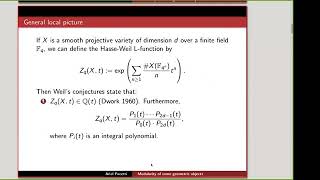
Modularity of Some Geometric Objects - Definitions, Reasons and State of the Art
Explore zeta functions, L-functions, and Galois representations in geometric objects, focusing on plane projective curves and their conjectured relationships with analytic functions.
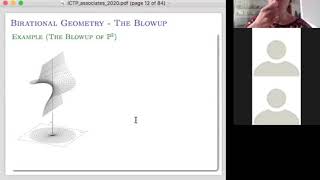
Symmetries in Algebraic Geometry and the Cremona Group
Explore symmetries in algebraic geometry, focusing on automorphisms and birational self-maps of projective varieties. Delve into the Cremona group and its subgroups, with insights from recent research.
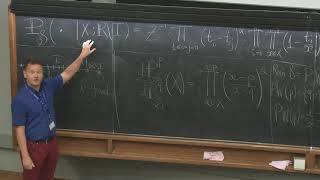
Determinantal Point Processes - V
Explore determinantal point processes, covering conditional measures, sign processes, gamma kernels, Palm measures, and infinite determinantal measures in this advanced mathematics lecture.
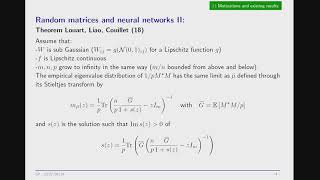
Eigenvalue Distribution for Non Linear Models of Random Matrices
Explore eigenvalue distribution in non-linear random matrix models, covering motivation, limits, batch normalization, and moment methods with speaker Sandrine PECHE.
Random Matrices and the Uses of Dyson-Schwinger Equations - III
Explore advanced topics in random matrix theory, including Dyson-Schwinger equations, operator algebra, and central limit theorems, with applications in mathematical physics.
Determinantal Point Processes - II
Exploration of determinantal point processes, covering theorems, Young graphs, Markov chains, and related mathematical concepts with applications in random matrix theory.
Solving the 4NLS with White Noise Initial Data
Explore white noise initial data in solving 4NLS, covering Hamiltonian PDE, globalization arguments, and limit equations. Gain insights into complex mathematical concepts and proofs.
Regularity Theory for Area-Minimizing Currents
Explore advanced concepts in geometric measure theory, including zero forms, currents, and rectifiability theorems, with applications to area-minimizing problems in mathematics.
Regularity Theory for Area-Minimizing Currents
Explore advanced concepts in geometric measure theory, including currents, boundaries, and regularity theory for area-minimizing surfaces, with applications to optimal transport problems.