Infrastructure for High-Fidelity Testing in HPC Facilities
Explore infrastructure and tools for high-fidelity testing in HPC environments, focusing on hardening software for DOE's Exascale Computing Project and future applications.
How IDEAS-ECP Has Advanced Software Productivity and Sustainability
Discover strategies for enhancing software practices in exascale computing and learn valuable lessons from the IDEAS Productivity Project's experience.
Secure Software Programming Practices and Development for Scientific Software
Explore secure software development practices to mitigate malicious attacks and protect scientific software integrity, authentication, and sustainability.
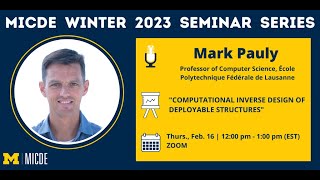
Computational Inverse Design of Deployable Structures
Explore computational design methodologies for deployable structures, combining geometry, simulation, and optimization to create innovative material systems with multiple geometric states.
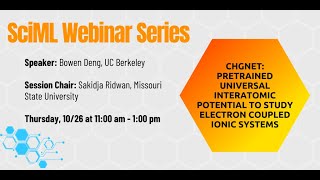
CHGNet: A Pre-trained Universal Interatomic Potential for Electron-Coupled Ionic Systems
Explore CHGNet, a graph-neural-network-based machine-learning potential for modeling universal potential energy surfaces in large-scale simulations with complex electron interactions.
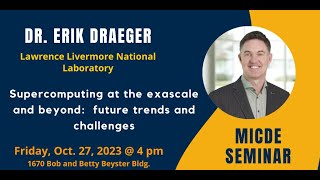
Supercomputing at the Exascale and Beyond: Future Trends and Challenges
Explore exascale computing advancements, best practices, and future trends in high-performance computing. Learn strategies for developing portable, performant code and adapting algorithms for heterogeneous architectures.
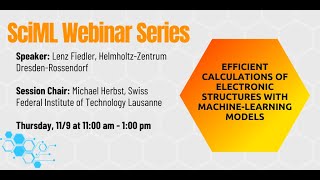
Efficient Calculations of Electronic Structures with Machine-Learning Models
Explore machine learning models for efficient electronic structure calculations in materials discovery and drug design, focusing on density functional theory and the Materials Learning Algorithms library.
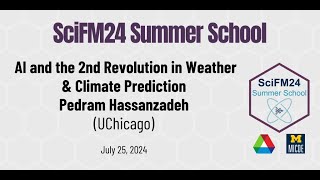
AI and the Second Revolution in Weather and Climate Prediction
Explore AI's transformative impact on weather and climate prediction, revolutionizing forecasting techniques and enhancing our understanding of atmospheric dynamics.
Retrieval Augmented Generation (RAG) - Tutorial 4
Explore Retrieval Augmented Generation (RAG) techniques to enhance AI models' knowledge and responses using external data sources, improving accuracy and relevance in various applications.
AI Agents for Autonomous Labs - Tutorial 4
Explore AI agents for autonomous labs, focusing on their applications and potential in scientific research and experimentation.
Diffusion Models for Solving Forward and Inverse Problems in PDEs - Tutorial 3
Explore diffusion models for solving forward and inverse problems in partial differential equations with expert Tony Zhuang.
Neural Scaling Laws - Fitting Scaling Laws for Scientific Foundation Models - Tutorial 3
Explore neural scaling laws and learn techniques for fitting scaling laws to scientific foundation models in this advanced tutorial.
Foundation Models for Science
Explore foundation models' potential in scientific research, focusing on their applications and impact on various scientific disciplines.
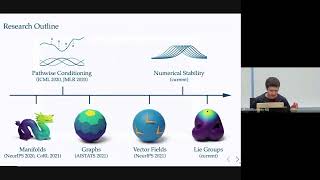
Pathwise Conditioning and Non-Euclidean Gaussian Processes
Explore advanced Gaussian process techniques for efficient Bayesian optimization, including pathwise conditioning and models on graphs and manifolds, enhancing decision-making in complex settings.
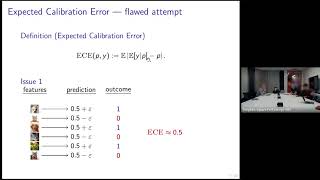
A Unifying Theory of Distance to Calibration
Explore a rigorous framework for analyzing calibration measures in probabilistic predictors, examining consistent measures and establishing fundamental bounds on measuring calibration distance.
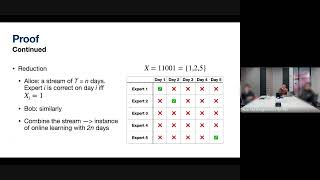
Online Prediction in Sub-linear Space
Explore innovative algorithms for online learning with expert advice, focusing on sub-linear memory solutions and their implications for sequential decision-making.
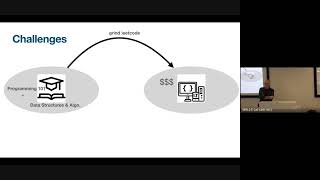
Socially Responsible Software Development - Teaching Software Design Systematically
Explore socially responsible software development and its importance in education. Learn strategies for creating curricula that emphasize software as a message to future developers.
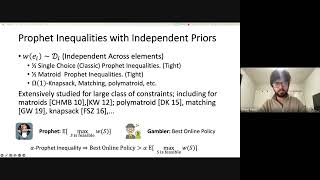
Limitations of Stochastic Selection with Pairwise Independent Priors
Explore stochastic selection problems with pairwise-independent priors and matroid constraints, examining limitations and optimal bounds for contention resolution and prophet inequalities.

Design is Testability - Understanding Software Testing Through Design Principles
Explore software design's impact on testability, linking design concepts to testing strategies for effective automated testing in continuous integration systems.

Algorithms and Hardness for Attention and Kernel Density Estimation
Explore algorithmic techniques for Attention and Kernel Density Estimation, examining fast algorithms and hardness results to optimize computational efficiency in machine learning and statistical tasks.
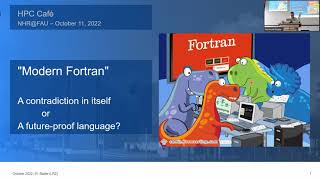
Modern Fortran - A Contradiction or Future-Proof Language?
Explore modern Fortran's evolution, focusing on program design, parallelism, and interoperability. Discover how this 65-year-old language remains relevant for scientific simulations.