A Simple Axiom for Euclidean Quantum Field Theory
Explore a concise mathematical definition of quantum field theory and its implications for physics through a categorical approach to Riemannian manifolds and Hilbert spaces.
Quantum Simulation of Conformal Field Theory
Explore quantum algorithms for simulating conformal field theory dynamics and local conformal transformations in scaling-symmetric systems.
Vertex Model for Tissue Mechanics - Part I
Explore vertex models for tissue mechanics, focusing on fundamental concepts and applications in biological systems.
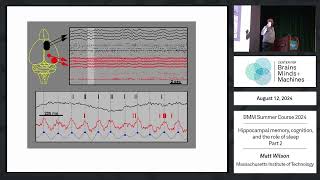
Hippocampal Memory, Cognition, and the Role of Sleep - Part 2
Explore hippocampal memory, cognition, and sleep's role in brain function through advanced neuroscience research and insights from MIT expert Matt Wilson.
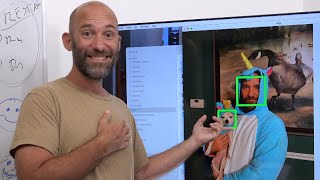
Python - OpenCV for Computer Vision
Learn to use OpenCV with Python for computer vision tasks. Process images and live video, create bounding boxes, and trigger events based on real-time input. Run locally for privacy on various systems.
Research Ops - Challenges and Practical Solutions for Distributed Scientific Computing
Explore challenges and practical solutions for distributed scientific computing in research operations, focusing on advanced cyberinfrastructure.
Quantum Machine Learning with Covalent
Explore quantum machine learning using Covalent, gaining insights into advanced computational techniques and their applications in data analysis and problem-solving.
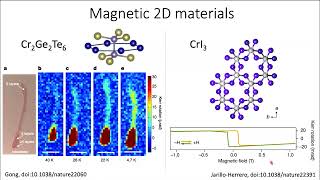
Materials Science and Discovery Powered by Machine Learning
Explore machine learning applications in materials science, focusing on innovative discovery techniques and computational advancements in the field.
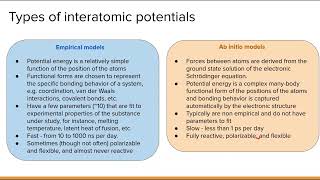
Crystallization Machine Learning - Theory and Simulation Techniques
Explore machine learning applications in crystallization, from molecular dynamics to enhanced sampling techniques for rare events and homogeneous nucleation.
Introduction to Quantum Computing
Explore quantum computing fundamentals, including qubits, superposition, and entanglement. Gain insights into potential applications and future implications of this revolutionary technology.
Exascale Computing: From Shared Memory to GPU Architecture
Explore exascale computing, HPC architectures, and GPU programming with Dr. Meifeng Lin from Brookhaven National Laboratory.
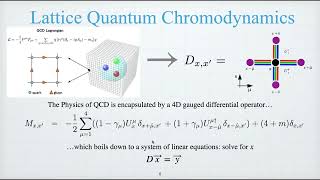
GPU Computing and Krylov Solvers
Explore GPU computing and Krylov solvers for advanced numerical computations, enhancing problem-solving skills in high-performance computing environments.
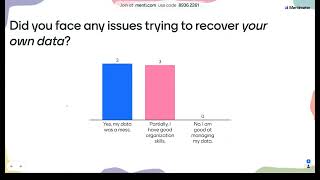
Data Management from First Principles
Learn essential data management principles for research, including tools, metadata, and FAIR practices. Enhance project organization and efficiency.
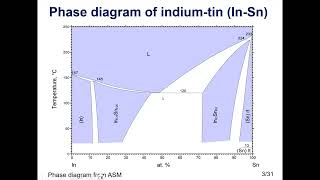
First Principles Thermodynamics
Explore computational condensed matter using first principles thermodynamics, gaining insights into advanced techniques and applications.
Template Task Graphs: An Introduction to Parallel Programming for Irregular Data Sets
Explore the Template Task Graph programming paradigm for expressing task parallelism in algorithms with irregular data sets. Learn installation and integration techniques.
Investing in Code Reviews for Better Research Software
Explore code review benefits for scientific software: improved quality, teamwork, and knowledge transfer. Learn approaches to facilitate effective reviews.
Lab Notebooks for Computational Mathematics, Sciences and Engineering
Explore lab notebooks' adaptation to computational research, with examples addressing challenges in transitioning from experimental to computational sciences.
Our Road to Exascale: Particle Accelerator and Laser-Plasma Modeling
Explore the journey to exascale computing in particle accelerator and laser-plasma modeling, featuring WarpX's development and the 2022 ACM Gordon Bell Prize.
Strategies for Inclusive Mentorship in Computing
Discover effective strategies for inclusive mentorship in computing, enhancing workforce development and retention through dynamic relationships that support personal and professional growth.
Facilitating Electronic Structure Computations on GPU-based Exascale Platforms
Explore GPU-based electronic structure computations for exascale platforms using PROGRESS and BML libraries. Learn implementation strategies, performance optimization, and scaling techniques.
Writing Clean Scientific Software
Learn strategies for writing readable, reusable, and maintainable scientific code. Master techniques for creating concise functions, restructuring complex code, and effective commenting.