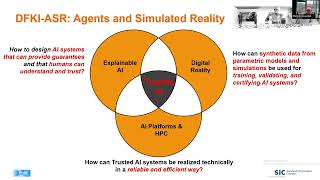
Digital Reality: From Learned Models via Synthetic Data to Trusted-AI - and Back
Explore AI systems' understanding of complex reality through modular learning, simulations, and synthetic data generation. Discover the "Digital Reality" approach combining modeling, AI, and high-performance computing.
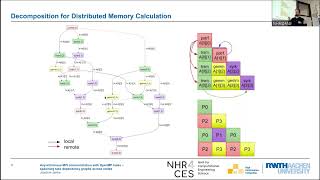
Asynchronous MPI Communication with OpenMP Tasks - Spawning Task Dependency Graphs Across Nodes
Explore asynchronous MPI communication with OpenMP tasks to improve parallel code scalability. Learn to integrate MPI detached communication for real asynchronous execution across processes.
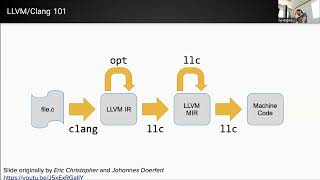
LLVM in HPC - Enabling Performance Portability, Interoperability, and Novel Features - Part 1
Explore LLVM's impact on HPC, covering portable CUDA, debugging at scale, GPU execution of legacy code, and ML in compilers. Learn about efforts to enhance performance, tooling, and development in HPC.
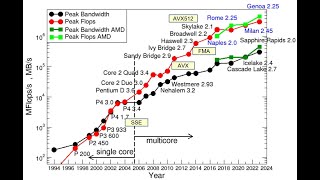
A Review of Processor Advances Over the Past Thirty Years - An Outsider's Perspective
Explore 30 years of processor advancements, focusing on x86 chips in HPC systems. Analyze core properties, memory hierarchy, and compare with Apple Silicon architecture.
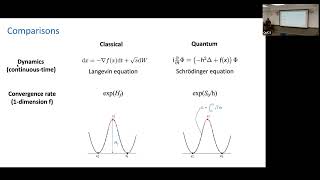
Quantum Speedups for Nonconvex Optimization via Quantum Tunneling Walks
Explore quantum speedups for nonconvex optimization using quantum tunneling walks. Learn how this approach outperforms classical algorithms in specific landscapes with high, thin barriers between minima.
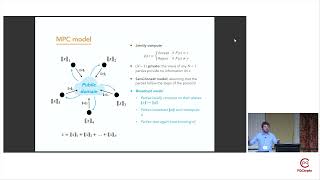
Post-Quantum Signatures from Multiparty Computation - Recent Advances
Explore recent advances in post-quantum signatures derived from multiparty computation, presented by Thibauld Feneuil at PQCrypto 2023.
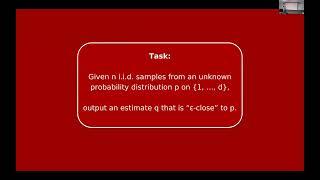
New Directions in Quantum State Learning and Testing
Explore efficient quantum state tomography algorithms, distance metrics in quantum systems, and quantum-inspired improvements to classical independence testing.
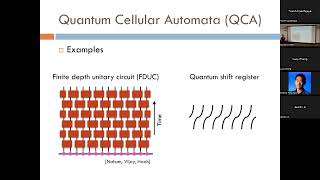
Measurement Quantum Cellular Automata and Anomalies in Floquet Codes
Explore quantum measurement circuits, local reversibility, and measurement quantum cellular automata. Discover Z_2 bulk invariants in Floquet codes and their implications for boundary dynamics.
Unexpected Applications of Analog Quantum Computers
Explore unexpected applications of analog quantum computers, their advantages over digital counterparts, and potential uses in physics simulations. Gain insights into the future of quantum computing technology.
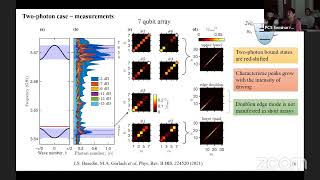
Topological Phases and Optimal Control in Arrays of Superconducting Qubits
Explore quantum geometric tensor concepts, Berry curvature, and quantum metric applications in superconducting qubit arrays for topological states and optimal quantum system control.
Unraveling Opinion Dynamics - Insights from Network Science and the Ising Model
Explore opinion dynamics using network science and the Ising model. Discover how network topologies influence opinion formation and evolution across diverse structures, with insights from statistical physics simulations.
Exact Projected Entangled Pair Ground States with Topological Euler Invariant
Explore exact projected entangled pair ground states and their connection to topological Euler invariants in quantum systems, advancing understanding of quantum many-body physics.
Discovery in High Dimensions - 2008
Explore statistical methods for uncovering hidden structures in high-dimensional data from various fields, including genetics, astronomy, and consumer behavior.

Machine-Learning Enabled Imaging: From Microscopy to Medical Imaging to Astronomy - Kirk Lecture
Explore machine learning's impact on imaging across microscopy, medical imaging, and astronomy. Learn how neural networks leverage training data and physical models for improved image quality and resolution.
The Power and Weakness of Randomness When You Are Short on Time
Explore the power and limitations of randomness in computational algorithms, focusing on its impact on efficiency, space-bounded computation, and probabilistic proofs.
Quantum Shannon Theory - Rothschild Lecture
Explore quantum Shannon theory, examining channel capacities, coding theorems, and entropic quantities in quantum information science. Delve into mathematical challenges and open problems in the field.
Growth and Mechanics of Tissues - SPL Rothschild Lecture
Explorez les propriétés mécaniques des tissus et leur rôle dans la croissance et l'expression génétique, en mettant l'accent sur les tissus cancéreux et le développement précoce.
From Black Holes to Holographic Spacetime - Rothschild Lecture
Explore the concept of holographic spacetime, tracing its origins from Hawking's black hole discoveries to implications for our understanding of quantum reality and dimensions.
How Physical Systems Can Learn by Themselves - Kirk Lecture
Explore how physical systems can learn autonomously, inspired by biological neural networks, without external computation or top-down control.
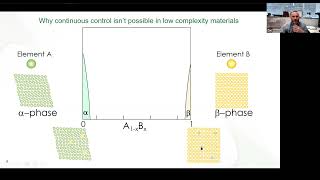
Breaking Symmetries in Compositionally Complex Oxides
Explore experimental studies of high entropy oxides and their symmetry-breaking properties in compositionally complex systems.
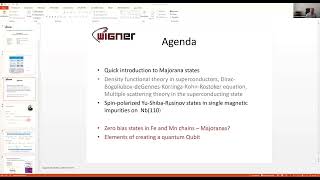
Electronic Structure in the Superconducting State from First Principles
Explore first-principles theory of inhomogeneous superconductivity, focusing on magnetic atom chains on superconductor surfaces and the identification of Majorana Zero Modes in topological systems.