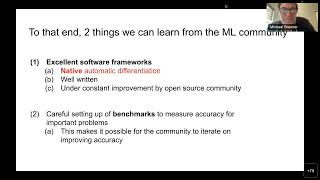
Scientific Uses of Automatic Differentiation - DDPS
Explore automatic differentiation's scientific applications beyond machine learning. Discover innovative approaches in PDEs, self-assembly, fluid dynamics, and protein modeling using large-scale optimization.
RADIUSS and HPCIC: Outreach Through Open-Source Software in the Exascale Era
Explore LLNL's open-source HPC software portfolio and learn about collaboration opportunities in the exascale era. Gain insights into innovative tools addressing emerging challenges in high-performance computing.
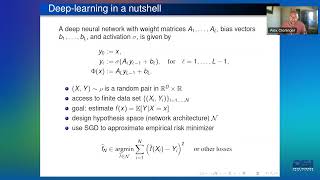
Networks that Adapt to Intrinsic Dimensionality Beyond the Domain
Explore neural networks' ability to adapt to intrinsic dimensionality, focusing on ReLU networks approximating functions with dimensionality-reducing feature maps. Gain insights into manifold learning and data analysis.
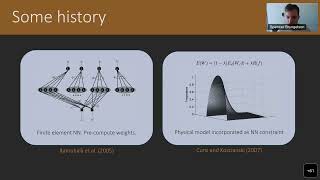
Competitive Physics Informed Networks - Overcoming Limitations in PDE Solutions
Explore competitive physics-informed neural networks for solving PDEs with unprecedented accuracy. Learn about adversarial approaches and zero-sum games to achieve single-precision accuracy in numerical simulations.
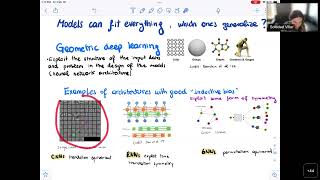
The Passive Symmetries of Machine Learning
Explore passive symmetries in machine learning, their implications, and implementation as group equivariances. Gain insights on generalization and links to causal modeling.
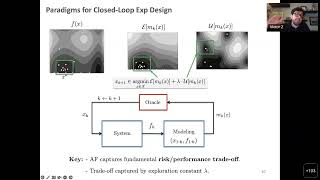
Bayesian Optimization: Exploiting Machine Learning Models, Physics, and Throughput Experiments
Explore new Bayesian Optimization paradigms leveraging machine learning, physics, and high-throughput experiments. Learn to accelerate searches, enable parallel exploration, and utilize large-scale models for various applications.
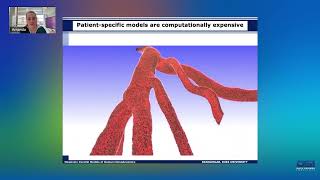
Using Data Science to Advance the Impact of Vascular Digital Twins in Medicine
Explore high-resolution digital twins of vascular anatomy to inform disease treatment. Learn how data science and physics-based modeling combine to address personalized medicine challenges.
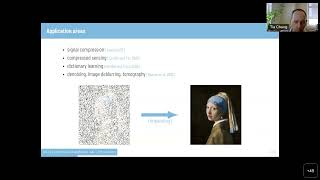
Big Data Inverse Problems - Promoting Sparsity and Learning to Regularize
Explore novel methods for solving big data inverse problems, focusing on sparse representation and L1 regularization. Learn about variable projection and deep neural networks for parameter optimization.
Scientific Machine Learning through the Lens of Physics-Informed Neural Networks
Explore physics-informed neural networks (PINNs) as an alternative to traditional scientific computation, addressing limitations and showcasing applications in solving complex physical problems.
ML-driven Models for Material Microstructure and Mechanical Behavior - DDPS
Explore ML-driven approaches for generating microstructures and accelerating material behavior analysis. Learn transfer learning techniques and rapid assessment methods for materials design optimization.
Adversarial Machine Learning: Categories, Concepts, and Current Landscape
Explore adversarial machine learning vulnerabilities, including data subversion, evasion, and model revelation. Learn to identify potential threats and build robust defense strategies.
Scaling Up AI: Embedding Physics Modeling into End-to-end Learning and Harnessing Random Projection
Explore AI-driven scientific discovery through embedding physics models in end-to-end learning and utilizing random projection for efficient simulation and gradient propagation in PDE-based systems.
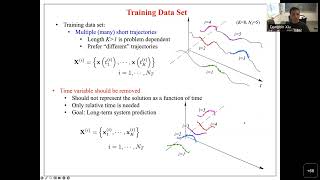
Data-Driven Modeling of Unknown Systems with Deep Neural Networks
Explore data-driven modeling of unknown systems using deep neural networks. Learn to discover and approximate evolution operators for predictive analysis across various problem domains.
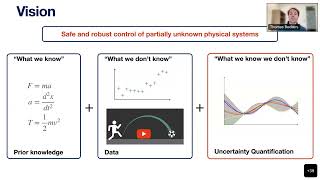
Physics-Enhanced Gaussian Processes for Learning of Electromechanical Systems
Explore physics-enhanced Gaussian processes for modeling electromechanical systems. Learn about GP-PHS and physics-enhanced variational autoencoders to improve data efficiency and ensure physical correctness.
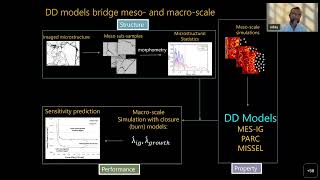
Data-Driven Multi-Scale Simulations for Materials-by-Design of Energetic Materials
Explore multi-scale modeling of energetic materials using machine learning for scale bridging. Learn about structure-property-performance relationships and optimization strategies for materials design.
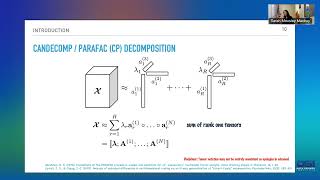
Tensor Factorization for Biomedical Representation Learning
Explore tensor factorization for biomedical representation learning, addressing challenges in healthcare data and improving predictive power for various downstream tasks.
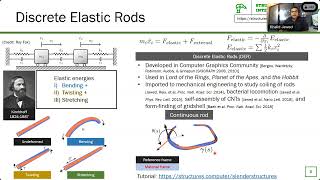
Reduced Order Modeling and Inverse Design of Flexible Structures by Machine Learning
Explore machine learning applications in structural mechanics, focusing on reduced-order modeling for dynamic simulations and inverse design of shape-morphing structures using neural networks and active learning.
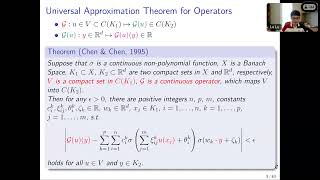
Deep Neural Operators with Reliable Extrapolation for Multiphysics and Multiscale Problems
Explore deep neural operators for complex systems, focusing on DeepONet and its extensions for multiphysics and multiscale problems. Learn about extrapolation challenges and solutions in deep learning models.
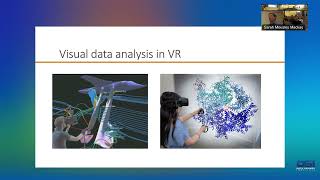
Quantifying the Benefits of Immersion in Virtual Reality
Explore the quantifiable benefits of VR immersion for real-world applications beyond gaming, backed by empirical studies and successful case studies in areas like scientific visual data analysis.
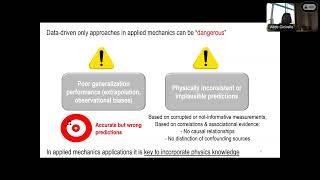
Challenges and Opportunities for Integrating Physics-Knowledge in Machine Learning Strategies
Explore integrating physics knowledge into machine learning algorithms for improved generalization and physics-consistent predictions. Examine biases and strategies through a friction identification case study.
Caliper, Hatchet, and Thicket: Open-Source Tools for HPC Performance Analysis
Explore open-source tools for integrating performance profiling, analyzing hierarchical data, and optimizing application performance on supercomputers. Learn to leverage Caliper, Hatchet, and Thicket for HPC environments.