Using the Query Function to Write Elegant and Efficient Programs in Wolfram Language
Explore efficient data manipulation using Wolfram Language's Query function with Professor Seth Chandler. Learn elegant programming techniques for extracting information from datasets.
What's New and Improved in Wolfram Language Version 14
Explore Wolfram Language 14's enhancements in AI, graphics, engineering, math, and more. Learn about LLM integration, data visualization, PDE models, and improved computational capabilities.
Designing Engaging Pre-College Research-Based Learning Programs
Explore intentional design choices and pedagogies for pre-college research programs that foster computational thinking and deep subject engagement.
visX - A Block-Based Frontend to Wolfram Language
Explore visX, a block-based coding approach for Wolfram Language. Learn to organize code visually, enhancing understanding and leveraging the language's power and flexibility.
What's New and Improved in Wolfram Language and Mathematica Version 14.1
Explore Wolfram Language 14.1's new features, including Chat Notebooks, LLM functionality, and AI tools. Discover updates in calculus, geometry, astronomy, and more.
Updates for the Wolfram Compiler, System Modeler and External Language Integration in Wolfram 14.1
Explore performance updates for Wolfram Compiler, new features in System Modeler, and advancements in external language integration in Wolfram Language and Mathematica version 14.1.
New and Powerful Components for AI and LLMs in Wolfram Language 14.1
Explore Wolfram Language 14.1's latest AI tools, including LLM connections, prompt engineering, speech recognition, and audio/video processing advancements.
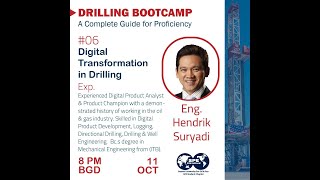
Digital Transformation in Well Construction
Explore digital transformation's impact on well construction, examining innovative technologies and strategies reshaping the industry's future.
Artificial Intelligence in Oil Fields
Explore AI applications in oil field operations, enhancing efficiency and decision-making processes in petroleum engineering and reservoir management.
Digital Transformation: A New Era of Well Construction
Explore digital transformation's impact on well construction, revolutionizing processes and enhancing efficiency in the oil and gas industry.
From One Brain to Everyone's Brain
Explore the evolution of collective intelligence and its impact on society with Dr. Omar Alfarisi's insights on brain connectivity and shared knowledge.
Practice Machine Learning for Petroleum Engineers with Little to No Code
Explore machine learning applications in petroleum engineering with minimal coding. Gain practical skills for implementing ML solutions in reservoir analysis and production optimization.
Modern Paradigms of Generalization - The Heliocentric Model of Aristarchus
Explore modern generalization paradigms and historical scientific models in this insightful lecture on machine learning theory and its historical parallels.
The Elusive Generalization: Classical Bounds to Double Descent to Grokking
Explore the evolution of generalization in machine learning, from classical bounds to double descent and grokking, challenging traditional assumptions and practices in the field.
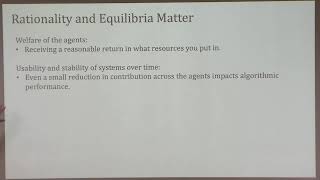
A Theory of Multi-objective Machine Learning
Explore multi-objective learning as a unifying paradigm for robustness, collaboration, and fairness in machine learning, with technical tools and empirical evidence.
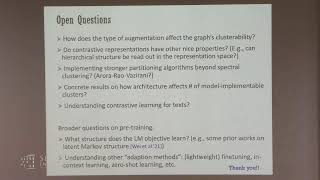
Understanding Generalization from Pre-training Loss to Downstream Tasks
Explore the mystery of pre-trained models' effectiveness, examining contrastive loss, embedding spaces, and the roles of inductive bias and optimizers in generalization to downstream tasks.
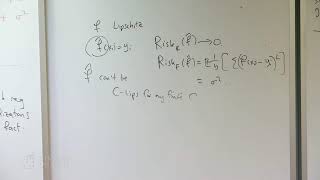
Prediction, Generalization, and Complexity in Statistical Decision Theory - Part 2
Explore statistical decision theory's insights on prediction error, generalization gap, and model complexity. Examine fixed-X vs. random-X perspectives and their implications for machine learning.
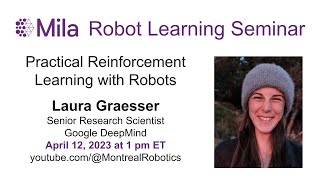
Practical Reinforcement Learning with Robots
Explore practical reinforcement learning for robotics, covering environment design in simulation and real-world applications, with insights on implementing RL in robotic systems.
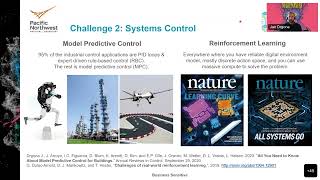
Differentiable Programming for Modeling and Control of Dynamical Systems
Explore differentiable programming for optimal control of dynamical systems, focusing on differentiable predictive control and its applications in building control and power systems optimization.
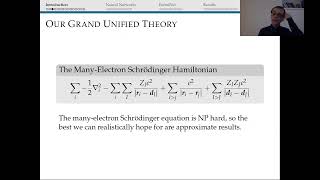
Solving the Many-Electron Schrödinger Equation with Deep Neural Networks
Explore deep neural networks for solving complex quantum mechanical equations in many-electron systems, advancing computational physics and materials science.
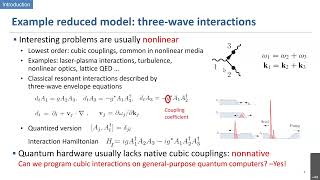
Using Quantum Computers to Simulate Laser-Plasma Interaction - A Toy Problem
Explore quantum computing applications in simulating laser-plasma interactions, focusing on a toy problem to demonstrate potential advancements in high-energy density science.