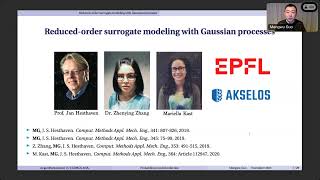
Probabilistic Methods for Data-Driven Reduced-Order Modeling
Explore probabilistic methods for data-driven reduced-order modeling, including Gaussian process regression, deep kernel learning, and Bayesian reduced-order operator inference for efficient multi-query simulations and digital twinning.
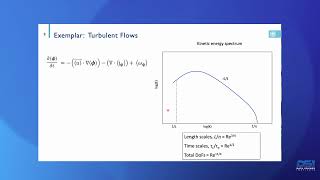
Higher-Order Multi-Variate Statistics for Scientific Data Analysis
Explore advanced multi-variate statistical techniques for scientific data analysis, focusing on higher-order methods like coskewness and cokurtosis for rare event detection and dimensionality reduction in complex systems.
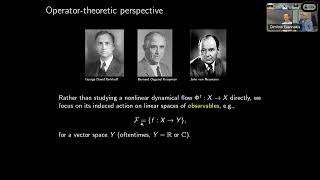
Quantum Information and Data Science for Modeling Classical Dynamics
Explore quantum information and data science approaches for modeling classical dynamics, focusing on operator-theoretic techniques and their applications in dynamical systems and climate modeling.
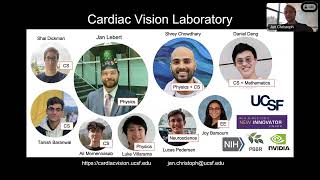
Predicting Heart Rhythm Disorders from Spatio-Temporal Imaging Data Using AI
Explore AI-driven techniques for predicting heart rhythm disorders using spatio-temporal imaging data, combining fluorescence and ultrasound imaging to overcome diagnostic limitations.
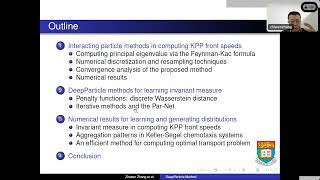
DeepParticle: Learning Invariant Measure by Deep Neural Network Minimizing Wasserstein Distance
Explore DeepParticle: an integrated approach combining deep learning, optimal transport, and interacting particles to solve high-dimensional PDEs, demonstrated through Fisher-Kolmogorov-Petrovsky-Piskunov front speeds in incompressible flows.
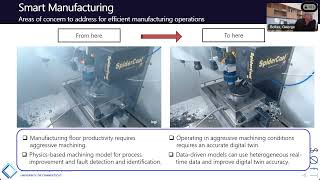
Physics Informed Machine Learning through Symbolic Regression
Explore symbolic regression for identifying PDE models from scarce, noisy data. Compare with Physics-Informed Neural Networks and discuss applications in fault detection and system health prognostics.
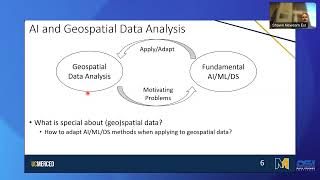
GeoAI: Past, Present, and Future
Explore GeoAI's evolution, applications, and future prospects in geographic data analysis. Gain insights into spatial context integration, multi-modal foundation models, and potential challenges with generative AI.
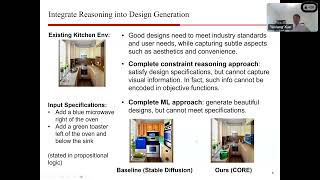
Vertical Reasoning Enhanced Learning, Generation and Scientific Discovery
Explore vertical reasoning's impact on AI, enhancing image generation, symbolic regression, and PDE learning. Discover innovative approaches to integrating reasoning and learning for advanced AI applications.
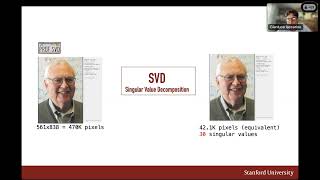
AutoEncoders for Aerodynamic Predictions
Explore autoencoders for aerodynamic predictions, focusing on flow past wing geometries. Learn about non-linear compression, latent representations, and uncertainty quantification in data-driven modeling.

Recent Progress in Reduced-Order Modeling for Computer Graphics and Sound
Explore advancements in reduced-order modeling for graphics and sound, focusing on progressive simulation for art-directable physics and improved water sound synthesis using coupled acoustic bubbles.
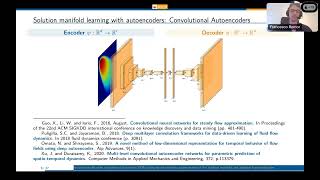
Intrusive Model Order Reduction Using Neural Network Approximants
Explore innovative neural network-based techniques for efficient reduced-order modeling of complex parametric partial differential equations, focusing on intrusive and interpretable methodologies.
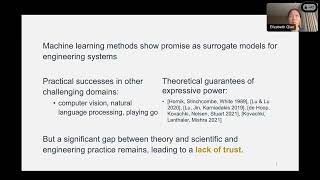
Multi-fidelity Linear Regression for Scientific Machine Learning from Scarce Data
Explore multi-fidelity linear regression for scientific machine learning, addressing data scarcity challenges in complex engineering systems through innovative training approaches.
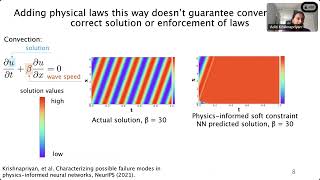
Bridging Numerical Methods and Deep Learning with Physics-Constrained Differentiable Solvers
Explore machine learning strategies for neural PDE solvers, focusing on self-supervised learning and simulation-in-the-loop approaches to enhance spatiotemporal modeling across various systems.
BLT (Build, Link, Test) Tutorial for HPC Software Development - 2024
Explore BLT, a CMake-based foundation for HPC applications. Learn to build, link, and test across various compilers, operating systems, and technologies for streamlined development.

Navajo Code Talkers in World War II - Personal Experiences - 20240808
Discover the remarkable story of a Navajo code talker's WWII experiences, exploring Native American contributions to U.S. military history and cultural preservation.
WEAVE: Building Complex HPC Workflows - Tutorials 2024
Explore WEAVE's integrated tools for building complex HPC workflows, enhancing productivity and scientific quality through common infrastructure and tool integration.
Ascent: In Situ Visualization and Analysis for HPC Simulations - Tutorial 2024
Learn to use Ascent, an open-source in situ visualization and analysis tool for HPC simulations. Explore its capabilities for multi-physics applications on many-core architectures.
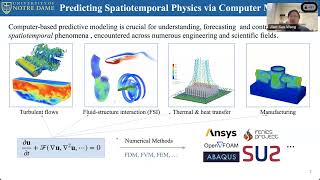
Neural Differentiable Physics: Unifying Numerical PDEs and Deep Learning for Data-Augmented Computational Physics
Explore Neural Differentiable Physics, unifying numerical PDEs and deep learning for enhanced computational modeling of complex physical systems. Learn innovative SciML approaches integrating physics principles with AI.
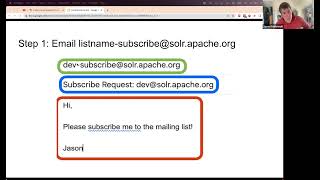
Contributing to Apache Solr - Session 1
Learn how to contribute to Apache Solr with guidance from experienced committers. Explore the contribution process, best practices, and ways to get involved in this open-source search engine project.
Contributing to Apache Solr - Session 1
Learn how to contribute to Apache Solr with guidance from experienced committers. Explore the contribution process, best practices, and ways to get involved in this open-source search engine project.
Lightning Talks on Search Relevance and AI - Haystack US 2024
Explore cutting-edge search and AI topics through lightning talks from Haystack US 2024. Gain insights on information retrieval, LLMs, vector search, semantic search, and more from industry experts.