Expressive Compile Time Parsers in Modern C++
Explore compile-time parsers in C++, from C++11 to C++23. Learn techniques for expressive APIs, zero-overhead code, and advanced features like compile-time regex and reflection.
Regular Types in C++ Programming - Revisited
Explore Regular types in C++ programming, their importance in STL design, and their impact on everyday coding. Learn to design intuitive, well-constrained types and functions.
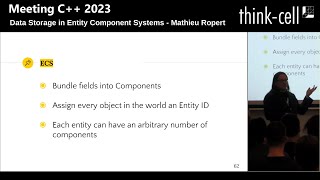
Data Storage in Entity Component Systems
Explore Entity Component System architecture, optimizing data arrangement for fast iteration and lookup in game development and beyond.
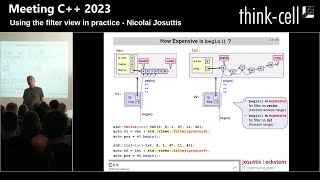
Using the Filter View in Practice - C++20 Standard Views
Explore the C++20 filter view's design, benefits, and potential pitfalls. Learn crucial aspects for successful element filtering and avoid unexpected compile-time and runtime errors.
Type Erasure - The Implementation Details
Explore Type Erasure implementation techniques, from simple wrappers to advanced optimizations. Master this powerful design pattern to reduce coupling in C++ codebases.
C++20's Coroutines for Beginners - Lecture 1
Explore C++20 coroutines from basics to advanced concepts. Learn new keywords, customization points, and how to implement generators. Understand cooperative multitasking and coroutine benefits in concurrent programming.
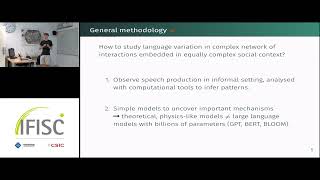
Diversity in and of Languages: How We Can Measure and Model Its Emergence to Unveil Underlying Social Processes
Explore linguistic diversity measurement and modeling techniques to uncover societal patterns and language emergence mechanisms.
Quantum-Inspired Algorithms in the NISQ Era
Explore quantum-inspired algorithms, their properties, benefits, and challenges in the NISQ era. Learn key algorithms and future applications in quantum computing.

Observability Strategies to Not Overload Engineering Teams
Explore observability strategies to optimize engineering team workload, including proxy, OpenTelemetry, and eBPF approaches for effective monitoring and performance management.
Deep Dive into Kubernetes Operators
Explore Kubernetes Operators, from control loops to custom resources. Master advanced concepts, frameworks like Kubebuilder and Operator SDK, and see a practical demo for hands-on learning.
Journey Beyond - AWS Quest for Excellence
Explore AWS optimization strategies for media production workloads. Learn about SES, workload analysis, evolution, rightsizing, scaling, and database management to enhance cloud performance and efficiency.
GenAI Pipeline for Content Generation with Apache Airflow
Explore Apache Airflow's key features for building GenAI pipelines, including TaskFlow API, automatic retries, branching, and dynamic task mapping. Learn to overcome challenges in content generation workflows.
Unveiling Tomorrow: Exploring the Frontiers of Generative AI
Explore the frontiers of generative AI, from emerging models and use cases to challenges, trends, and regulatory implications. Gain insights into implementation, security, and future developments.

Measuring Developer Productivity with DORA, SPACE, and DevEx Frameworks
Explore engineering productivity frameworks to measure and enhance team performance, focusing on DORA, SPACE, and DevEx methodologies.
Diffusion Probabilistic Modeling of Protein Backbones in 3D for Motif-Scaffolding
Explore diffusion probabilistic modeling for protein backbone design, focusing on motif-scaffolding applications. Learn about SMCDiff algorithm, E(3)-equivariant graph neural networks, and diverse scaffold generation.
HyenaDNA: Long-Range Genomic Sequence Modeling at Single Nucleotide Resolution
Explore HyenaDNA: a genomic foundation model using long-range context and single nucleotide resolution. Learn about its design, experiments, and state-of-the-art performance in genomic sequence modeling.
An Open MetaGenomic Corpus for Mixed-Modality Genomic Language Modeling
Explore the Open MetaGenomic corpus for genomic language modeling, featuring 3.1T base pairs and 3.3B protein coding sequences. Learn about mixed-modality approaches and their impact on AI for drug discovery.
EntityValue and EntityStore - Accessing Your Own Data via the Wolfram Data Framework
Explore data using EntityValue and EntityStore functions in the Wolfram Data Framework. Learn to access and manipulate your own datasets effectively.
Live Coding: Avoiding Traffic with Wolfram Language
Explore real-time problem-solving using Wolfram Language to avoid London's morning rush hour traffic through API calls, machine learning, image processing, and graph theory.
Live Coding: Exploring Mars with Wolfram Language
Explore Mars using Wolfram Language: Generate and analyze Martian surface videos, connect to NASA's API, apply frame interpolation, and utilize machine learning for image analysis.
Bridging Quantum Computation and Practice with Wolfram Language
Explore quantum computing concepts and their practical applications using Wolfram Language. Learn about tensor networks, phase space, and stabilizer formalism in this informative livestream for researchers and practitioners.