
Reintroduction to C
Fast-paced, comprehensive reintroduction to C programming, covering syntax, semantics, and intricacies. Suitable for those seeking a thorough refresh on this fundamental language.

AutoFR - Automated Filter Rule Generation for Adblocking
Innovative reinforcement learning framework for automated ad-blocking filter rule creation, balancing ad removal and visual integrity while matching EasyList's effectiveness and offering scalability.

RIDAS - Real-Time Identification of Attack Sources on Controller Area Networks
Real-time method for identifying attack sources on vehicle networks, enhancing cybersecurity through error handling and sequential ECU inspection. Robust against environmental changes and attacker evasion.

Account Verification on Social Media - User Perceptions and Paid Enrollment
Explores user perceptions of social media verification, focusing on Twitter's changes. Combines survey data and account analysis to reveal misunderstandings and shifts in verified user demographics.

TAP - Transparent and Privacy-Preserving Data Services
Explore a novel system for transparent, privacy-preserving data services. Learn about TAP's tree structure, zero-knowledge proofs, and verifiable operations, addressing limitations in existing approaches.

Gradient Obfuscation Gives a False Sense of Security in Federated Learning
Explores vulnerabilities in federated learning, demonstrating how gradient obfuscation techniques may not provide adequate privacy protection. Proposes a new attack framework and challenges existing evaluation methods.

Prime Match - A Privacy-Preserving Inventory Matching System
Privacy-preserving inventory matching system for financial stock trading, enabling efficient order matching while maintaining client confidentiality. Introduces innovative secure linear comparison protocol for computing minimums with malicious security.

Neuropots - Realtime Proactive Defense against Bit-Flip Attacks in Neural Networks
Innovative defense strategy against bit-flip attacks in neural networks using "honey neurons" to lure attackers, enabling efficient detection and model recovery in safety-critical AI applications.

Long Live The Honey Badger - Robust Asynchronous DPSS and its Applications
Explore robust asynchronous Dynamic-committee Proactive Secret Sharing (DPSS) protocols that handle network churn and faults efficiently, with insights on high-threshold DPSS and batch-amortized schemes.

Squirrel - A Scalable Secure Two-Party Computation Framework for Training Gradient Boosting Decision Tree
Scalable framework for secure two-party GBDT training on vertically split datasets, featuring novel cryptographic techniques for privacy-preserving machine learning in distributed environments.
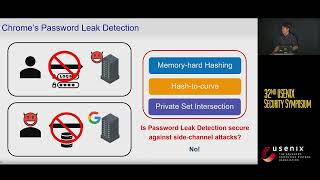
Checking Passwords on Leaky Computers - A Side Channel Analysis of Chrome's Password Leak Detect Protocol
Explore side-channel vulnerabilities in Chrome's password leak detection, revealing potential risks to user privacy and security through microarchitectural attacks on cryptographic implementations.

VulChecker - Graph-based Vulnerability Localization in Source Code
Explore VulChecker, a tool for precise vulnerability detection in source code using graph-based neural networks. Learn about its innovative approach to locating and classifying security flaws.

DScope - A Cloud-Native Internet Telescope
Explore DScope, a scalable cloud-based Internet telescope for monitoring malicious behavior. Learn about its design, implementation, and advantages over traditional methods in capturing cloud-targeting traffic.

CSHER - A System for Compact Storage with HE-Retrieval
Innovative system for compact storage using homomorphic encryption, addressing high storage overhead while maintaining data confidentiality. Demonstrates practical performance in multi-cloud environments.
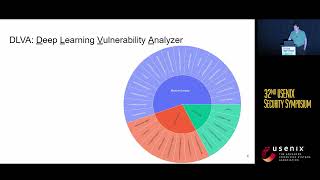
Smart Learning to Find Dumb Contracts
Deep learning tool for detecting vulnerabilities in Ethereum smart contracts, offering faster analysis and high accuracy without manual feature engineering or expert rules.

Snapping Snap Sync - Practical Attacks on Go Ethereum Synchronising Nodes
Practical attacks on Go Ethereum synchronization revealed, allowing adversaries to manipulate blockchain consensus and potentially profit through off-chain trading and code execution on Ethereum forks.

HashTag - Hash-based Integrity Protection for Tagged Architectures
Innovative hash-based error detection and correction technique for DRAM, enabling efficient implementation of tagged memory architectures while maintaining strong data integrity protection.
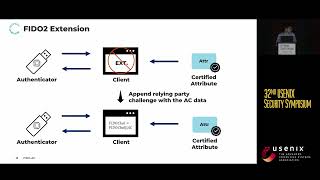
Fast Identity Online with Anonymous Credentials - FIDO-AC
Explores combining FIDO2 authentication with anonymous credentials, enhancing privacy and security in online identity verification while maintaining user control over attribute disclosure.

Combating Robocalls with Phone Virtual Assistant Mediated Interaction
Innovative approach using NLP-based virtual assistant to combat robocalls by vetting incoming calls, preserving user experience while effectively blocking spoofed and automated calls.

Squint Hard Enough - Attacking Perceptual Hashing with Adversarial Machine Learning
Explores vulnerabilities in perceptual hash matching systems used for detecting illicit content, demonstrating potential for targeted attacks and detection avoidance in online communications.

Calpric - Inclusive and Fine-grain Labeling of Privacy Policies with Crowdsourcing and Active Learning
Innovative approach combining crowdsourcing and active learning for efficient, cost-effective labeling of privacy policies, resulting in more accurate and comprehensive deep learning models with balanced datasets.