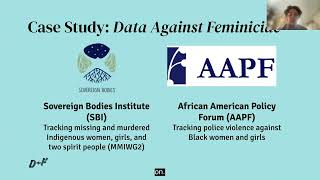
Towards Intersectional Feminist and Participatory ML - A Case Study in Supporting Feminicide Counterdata Collection
Explore intersectional feminist approaches to machine learning through a case study on feminicide data collection, addressing biases and promoting participatory methods.

Subverting Fair Image Search with Generative Adversarial Perturbations
Explore techniques to manipulate fair image search algorithms using adversarial perturbations, examining methods, experiments, and implications for algorithmic fairness.
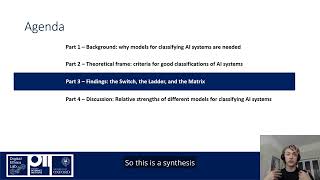
Models for Classifying AI Systems - The Switch, the Ladder, and the Matrix
Explore three models for classifying AI systems: the Switch, the Ladder, and the Matrix. Gain insights into AI governance and evaluation criteria for effective classification frameworks.

The Algorithmic Leviathan - Arbitrariness, Unfairness, and Opportunity in Algorithmic Decision Making
Explore the ethical implications of algorithmic decision-making systems, focusing on arbitrariness, unfairness, and potential solutions in automated processes across various domains.

Chasing Your Long Tails - Differentially Private Prediction in Health Care Settings
Explore differential privacy in healthcare ML, addressing unique challenges, extreme tradeoffs, and fairness considerations for underrepresented groups in medical datasets.

One Label, One Billion Faces - Usage and Consistency of Racial Categories in Computer Vision
Explores racial categorization in computer vision, examining usage, consistency, and implications for fairness in AI systems. Highlights challenges and potential biases in facial recognition technology.

Impossible Explanations? Beyond Explainable AI in the GDPR from a COVID-19 Use Case Scenario
Exploring AI explainability challenges in GDPR compliance using COVID-19 scenarios, emphasizing justifiability over technical explanations in legal and ethical contexts.
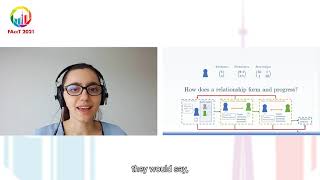
An Agent-Based Model to Evaluate Interventions on Online Dating Platforms to Decrease Racial Homogamy
Explore an agent-based model evaluating interventions on dating platforms to reduce racial homogamy, examining societal impacts and potential solutions.

Avoiding Disparity Amplification under Different Worldviews
Explore strategies to prevent amplification of disparities in machine learning systems while considering diverse worldviews, with a focus on fairness and utility in decision-making processes.

Agreement Testing Theorems on Layered Set Systems
Explore agreement testing theorems on layered set systems, their applications in CSPs, and recent advancements in this field of theoretical computer science.

Sublinear Algorithms for Gap Edit Distance
Explore sublinear algorithms for efficiently computing gap edit distance, including dynamic programming, approximation techniques, and key theoretical results.

Derandomization from Algebraic Hardness - Treading the Borders
Explore derandomization techniques in algebraic complexity, focusing on hitting set construction and generator design for improved bootstrapping in computational theory.
Efficient Construction of Rigid Matrices Using an NP Oracle
Explore matrix rigidity, its applications in communication complexity and circuit lower bounds, and innovative algorithmic approaches for constructing rigid matrices.

Hardness of Coding Problems
Explore SETH hardness in coding problems, focusing on linear codes, nearest codeword problem, and minimum distance problem. Learn about reductions and key concepts in computational complexity.
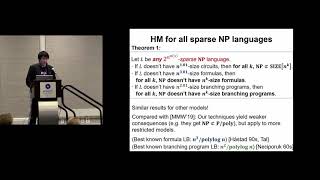
Hardness Magnification for All Sparse NP Languages
Explore hardness magnification in computational complexity, focusing on sparse NP languages and the Minimum Circuit Size Problem, with insights on algorithms and open challenges.
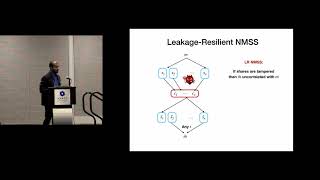
Leakage Resilient Secret Sharing Against Colluding Parties
Explore leakage-resilient secret sharing techniques against colluding parties, discussing bounded collusion protocols, communication complexity, and non-malleable secret sharing.

Non-Malleable Commitments Using Goldreich-Levin List Decoding
Explore non-malleable commitments using Goldreich-Levin list decoding. Learn about semantic security, commitment schemes, and applications in cryptography.
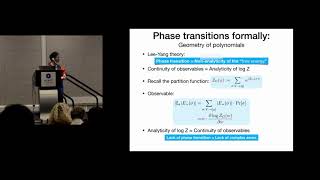
A Deterministic Algorithm for Counting Colorings with 2Δ Colors
Explore a deterministic algorithm for counting colorings, delving into phase transitions, partition functions, and entropy conditions in graph theory.
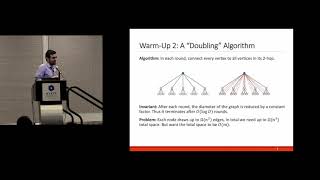
Near Optimal Massively Parallel Graph Connectivity
Explore efficient parallel algorithms for graph connectivity, focusing on near-optimal solutions and innovative techniques for large-scale graph processing.
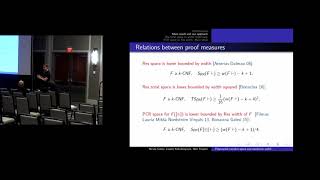
Polynomial Calculus Space and Resolution Width
Explore proof complexity, resolution systems, and space complexity in polynomial calculus, featuring combinatorial characterizations and discussions on total spaces and tight bounds.
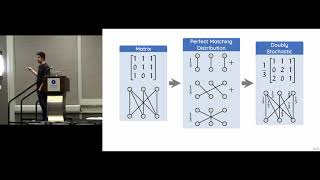
A Tight Analysis of Bethe Approximation for Permanent
Explore the Bethe approximation for permanent, analyzing its accuracy and limitations through various approximation factors and distributions on perfect matchings and trees.