Responsible AI in Industry - Lessons Learned in Practice
Explore practical lessons on implementing responsible AI in industry, covering explainability, fairness, and challenges faced by major tech companies.
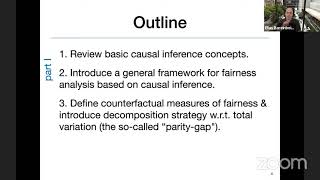
Translation Tutorial - Causal Fairness Analysis
Explore causal fairness analysis in AI, covering structural causal models, causal diagrams, and demographic disparities. Learn why causality matters and how to address fairness challenges in artificial intelligence.

Implications Tutorial - AI on the Ground Approach
Explore the real-world impact of AI through case studies, examining challenges, harms, and social implications. Learn strategies for studying AI's effects on communities and society.

Algorithms, Accountability and Journalism
Explore algorithmic accountability in journalism with Julia Angwin. Discover The Markup's innovative approaches to privacy, data analysis, and investigative reporting on tech companies and societal impacts.

Image Representations Learned With Unsupervised Pre-Training Contain Human-like Biases
Explore how unsupervised pre-training in image representations can lead to human-like biases, examining methods, results, and implications for AI fairness and ethics.

On the Dangers of Stochastic Parrots - Can Language Models Be Too Big?
Explore the risks and ethical concerns of large language models, including data management, research implications, and potential mitigation strategies for AI development.

You Can't Sit With Us - Exclusionary Pedagogy in AI Ethics Education
Explores exclusionary practices in AI ethics education, highlighting methodological dogmatism, lack of co-creation, and siloed citations. Proposes ideas for more collaborative and inclusive pedagogical approaches.

Fairness Through Robustness - Investigating Robustness Disparity in Deep Learning
Explore robustness disparity in deep learning, its impact on fairness, and potential mitigation strategies for more equitable AI systems.

Measurement and Fairness
Explore the intersection of measurement and fairness in computing, examining reliability, validity, and group fairness concepts to enhance ethical decision-making in technology.

Removing Spurious Features Can Hurt Accuracy and Affect Groups Disproportionately
Explore the impact of removing spurious features on model accuracy and group fairness in machine learning, examining potential unintended consequences and ethical implications.

What Does Fairness Mean in Data Protection Law
Explore legal concepts of fairness in data protection, examining justice, equality, and AI ethics through practical scenarios and GDPR implications.
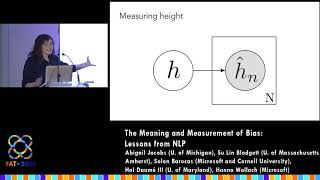
The Meaning and Measurement of Bias - Lessons from NLP
Explore the complexities of bias in NLP, covering measurement processes, construct validity, and fairness evaluation. Gain insights into representational harms and practical examples in word embeddings.

Can an Algorithmic System Be a 'Friend' to a Police Officer's Discretion?
Explore the intersection of algorithmic systems and police discretion, examining challenges, legal frameworks, and real-world applications in domestic abuse risk assessment and decision-making.
Positionality-Aware Machine Learning
Explore positionality in machine learning, examining its impact on data, models, and outcomes through case studies and diverse perspectives.
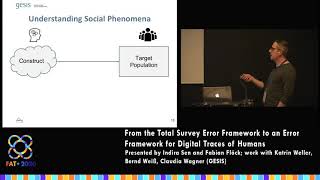
From the Total Survey Error Framework to an Error Framework for Digital Traces of Humans
Explore error frameworks for digital human traces, bridging survey methodologies with computational approaches to enhance data quality and interpretation in social research.

Learning Algorithms
Exploration of fairness in machine learning algorithms, focusing on disparity assessment, classification with fairness constraints, and comparative studies of fairness-enhancing interventions.

Fairness, Rankings, and Behavioral Biases
Exploring fairness in ranking systems, behavioral biases, and interventions to improve diversity and equity in selection processes through mathematical modeling and analysis.

The Cost of Fairness in Binary Classification
Explore the cost of fairness in binary classification, analyzing risk, optimal classifiers, and fairness frontiers with implications for stereotypes and decision-making.
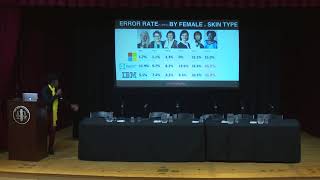
Gender Shades - Intersectional Accuracy Disparities in Commercial Gender Classification
Explore intersectional accuracy disparities in commercial gender classification systems, examining biases and implications for AI fairness and ethics in facial recognition technology.

Interpretable Active Learning
Explore interpretable active learning techniques for machine learning models, focusing on transparency and understanding of model decisions in real-world applications.

Interventions over Predictions - Reframing the Ethical Debate for Actuarial Risk Assessment
Reframing ethical debates on actuarial risk assessment, focusing on interventions over predictions. Explores historical context, machine learning implications, and causal inference in risk evaluation.