Replacing Probability Distributions in Security Games via Hellinger Distance
Explore statistical distance in security games, focusing on Hellinger distance as an alternative to max-log for bit security frameworks and leftover hash lemma applications.
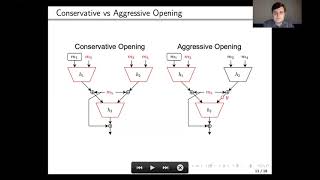
Hashing Five Inputs with Three Compression Calls
Innovative hashing technique using three compression calls for five inputs, offering improved efficiency and security for Merkle-Damgård hashing and Merkle trees with potential applications in cryptography.
2021 ITC Conference - Code Offset in the Exponent
Explore novel fuzzy extractor construction using error-correcting codes and cryptographic groups, supporting MIPURS distributions for enhanced biometric authentication security.

ITC Conference - Line Point Zero Knowledge and Its Applications
Explore line-point zero knowledge proofs, their efficiency in arithmetic circuit satisfiability, and applications in non-interactive secure computation and vector oblivious linear evaluation.
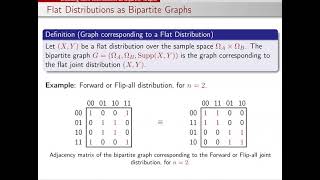
ITC Conference: P4-Free Partition and Cover Numbers & Applications
Explore P4-free partition and cover numbers in graph theory, their applications in cryptography, and connections to communication complexity and randomness extraction.

2021 ITC Conference - Doubly-Affine Extractors, and Their Applications
Explores doubly-affine extractors for efficient information-theoretic encryption, proposing solutions with large keys and a novel architecture for outsourcing key storage to semi-trusted servers.
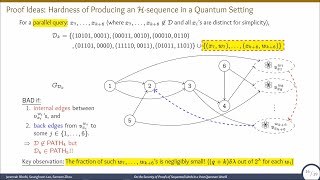
On the Security of Proofs of Sequential Work in a Post-Quantum World
Explores security of Proofs of Sequential Work in post-quantum settings, analyzing constructions, research questions, and formal proofs for cryptographic applications.

On Prover-Efficient Public-Coin Emulation of Interactive Proofs
Explore the relationship between private-coin and public-coin interactive proofs, focusing on efficiency-preserving transformations and their implications for cryptographic assumptions and protocol design.
Quantum-Access Security of the Winternitz One-Time Signature Scheme
Explore quantum-access security of Winternitz one-time signatures, analyzing hash chains in the quantum random oracle model and discussing blind-unforgeability for enhanced post-quantum cryptographic security.
2021 ITC Conference - Generic-Group Identity-Based Encryption - A Tight Impossibility Result
Explores impossibility results for generic-group identity-based encryption, presenting a tight threshold and discussing implications for algebraic constructions in cryptography.

On the Randomness Complexity of Interactive Proofs and Statistical Zero-Knowledge Proofs
Explore randomness complexity in interactive and statistical zero-knowledge proofs, focusing on reducing verifier's random bits and achieving tradeoffs in SZK protocols.

The Quantum Internet - Recent Advances and Challenges
Explore recent advances and challenges in quantum internet technology, including architecture, resource allocation, and performance evaluation of quantum switches, with insights on future research directions.

Algorithmic Motion Planning Meets Min-Invasive Robotic Surgery
Explores algorithmic motion planning for minimally-invasive surgical robots, focusing on efficient planning methods with provable guarantees to enhance safety and effectiveness in medical procedures.

How Will Quantum Computing Change the Technology Landscape? - Bruce Davie, Systems Approach, LLC
Explore quantum computing's potential impact on technology, from achieving quantum supremacy to revolutionizing cryptography, optimization, and machine learning, while addressing challenges and separating hype from reality.

Building Low-power Software for Nano-satellites
Explore challenges and solutions in developing software for nanosatellites, including disconnected operations, energy management, and communication issues in space environments.
Acoustic Perception in IoT - Opportunities and Perils
Explore acoustic sensing in IoT: opportunities for human-centric applications and efficient perception, alongside potential security and privacy risks. Insights into situational awareness for aerial robots and acoustic leakages in sensor-rich environment…

Searching for Information in the Ocean - Adaptive Sampling of Dynamic Processes in Coastal Areas and Fjords Using Autonomous Underwater Vehicles
Exploring adaptive sampling techniques using autonomous underwater vehicles for studying dynamic coastal ocean processes, focusing on phytoplankton biomass and its impact on biogeochemical processes.
2019 ADSI Summer Workshop- Algorithmic Foundations of Learning and Control
Explore uncertainty in perception for control systems, covering model-free algorithms, pixel-based control, and machine learning applications in robotics and autonomous systems.
2019 ADSI Summer Workshop- Algorithmic Foundations of Learning and Control
Explore advanced techniques in reinforcement learning, focusing on randomized value functions and their applications in exploration strategies for complex decision-making problems.
ADSI Summer Workshop: Algorithmic Foundations of Learning and Control - Emma Brunskill
Explore batch/counterfactual reinforcement learning techniques to optimize decision-making with minimal data, focusing on policy evaluation, generalization bounds, and applications in healthcare simulations.
ADSI Summer Workshop- Algorithmic Foundations of Learning and Control
Explore model-based control for physical systems, covering inverse dynamics, optimization techniques, and automated discovery methods for advanced robotics and control applications.