Introduction to Q-Learning for Game Play - Lecture 12.2
Explore Q-Learning for game AI: build policy tables, suggest optimal actions, and apply Python techniques for environment-based decision-making in this introduction.
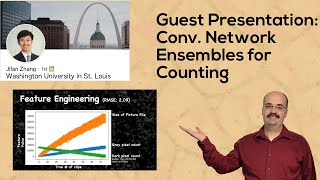
Cloud-Based Convolution Neural Network Ensembles for Computer Vision Counting
Explore ensemble CNN techniques for computer vision counting, featuring cloud computing evaluation and strategies for achieving low RMSE scores in competitive settings.

Using FFMPEG to Encode-Decode Video for Offline Video-Based Machine Learning
Learn to use FFMPEG for video encoding/decoding in machine learning, enabling frame-by-frame processing and video generation from individual images.
Exploring Style GAN2 Latent Vector - Controlling Facial Properties
Dive into StyleGAN2's latent vectors to control facial features in generated images, including a technique for adding glasses to faces.
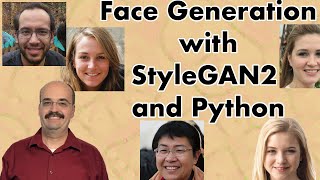
Face Generation with NVIDIA StyleGAN2 and Python 3
Generate realistic faces using nVidia StyleGAN2 and Python. Learn to utilize pretrained weights, TensorFlow wrapper, and Google CoLab GPU for efficient face generation without extensive training.

TensorFlow 2.0 GPU, Keras, and Python 3.7 Installation Guide for Windows 10 - 2020 Update
Comprehensive guide for setting up TensorFlow 2.0 with GPU support on Windows 10, covering installation of necessary drivers, CUDA, cuDNN, and Anaconda environment configuration.
Generating Faces with a Generative Adversarial Networks - GAN in Keras-Tensorflow 2.0
Learn to implement a Generative Adversarial Network (GAN) from scratch using TensorFlow and Keras to generate realistic human faces, with step-by-step guidance and practical code examples.
Multi-Variate Feature Engineering Presentation for Machine Learning
Learn advanced feature engineering techniques for machine learning, including feature importance, target coding, neural networks, and embedding layers to improve model performance and extrapolation.
Keras Convolutional Neural Networks for MNIST and Fashion MNIST
Explore convolutional neural networks for image processing, focusing on MNIST and Fashion MNIST datasets. Learn about CNN architecture, training, and evaluation for advanced deep learning applications.
Statistical Learning Theory and Applications - Class 16
Explore statistical learning theory, focusing on complexity, dual norm equality, and calligraphic G. Gain insights into advanced concepts and their applications in machine learning.
Statistical Learning Theory and Applications - Class 6
Explore statistical learning theory with focus on Newton's method, recursive computation, and online methods for efficient problem-solving and data analysis.
Statistical Learning Theory and Applications - Class 7
Explore statistical learning theory, covering least squares, gradient descent, regularization, and induction, with insights into historical context and practical applications.

The Deep Learning Revolution
Explore the evolution of deep learning, from its origins to modern applications, covering key milestones, breakthroughs, and future prospects in AI and neuroscience.
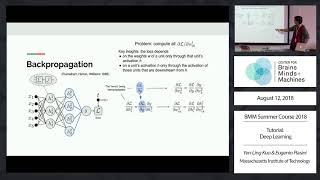
Deep Learning Tutorial
Explore deep learning fundamentals, from supervised learning to convolutional networks, with practical examples and historical context. Gain insights into advanced concepts and applications.
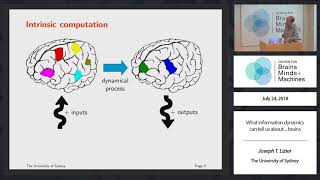
What Information Dynamics Can Tell Us About Brains
Explore information dynamics in complex systems, focusing on intrinsic computation, information transfer, and applications in neuroscience and network analysis.
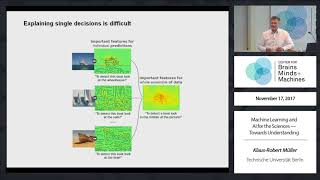
Machine Learning and AI for the Sciences - Towards Understanding
Explore ML and AI applications in sciences, focusing on neuroscience, medicine, and physics. Learn about extracting insights from ML models to enhance understanding in fields like quantum chemistry.
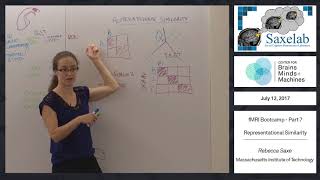
FMRI Bootcamp - Representational Similarity
Explore advanced fMRI analysis techniques, focusing on representational similarity and its applications in neuroimaging research.
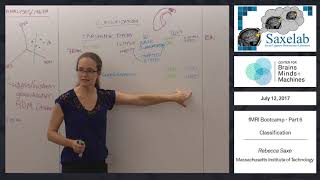
FMRI Bootcamp - Classification
Explore fMRI classification analysis techniques, including training vs testing, generalization, and hierarchical logic, with insights on visual stream processing.
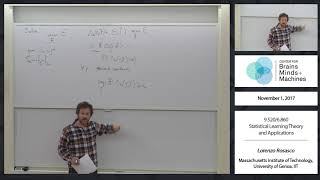
Generalization Error and Stability
Explore statistical learning theory, focusing on generalization error, stability, and empirical risk minimization. Gain insights into universal consistency and the law of large numbers.
Exploring Creative CSS Hover Effects for Inline Links
Learn innovative CSS techniques to create eye-catching hover effects for inline links, moving beyond standard designs to enhance user experience and visual appeal on your web pages.
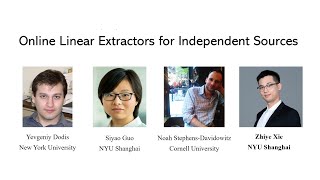
2021 ITC Conference- Online Linear Extractors for Independent Sources
Explore online linear extractors for independent sources, focusing on key components of Windows 10's RNG design and examining the effectiveness of rotation as an extractor and condenser.