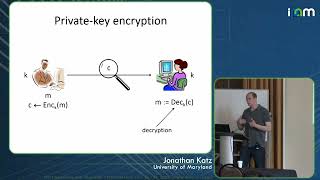
Jonathan Katz - Introduction to Cryptography Part 1 of 3 - IPAM at UCLA
Comprehensive introduction to modern cryptography, covering provable security, perfect secrecy, computational security, pseudorandom generators, and proof-by-reduction techniques for graduate-level students.
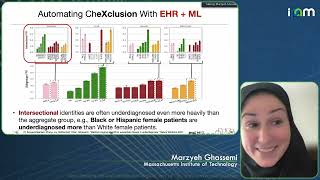
Designing Machine Learning Processes for Equitable Health Care Systems
Explore machine learning processes for creating fair and inclusive healthcare systems, focusing on addressing sex and gender biases in medical data and AI applications.
Economic Fairness - IPAM at UCLA
Explore economic fairness concepts with Sendhil Mullainathan in this UCLA summer school lecture, covering key principles and their applications in algorithmic decision-making.
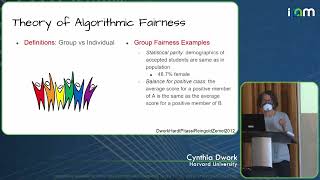
Cynthia Dwork - Group Fairness and Individual Fairness - IPAM at UCLA
Explore group and individual fairness in algorithmic decision-making, examining their definitions, advantages, and limitations in the context of ethical AI and machine learning applications.
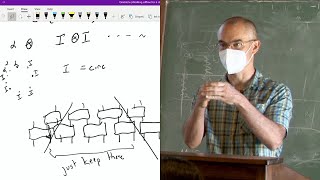
Introduction to Quantum Cellular Automata
Explore quantum cellular automata: fundamental concepts, applications, and connections to topological phases of matter in this comprehensive lecture by Microsoft Research expert.
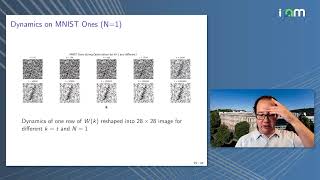
Learning Deep Matrix Factorizations Via Gradient Descent - Implicit Bias Towards Low Rank
Explores implicit bias in gradient descent algorithms for deep matrix factorizations, analyzing convergence to low-rank matrices and discussing implications for tensor decompositions.
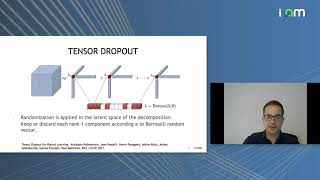
Efficient Tensor Representation for Deep Learning with TensorLy and PyTorch
Explore tensor methods for deep learning, improving performance, speed, and robustness. Learn practical implementation using TensorLy-Torch for video and image classification tasks.
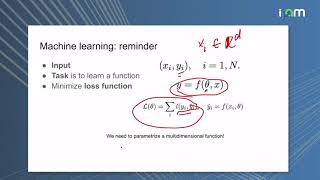
Tensor-Train Decomposition and Its Applications in Machine Learning
Explore tensor-train decomposition and its applications in machine learning, including neural network compression, high-dimensional distribution approximation, and deep neural network analysis.
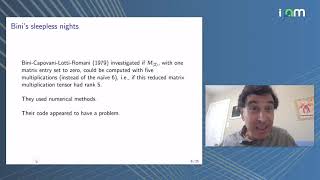
Introduction to the Geometry of Tensors
Explore tensor geometry and its applications in physical and data sciences through a gentle introduction, emphasizing how geometric perspectives advance practical implementations.
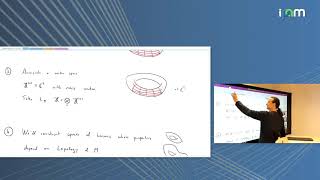
Stabilizer Formalism & Quantum Error Correction Through the Lens of Tensors - Part 1
Explore stabilizer formalism and quantum error correction using tensor methods. Learn about many-body systems, error correction challenges, and connections to finite symplectic geometries.
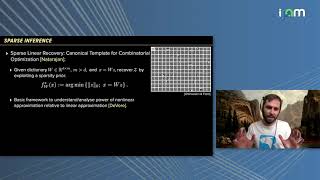
On Sparse Linear Programming and Simple Neural Networks
Explores connections between sparse linear programming and neural networks, focusing on overparametrized learning and sparse inference from computational perspectives.
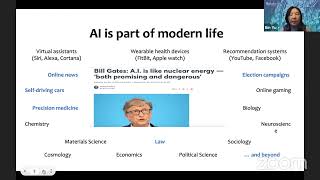
Interpreting Deep Neural Networks Towards Trustworthiness
Explores methods for interpreting complex neural networks, introducing ACD and AWD techniques. Advocates for a quality-controlled data science lifecycle to ensure trustworthy model interpretation.
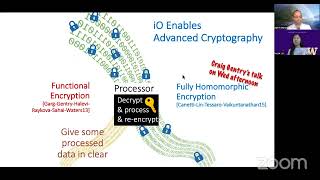
The Mathematics of Hiding Secrets in Software
Explore indistinguishability obfuscation, a powerful cryptographic tool for transforming programs into incomprehensible yet functionally equivalent versions, and its applications in securing software.
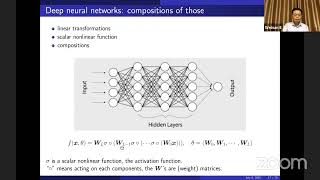
A Mathematical Perspective on Machine Learning
Explore deep learning's impact on AI and science, its theoretical foundations, and its potential for solving high-dimensional problems in scientific computing and beyond.
Flux - A Next Generation Resource Manager for HPC and Beyond - IPAM at UCLA
Explore Flux, a next-gen resource manager for HPC, offering advanced scheduling, standardized interfaces, and nested instance capabilities for improved scientific workflows.
ExaFEL - Achieving Real-Time XFEL Data Analysis Using Exascale Hardware
Explore real-time data analysis for X-ray Free Electron Laser experiments using high-performance computing, focusing on challenges, workflow design, and performance insights for future scientific applications.
Scaling NumPy Applications from 1 CPU to Thousands of GPUs - IPAM at UCLA
Discover cuNumeric: a NumPy replacement enabling Python applications to scale across multiple nodes and leverage GPU acceleration for enhanced performance and dataset handling.
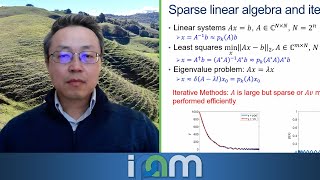
Practical Quantum Circuits for Block Encodings of Sparse Matrices
Explore efficient quantum circuits for block encodings of sparse matrices, focusing on strategies for well-structured matrices and quantum walks on graphs. Gain insights into quantum linear algebra algorithms.
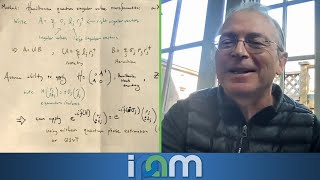
Seth Lloyd - Quantum Polar Decomposition - IPAM at UCLA
Explore quantum polar decomposition algorithm, its applications in unitary operations, Hermitian matrix measurements, and potential uses in quantum numerical linear algebra.
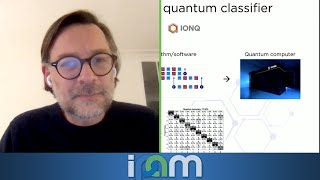
New Results in Quantum Linear Algebra - IPAM at UCLA
Explore cutting-edge advancements in quantum linear algebra, including optimized circuit constructions and their applications in numerical computations and algorithms.
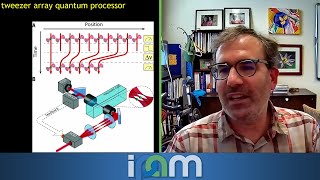
Approaches to Quantum Information Processing With Cold Atoms
Explore quantum simulation and computation approaches using cold atoms for understanding nature and advancing computational capabilities.