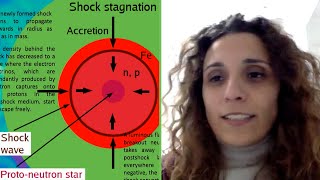
Deep Learning Algorithm for Core-Collapse Supernova Detection
Explore deep learning algorithms for detecting gravitational waves from core-collapse supernovae, enhancing multi-messenger astronomy and uncovering insights into extreme cosmic events.
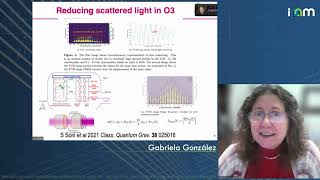
Non-Astrophysical Transients in LIGO Detectors: Help With Machine Learning
Explore machine learning techniques for diagnosing non-astrophysical transients in LIGO detectors, enhancing gravitational wave detection and analysis in multi-messenger astrophysics.
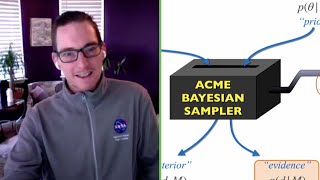
Building Flexible, but Not Too Flexible, Models of Gravitational Wave Data
Explore gravitational wave data analysis techniques, focusing on flexible modeling approaches to reduce biases in LIGO-Virgo observations while preventing overfitting.
David Silver: Simulation-Based Search
Explore simulation-based search algorithms with DeepMind's David Silver, covering Monte Carlo tree search and its applications in AI and game-playing systems.

Non Asymptotic Analysis of L1 Support Vector Machines
Explores non-asymptotic analysis of l1 support vector machines for sparse classification in high-dimensional data, providing error guarantees applicable to real-world scenarios.
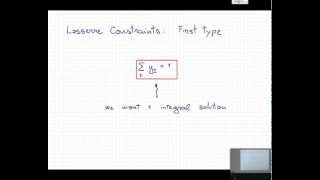
On Some Easy Problems That Are Hard for the Lasserre Hierarchy
Overview of lower bound results for the Lasserre hierarchy, including characterization of hardest problems, integrality gap for scheduling, and analysis of symmetric formulations using polynomial inequalities.
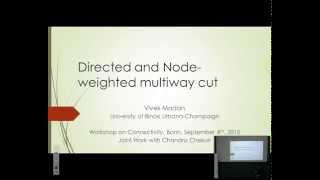
Simple and Fast Rounding Algorithms for Directed and Node Weighted Multiway Cut
Explore efficient algorithms for directed and node-weighted multiway cut problems, focusing on simple rounding techniques and integrality gap analysis in graph theory and combinatorial optimization.
Geometry of Secure Computation
Explore the geometric framework for secure computation, focusing on round and communication complexity for randomized-output functions. Learn about innovative approaches to long-standing cryptography challenges.
Collision-Resistance from Multi-Collision-Resistance
Exploring the transformation of multi-collision-resistant hash functions into collision-resistant hash functions, with insights on Reed-Solomon codes and cryptographic primitives.
New Ways to Garble Arithmetic Circuits
Explores innovative techniques for garbling arithmetic circuits, improving efficiency, modularity, and functionality. Presents constant-rate schemes for large integers and modular computation, with enhanced capabilities for mixed arithmetic-Boolean opera…
Unclonable Polymers and Their Cryptographic Applications
Explore unclonable polymers and their innovative applications in cryptography, focusing on minimal complexity assumptions for enhanced security measures.
Advisor-Verifier-Prover Games and the Hardness of Information Theoretic Cryptography
Explore proof systems and their implications for information-theoretic cryptography, examining the impossibility of efficient solutions for key tasks in the field.
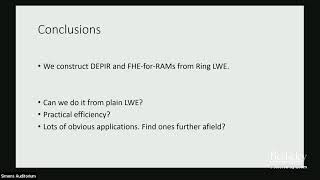
Doubly Efficient Private Information Retrieval and Fully Homomorphic RAM Computation from Ring LWE
Explores innovative cryptographic solutions for private internet searches, combining efficient data structures with Ring LWE-based encryption to enable secure, scalable information retrieval.
LaMini-LM - Mini Models Maxi Data
Explore LaMini-LM: mini language models trained on diverse, large-scale instruction data. Learn about dataset creation, model training, and practical applications through paper analysis and code demonstrations.
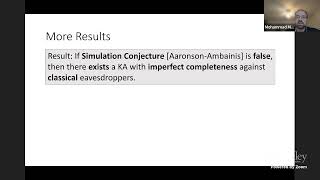
Black-Box Separations in Quantum Cryptography
Explores black-box separations in quantum cryptography, discussing efforts to extend classical results, related problems, and barriers for unconditional separations in the quantum setting.
Quantum Pseudorandomness in Algorithmica, and Its Implications to Cryptography and Complexity
Explore quantum pseudorandomness, its separation from one-way functions, and implications for cryptography and complexity theory. Discover potential for quantum cryptography without relying on traditional assumptions.
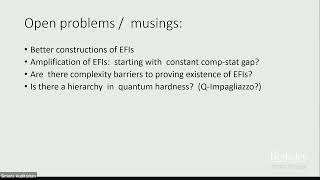
On the Computational Hardness Needed for Quantum Cryptography
Explores EFI pairs as essential for quantum cryptography, comparing their role to one-way functions in classical cryptography and demonstrating their necessity for various applications.
Commitments to Quantum States
Exploring quantum state commitments, their definition as erasure of sender's message, and applications in cryptography, including succinct arguments for NP and potentially QMA.
Quantum Minimalism
Exploring minimal quantum cryptographic assumptions beyond one-way functions, examining their significance and potential implications for future quantum-secure cryptographic systems.
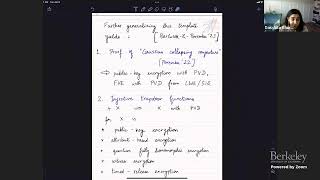
Cryptography with Certified Deletion
Explore quantum cryptography's certified deletion, enabling verifiable information-theoretic deletion of encrypted secrets, with applications in various cryptosystems and recent advancements in public verification.
Black-Hole Radiation Decoding as a Cryptographic Assumption
Explore the intriguing connection between black-hole radiation decoding and quantum cryptography, revealing how high-energy physics phenomena can imply the existence of secure cryptographic primitives.