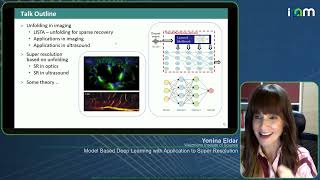
Model Based Deep Learning with Application to Super Resolution - IPAM at UCLA
Explore model-based deep learning for super-resolution microscopy, merging parametric models with optimization tools to create efficient, interpretable networks from limited training data.
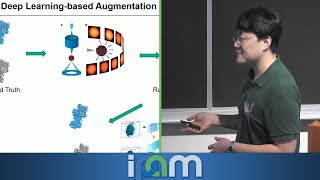
Neural Network-Assisted Atomic Electron Tomography - IPAM at UCLA
Neural network-assisted atomic electron tomography for 3D atomic structure measurement of nanoparticles, enabling precise surface characterization and functional property analysis at single-atom level.
AI Inroads in Imaging Sciences for Materials Research - IPAM at UCLA
Explore deep learning applications in materials research, focusing on convolutional neural networks for transmission electron microscopy and tomographic imaging advancements.
Toward Practical Phase Retrieval with Deep Learning - IPAM at UCLA
Exploring phase retrieval challenges, conventional methods, and deep learning approaches for scientific imaging. Presents novel solutions for practical phase retrieval problems in unprecedented regimes.
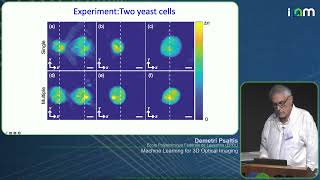
Machine Learning for 3D Optical Imaging - IPAM at UCLA
Explore machine learning techniques for enhancing 3D optical diffraction tomography, including digital phantom-based training and physics-constrained neural networks for improved image reconstruction.
3D Phase Imaging with Scattering Samples - IPAM at UCLA
Innovative microscopy techniques for 3D phase imaging in thick, scattering samples using computational algorithms and neural networks to reconstruct refractive index maps from angle-coded illumination.
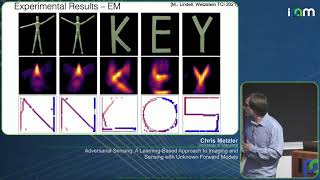
Adversarial Sensing - Learning-Based Approach to Imaging and Sensing with Unknown Models
Explore adversarial sensing for solving inverse problems with stochastic forward models, focusing on applications in atmospheric turbulence imaging and long-range sub-diffraction limited imaging.
On the Use of Machine Learning for Computational Imaging
Exploring machine learning applications in computational imaging, focusing on inverse problems, regularization, and challenges in phase retrieval, 3D structure reconstruction, and surface analysis.
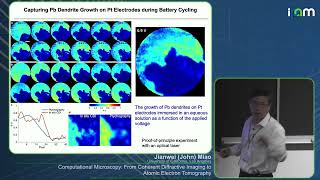
Computational Microscopy: Coherent Diffractive Imaging to Electron Tomography
Explore computational microscopy techniques from coherent diffractive imaging to atomic electron tomography with UCLA expert Jianwei Miao in this insightful presentation on cutting-edge imaging methods.
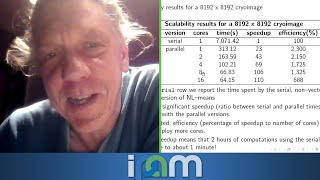
Algorithms for Non-Local Filtering - Application Cryo-Electron and Biological Microscopy
Efficient algorithms for non-local filtering in microscopy, focusing on fast implementations of Non-Local Means Denoising and feature detection in biological images for improved image processing and analysis.
Variational Methods for Computational Microscopy - IPAM at UCLA
Explore variational methods for computational microscopy with Stanley Osher, covering advanced techniques and applications in image processing and analysis.
Machine Learning and Computational Imaging - IPAM at UCLA
Explore AI's role in computational imaging, focusing on deep learning for inverse problems in image recovery and restoration, from denoising to nano-scale imaging.
Weakening Assumptions in Quantum Cryptography IV.a Part 1 of 2 - IPAM at UCLA
Explore quantum information's role in relaxing cryptographic assumptions, focusing on secure multiparty computation and oblivious transfer. Learn about advancements from Crepeau and Kilian to recent developments.
The Quantum Random Oracle Model Part 1 of 2 - IPAM at UCLA
Explore quantum random oracle models and proof techniques in cryptography, covering challenges in quantum settings and advanced methods like oneway-to-hiding theorem and compressed oracles.
Information-Theoretic Quantum Cryptography Part 2 of 2 - IPAM at UCLA
Explore advanced quantum cryptography topics, including secure delegated computation, quantum key distribution, and certified deletion, with a focus on security against unbounded adversaries.
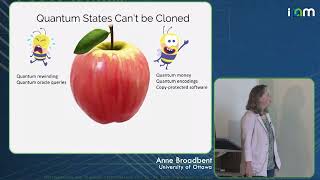
Information-Theoretic Quantum Cryptography Part 1 of 2 - IPAM at UCLA
Explore information-theoretic quantum cryptography, covering topics like quantum money, secure computation, and key distribution. Gain insights into the interplay between quantum information and cryptography.
Post-Quantum Key Exchange from Supersingular Isogenies - IPAM at UCLA
Explore post-quantum cryptography with a focus on Supersingular Isogeny Diffie-Hellman (SIDH) key exchange, aimed at beginners but benefiting from basic elliptic curve knowledge.
Introduction to Quantum Computing - Part 3 - IPAM at UCLA
Explore density matrices, mixed states, and quantum channels in cryptography. Learn about POVM measurement and distance measures for quantum states and operators.
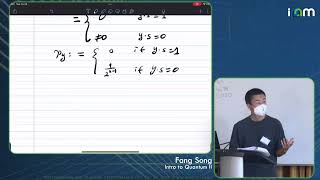
Introduction to Quantum Computing Part 2 of 3 - IPAM at UCLA
Explore quantum algorithms like period finding and Grover's search, including Simon's algorithm, phase estimation, and Shor's factoring algorithm. Examine their impact on cryptography and cryptosystem vulnerabilities.
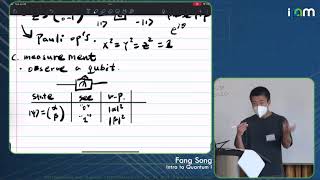
Introduction to Quantum Computing - Part 1 of 3
Explore quantum computing basics: qubits, unitary operations, superposition, entanglement, and no-cloning. Discover quantum circuits, information processing protocols, and elementary algorithms like Deutsch-Josza.
Introduction to Cryptography Part 2 of 3 - IPAM at UCLA
Explore public-key cryptography, including key exchange, encryption, and digital signatures. Delve into the random-oracle model and its applications in constructing cryptosystems.