Phase Transitions in the Complexity of Simulating Random Shallow Quantum Circuits
Explores phase transitions in simulating random shallow quantum circuits, discussing computational complexity, tensor network contraction, and mapping 2D circuits to 1D processes with implications for quantum computing.
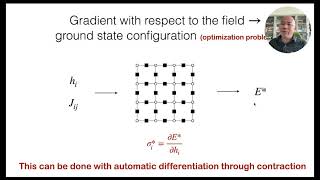
Tropical Tensor Networks
Unified tensor network approach for spin glasses using tropical algebra, enabling ground state energy computation, optimal configuration identification, and solution counting. Combines graphical models and quantum circuit simulation.
David Gross: Stabilizer Formalism & Quantum Error Correction Through the Lens of Tensors
Explore advanced quantum error correction techniques, focusing on the stabilizer formalism and its applications in quantum fault tolerance, using tensor-based approaches and group theory.
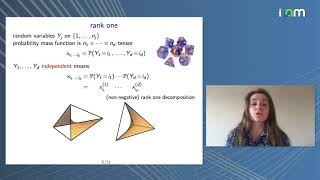
Tensors in Statistics and Data Analysis
Explore tensors in statistics and data analysis, covering probability tensors, biological measurements, and signature tensors for time-series data. Learn about decompositions and algebraic properties in this comprehensive overview.
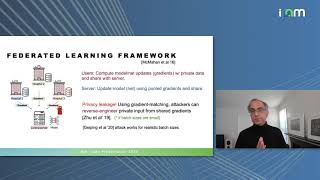
How to Allow Deep Learning on Your Data Without Revealing Your Data
Exploring secure deep learning on private data without revealing it, discussing InstaHide and TextHide methods, their applications in Federated Learning, and addressing potential security concerns.
Task-Driven Network Discovery via Deep Reinforcement Learning on Embedded Spaces
Explore task-driven network discovery using deep reinforcement learning on embedded spaces. Learn about improving network observability and optimizing data collection for accurate analysis.
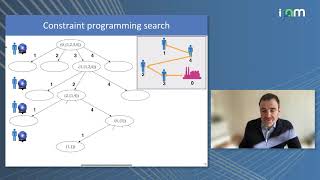
Combining Reinforcement Learning and Constraint Programming for Combinatorial Optimization
Explore a hybrid approach combining reinforcement learning and constraint programming for solving complex combinatorial optimization problems, with applications in various fields.
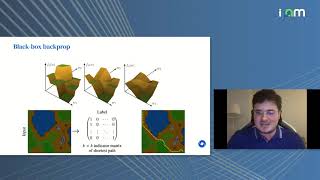
Reasoning on Natural Inputs
Explore neural algorithmic reasoning for natural inputs, bridging classical algorithms with deep learning to solve real-world problems more effectively in reinforcement learning environments.
Can ML Help in Solving Cargo Capacity Management Booking Control Problems
Explore ML applications in cargo capacity management, focusing on booking control problems and predicting solution costs for discrete optimization in revenue management.
The Transformer Network for the Traveling Salesman Problem
Explore how Transformer networks can tackle the Traveling Salesman Problem, improving upon existing heuristics with promising results for combinatorial optimization challenges.
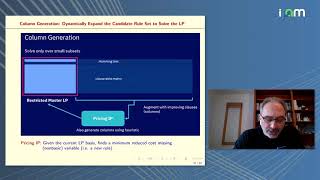
Fair and Interpretable Decision Rules for Binary Classification
Explore fair and interpretable decision rules for binary classification using Boolean rule sets in DNF, with a focus on maximizing accuracy while maintaining group fairness constraints.
Oscillator-to-Oscillator Codes Do Not Have a Threshold
Explores limitations of oscillator-to-oscillator codes in quantum information, proving they lack a threshold property for error correction when using constant squeezing and maximum likelihood decoding.
Machine Learning for Quantum Simulation - IPAM at UCLA
Explore machine learning applications in quantum simulation, focusing on neural networks for phase recognition and insights into complex quantum systems.

Tensor Networks -QC-DMRG- in a Complete Active Space Coupled Cluster Method
Explore tensor networks in quantum mechanics, focusing on their application in coupled cluster methods for modeling strongly correlated systems and computing dynamical correlations.
Embedding Theories for Quantum Simulations on Hybrid Classical-Quantum Architectures
Explore quantum embedding theory for spin-defects in solids, comparing frameworks and discussing applications on classical and quantum computers for electronic structure calculations of qubits.
Machine Learning Basics: A Speedrun - IPAM at UCLA
Speedrun through machine learning fundamentals, covering key concepts like inductive bias, regularization, and kernel methods for both linear and nonlinear regression.
Natasha Jaques - Social Reinforcement Learning - IPAM at UCLA
Explore social reinforcement learning, multi-agent RL, and environment generation for AI assistants. Discover techniques for generalization, transfer, and web navigation in intelligent systems.

Machine Learning and Game Theory for Social Impact
Explore machine learning and game theory applications in security, sustainability, and food rescue, featuring real-world deployments and innovative solutions for societal challenges.
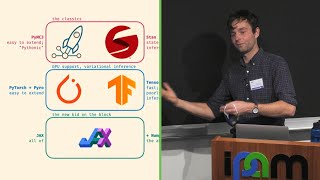
Methods for Scalable Probabilistic Inference - IPAM at UCLA
Explore scalable probabilistic inference methods for astrophysics, focusing on Gaussian Processes for time series analysis and open-source tools to accelerate Bayesian inference with large datasets.
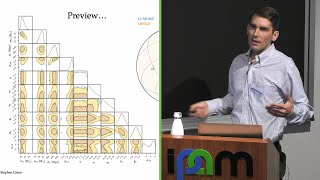
Real-Time Gravitational-Wave Parameter Estimation Using Machine Learning
Explore machine learning for real-time gravitational-wave parameter estimation, covering Bayesian inference, neural networks, and simulation-based techniques to enhance speed and accuracy in astrophysical data analysis.
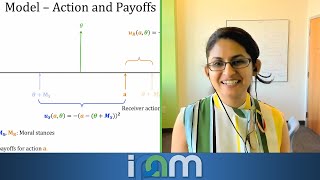
Learning and Persuading with Anecdotes - IPAM at UCLA
Explore learning and communication dynamics using anecdotal evidence, examining strategic behaviors, biases, and implications for opinion formation and collective intelligence.