Collective Intelligence for Deep Learning - A Survey of Recent Developments
Survey of recent developments in collective intelligence for deep learning, exploring self-organization, emergent behavior, and cellular systems to address robustness and adaptability issues in neural networks.
Physical Computation in Insect Swarms - IPAM at UCLA
Explore physical computation in insect swarms, focusing on firefly visual signals and bee pheromone communication. Discover how swarm intelligence emerges from individual interactions.
Multi-Agent Common Sense - IPAM at UCLA
Explore multi-agent common sense through mathematical frameworks combining Bayesian learning and game theory. Discover insights into human collaboration, joint intentions, and cultural knowledge acquisition.
The Brownian Transport Map - IPAM at UCLA
Explore Lipschitz transport maps between probability measures, focusing on the Brownian transport map's construction, properties, and applications to Euclidean functional inequalities.
Training Quantum Neural Networks with an Unbounded Loss Function - IPAM at UCLA
Explore quantum neural networks, unbounded loss functions, and techniques to overcome barren plateaus in quantum machine learning, with applications in thermal state and Hamiltonian learning.
Quantum Approximate Optimization Algorithm and Local Max-Cut - IPAM at UCLA
Explore quantum optimization algorithms, focusing on QAOA's application to LocalMaxCut. Discover insights on quantum supremacy and the performance comparison between local algorithms and QAOA on various graph instances.
Classical and Quantum Algorithms for Isogeny Problems
Explore classical and quantum algorithms for isogeny problems in post-quantum cryptography, focusing on computational challenges, path finding in isogeny graphs, and reductions to other problems in elliptic curve cryptography.
Heisenberg-Limited Ground State Energy Estimation for Early Fault-Tolerant Quantum Computers
Explore Heisenberg-limited ground state energy estimation for early fault-tolerant quantum computers, featuring a simplified circuit and classical post-processing for improved efficiency.
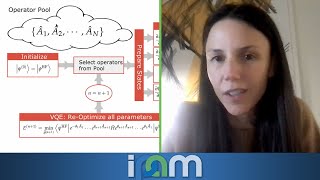
Sophia Economou - Problem-Tailored Variational Quantum Algorithms - IPAM at UCLA
Explore problem-tailored variational quantum algorithms, including symmetry-preserving circuits, ADAPT-VQE, and ctrl-VQE, for improved performance in quantum simulations.
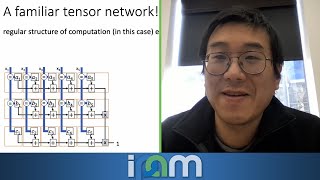
Arithmetic Tensor Networks and Integration - IPAM at UCLA
Explore arithmetic tensor networks and their applications in function integration, with insights on exact and approximate contraction methods and their implications for various mathematical problems.
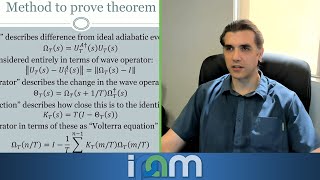
Optimal Scaling Quantum Linear Systems Solver via Discrete Adiabatic Theorem
Explore optimal quantum linear systems solver using discrete adiabatic theorem, achieving linear complexity in condition number and precision, with simplified implementation and constant factor analysis.
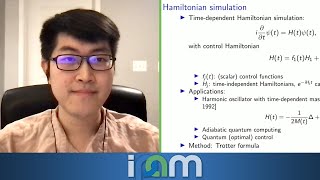
Improved Complexity Estimation for Hamiltonian Simulation with Trotter Formula
Explore improved complexity estimation for Hamiltonian simulation using Trotter formula, focusing on time-dependent effective mass and near adiabatic dynamics scenarios with potential for enhanced efficiency.
Dequantization and Quantum Advantage in Learning from Experiments - IPAM at UCLA
Explore quantum advantage in data processing, learning from experiments, and dequantization. Discover how quantum technology can revolutionize experimental data acquisition and analysis in various scientific tasks.
The Quantum Linear Systems Problem - IPAM at UCLA
Explore quantum algorithms for solving linear systems, including improved methods and complexity analysis, with a focus on potential exponential speedups and verification challenges.
Fast Algorithms for Quantum Signal Processing - IPAM at UCLA
Explore fast algorithms for quantum signal processing, focusing on optimization techniques, energy landscapes, and phase factor structures in quantum singular value transformation.
Quantum Algorithms for Quantum Information Processing Tasks
Explore quantum linear algebra methods for efficient quantum information processing, including block-encoding, singular value transformation, and applications in estimation, testing, and tomography tasks.
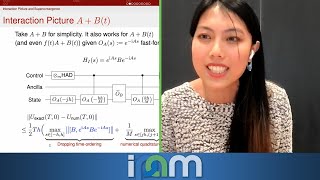
Time-Dependent Hamiltonian Simulation of Highly Oscillatory Dynamics - IPAM at UCLA
Explore highly oscillatory dynamics in quantum systems, focusing on efficient simulation algorithms for time-dependent Hamiltonians with applications in various scientific fields.
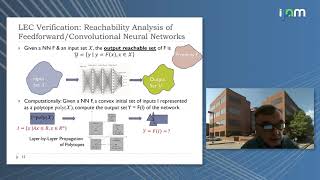
Towards Assurance-Based Learning-Enabled Cyber-Physical Systems
Exploring formal verification, monitoring, and safety case formalization for assurance-based learning-enabled cyber-physical systems, focusing on autonomous vehicles and their complex components.
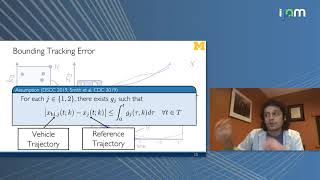
Bridging the Gap Between Safety and Real-Time Performance for Autonomous Vehicle Control
Explores a novel trajectory planning method for autonomous vehicles, balancing safety and real-time performance through offline computations and runtime optimization to ensure persistent feasibility.
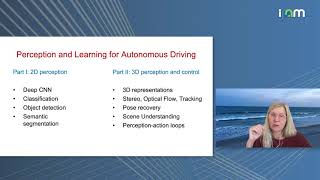
Perception and Learning for Autonomous Driving - Part 1
Explore perception and learning for autonomous driving, covering sensor suites, deep neural networks, and object detection techniques in this comprehensive tutorial.
Generalization Theory in Machine Learning
Explore generalization theory in machine learning, covering traditional methods, deep learning, and statistical learning theory. Gain insights into overcoming the curse of dimensionality and understanding learning bounds.