Fermionic Neural-Network Quantum States - IPAM at UCLA
Explore fermionic neural-network quantum states, their efficient representations, and applications in quantum mechanics with Giuseppe Carleo's insightful presentation at IPAM's workshop.
Contracted Quantum Eigensolver for the Quantum Simulation of Many-Electron Systems
Explore a novel quantum algorithm for many-body systems, comparing it to existing methods and demonstrating its advantages in molecular simulations and quantum computing applications.
Computational Microscopy at IPAM in Fall 2022
Explore cutting-edge computational microscopy techniques in this comprehensive program, featuring workshops on cryoelectron microscopy, deep learning, and electron microscopy advancements.
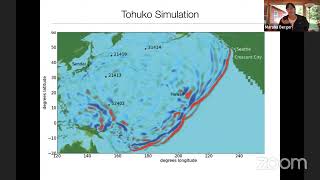
Marsha Berger - Towards Adaptive Simulations of Dispersive Tsunami Propagation
Explore adaptive simulations for tsunami propagation, focusing on shallow water equations, mesh refinement, and Boussinesq models. Learn about computational techniques for predicting tsunami impacts from various sources.
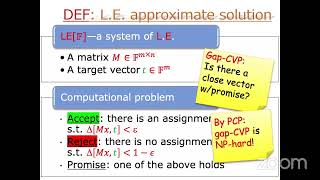
Mathematics of Computation Through the Lens of Linear Equations and Lattices
Explore mathematical foundations of computation through linear equations and lattices, covering error correction, vector problems, and lattice theory with implications for future computing.
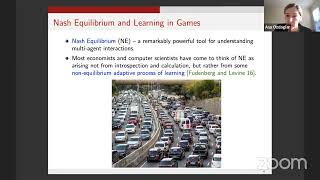
Independent Learning Dynamics for Stochastic Games - Where Game Theory Meets
Explore independent learning dynamics in stochastic games, bridging game theory and reinforcement learning. Discover convergent algorithms for multi-agent scenarios in dynamic environments.
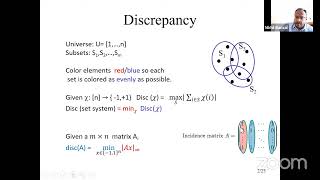
Algorithmic Aspects of Discrepancy Theory
Explore algorithmic aspects of discrepancy theory, including vector balancing, Spencer's Problem, and Banaszczyk's Theorem, with insights on geometric perspectives and partial coloring techniques.
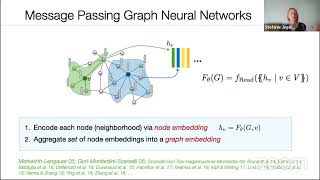
Theory of Graph Neural Networks: Representation and Learning
Explore the theory behind Graph Neural Networks, covering approximation, learning properties, and connections to graph isomorphism, equivariant functions, and dynamic programming.
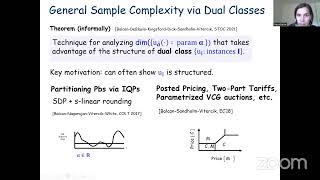
Learning Theoretic Foundations of Data-Driven Algorithm Design
Explore machine learning techniques for data-driven algorithm design, focusing on combinatorial problems and online optimization. Learn to adapt algorithms to specific domains for improved performance.
AI in the Exam Room - Ethical Concerns of DNA Collection and Usage
Explore the ethical implications of AI and biometric data in healthcare and beyond. Discover who has access to your genetic information and why it matters for privacy and security.
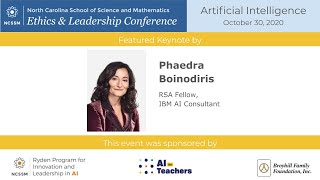
Ethics and Leadership in AI: Addressing Bias and Shaping the Future - 2020 NCSSM Conference Keynote
Explore AI ethics, bias, and societal impact with tech leader Phaedra Boinodiris. Gain insights on data privacy, future skills, and the role of education in shaping ethical AI development and implementation.

Quantum Simulation - IPAM at UCLA
Explore quantum simulation's origins, relevance, and key concepts with Nathan Wiebe. Delve into Schrödinger equations, Hamiltonian simulation, and Taylor's theorem in this comprehensive lecture.
Introduction to Quantum Algorithms - IPAM at UCLA
Explore quantum algorithms, focusing on Grover's algorithm, with mathematical foundations, quantum circuits, and practical applications in this comprehensive introduction.
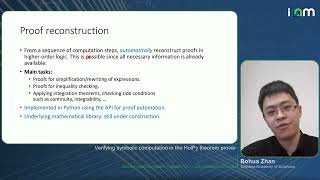
Verifying Symbolic Computation in the HolPy Theorem Prover - IPAM at UCLA
Explore HolPy, a new proof assistant for verifying symbolic computation using a user-friendly interface similar to computer algebra systems, with examples and future directions.
Deep Learning in Interactive Theorem Proving - IPAM at UCLA
Explore deep learning's impact on interactive theorem proving, challenges in formal mathematics, and future possibilities in machine-assisted proofs.
Autoformalization with Large Language Models - IPAM at UCLA
Explore autoformalization using large language models for translating natural language math to formal proofs, advancing formal verification and AI in mathematics.
Finding Counterexamples to Conjectures via Reinforcement Learning - IPAM at UCLA
Explore reinforcement learning techniques to find counterexamples in graph theory and combinatorics, resolving open problems and improving existing solutions.
End-to-End Learning and Auto-Differentiation - Forces, Uncertainties, Etc.
Explore deep learning and auto-differentiation in molecular simulations, covering surrogate functions, sampling distributions, and time-propagation of differential equations for scientific problem-solving.
Advancing Molecular Simulation with Deep Learning - IPAM at UCLA
Explore cutting-edge applications of deep learning in molecular simulation, covering quantum chemistry, force fields, and Markov State Models for advanced scientific research.
Interpretable Machine Learning via Program Synthesis - IPAM at UCLA
Explore interpretable machine learning through program synthesis, focusing on control policies and RNA splice prediction. Learn novel approaches for creating custom, problem-specific model families.
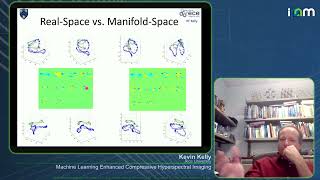
Machine Learning Enhanced Compressive Hyperspectral Imaging - IPAM at UCLA
Explore machine learning-enhanced compressive hyperspectral imaging techniques, combining optical systems and neural networks for efficient data acquisition and processing in various applications.