Transferring States in Discrete Quantum Walks
Explore discrete quantum walks, state transfer, and quantum walk search in graphs. Learn about coins, spectral correspondence, and applications in distance-regular graphs.
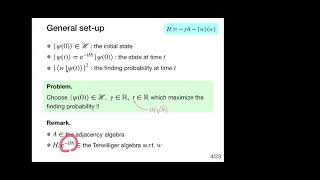
Spatial Search on Johnson Graphs by Continuous-Time Quantum Walk
Explore quantum walks on Johnson graphs for spatial search, covering setup, strategies, and analysis of search algorithms and success probabilities.
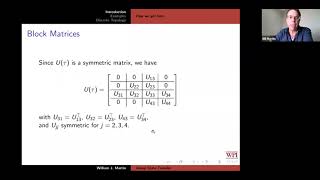
Quantum Walks on Graphs and Group State Transfer
Explore quantum walks, perfect state transfer, and group state transfer in graphs, focusing on algebraic structures and their applications in quantum information theory.
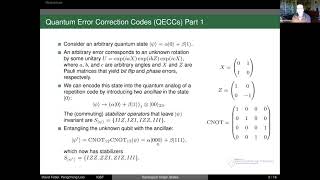
Topological Graph States
Explore topological graph states in quantum error correction, focusing on quantum graph states and their applications in error-correcting codes and topological systems.
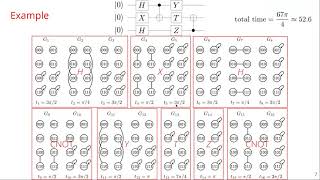
Simplifying Dynamic Quantum Walks for Quantum Gates
Explore simplification techniques for dynamic quantum walks in quantum gate implementation, focusing on Hadamard gates and cubic gates with practical examples and observations.
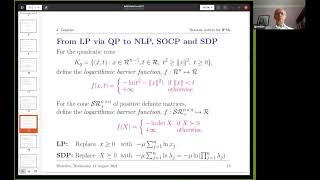
Recent Advances in Iterative Solvers for Interior Point Methods
Explore recent advancements in iterative solvers for interior point methods, covering linear programming, optimization theory, and applications in big data and compressed sensing.
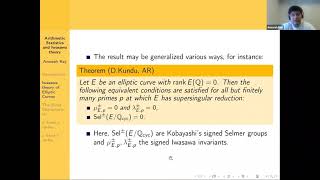
Arithmetic Statistics and the Iwasawa Theory of Elliptic Curves
Explore arithmetic statistics and Iwasawa theory of elliptic curves, covering Selmer groups, Greenberg's Conjecture, and p-adic Birch and Swinnerton-Dyer Conjecture in this advanced number theory seminar.
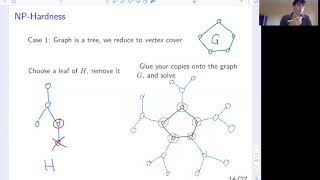
Approximation Algorithms for Hitting Subgraphs
Explore approximation algorithms for hitting subgraphs, covering inapproximability, NP-hardness, and semi-symmetric cut vertices in this advanced combinatorial algorithms lecture.
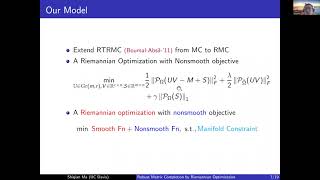
Robust Low-Rank Matrix Completion via an Alternating Manifold Proximal Gradient Continuation Method
Explore robust low-rank matrix completion using an alternating manifold proximal gradient method. Learn about its applications in computer vision, signal processing, and machine learning.
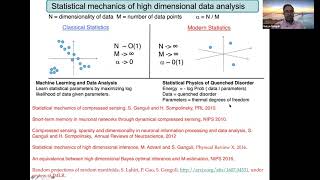
Weaving Together Machine Learning, Theoretical Physics, and Neuroscience
Exploring the intersection of machine learning, physics, and neuroscience through complex systems analysis to develop better algorithms and understand neural systems.
Laboratory for Interdisciplinary Breakthrough Science - Hybrid
Explore machine learning's impact on scientific challenges through an industry-academia consortium, fostering collaboration between TIFR centers and ML experts to tackle significant disciplinary problems.
Stochastic Gradient Descent and Machine Learning - Lecture 1
Explore optimization methods, gradient descent, Newton's method, and convexity in machine learning. Gain insights into iterative algorithms and their applications in statistical physics and data analysis.
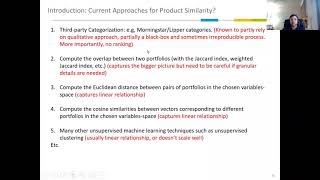
Mutual Funds Similarity Using Graph Machine Learning
Explore mutual fund similarity using graph machine learning techniques. Learn about bipartite networks, clustering coefficients, and homophily in financial data analysis.

Modeling with Cloth Simulation in Blender
Learn to harness Blender's cloth dynamics for realistic fabric modeling, enhancing your 3D creations with lifelike textures and movements.
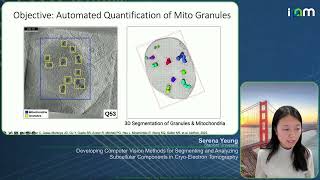
Computer Vision for Segmenting & Analyzing Subcellular Components in Cryo-Electron Tomography
Explore computer vision techniques for automated 3D segmentation and analysis of subcellular components in cryo-electron tomography, focusing on mitochondrial features in Huntington's Disease neurons.
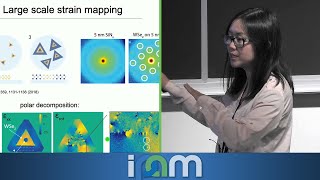
Assisting 4D-STEM Data Processing by Machine Learning and Bayesian Optimization
Explore machine learning and Bayesian optimization techniques for processing 4D-STEM data, enhancing efficiency in materials analysis and electron ptychography reconstruction.
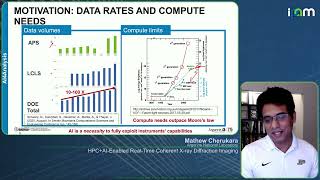
HPC+AI-Enabled Real-Time Coherent X-ray Diffraction Imaging - IPAM at UCLA
Explore HPC and AI-enabled real-time coherent X-ray diffraction imaging, revolutionizing materials characterization with advanced light sources, multi-modal techniques, and innovative data processing methodologies.
A Multi-Group Approach to Algorithmic Fairness - IPAM at UCLA
Explore multi-group approaches to algorithmic fairness, focusing on predictive algorithms, discrimination concerns, and calibration techniques for unbiased risk assessment across diverse populations.
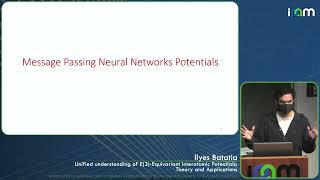
Unified Understanding of E(3)-Equivariant Interatomic Potentials - Theory and Applications
Explore E(3)-equivariant interatomic potentials, covering theory, applications, and advancements in machine learning approaches for quantum mechanics and molecular dynamics simulations.
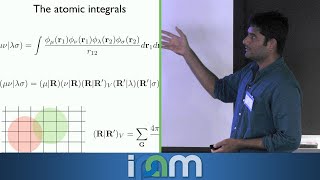
Auxiliary Field Quantum Monte Carlo - AFQMC with Multi Slater Wavefunctions
Explore advanced quantum Monte Carlo techniques, focusing on AFQMC with multi-Slater wavefunctions and efficient exchange matrix evaluation for large-scale quantum systems.
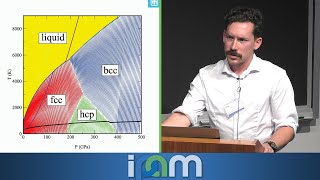
Machine Learning in Equation of State and Transport Modeling at Extreme Conditions
Explore machine learning applications in equation of state and transport modeling for extreme conditions, enhancing accuracy and efficiency in material science and astrophysics research.