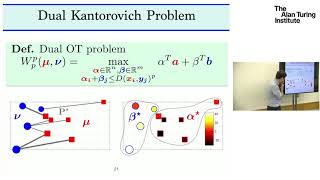
Regularization for Optimal Transport and Dynamic Time Warping Distances - Marco Cuturi
Explore regularization techniques for optimal transport and dynamic time warping distances, focusing on smoothing strategies to enhance machine learning applications and Fréchet mean computation.
The Automatic Statistician - Professor Zoubin Ghahramani
Explore Bayesian model selection strategies for automated data analysis and report generation, with insights on regression models, Gaussian processes, and computational resource allocation.
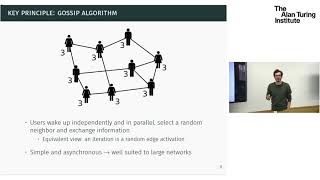
Privacy-Preserving Algorithms for Decentralised Collaborative Learning - Dr Aurélien Bellet
Explore privacy-preserving algorithms for decentralized collaborative learning, focusing on large-scale machine learning, distributed methods, and privacy protection in connected device data analysis.
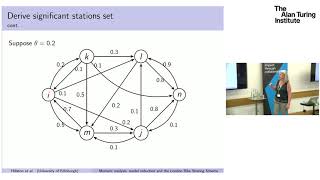
Jane Hillston - Moment Analysis, Model Reduction and London Bike Sharing
Explore moment analysis and model reduction techniques for complex systems, with applications to London's bike-sharing system. Learn about PCTMCs, moment equations, and directed contribution graphs.
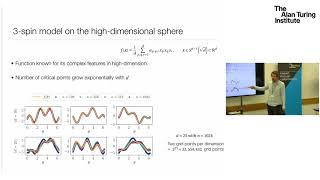
Neural Networks as Interacting Particle Systems
Explore neural networks as interacting particle systems, examining their mathematical foundations and applications in complex systems modeling across various scientific disciplines.
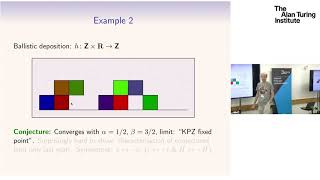
Universality Classes for 1+1 Dimensional Systems
Explore universality classes in 1+1 dimensional systems, focusing on weak universality conjecture, graphical construction, and links to Brownian web. Gain insights into complex systems modeling.
Privacy-Preserving Information Sharing - Tools and Applications
Explore privacy-preserving techniques for secure information sharing, including two-party computation, private set intersection, and authorized PSI, with applications in collaborative anomaly detection.

Solving Private Set Intersection via Cuckoo Hashing - Benny Pinkas, Bar-Ilan University, Israel
Explore private set intersection protocols, including custom and generic MPC approaches, with a focus on Cuckoo hashing for efficient computation of PSI variants in cryptography and security.
Making Sense of Mobile Network Traffic Using Deep Learning - Paul Patras, Edinburgh
Explore deep learning techniques for analyzing mobile network traffic, enhancing urban data interpretation and smart city development.
Using AI in the Exploration of Urban Modelling Scenarios - Richard Milton & Flora Roumpani
Explore urban modeling scenarios using AI, focusing on smart cities, deep learning for mobility data, and building resilient systems for future urban challenges.
Neural Opinion Dynamics Model for the Prediction of User-Level Stance Dynamics - Yulan He, Warwick
Explore neural opinion dynamics for predicting user stance shifts in digital democracy platforms, enhancing citizen engagement and policy-making through machine learning techniques.
Approximate Cross Validation for Large Data and High Dimensions - Tamara Broderick, MIT
Explore efficient cross-validation techniques for large datasets using linear approximation and dimensionality reduction. Learn about error bounds, high-dimensional challenges, and practical applications in machine learning.
Benign Overfitting - Peter Bartlett, UC Berkeley
Explore benign overfitting in machine learning, focusing on linear regression, deep networks, and statistical implications. Gain insights into effective rank, regularization, and future research directions.

A Function Space View of Overparameterized Neural Networks - Rebecca Willet, University of Chicago
Explore function spaces of overparameterized neural networks, focusing on weight-bounded networks and their approximation capabilities. Insights from Radon transform analysis reveal novel perspectives on learning with ReLU networks.
Big Data Is Low Rank - Madeleine Udell, Cornell University
Explore big data's low-rank structure, generalized low-rank models, and their applications in machine learning. Learn about dimensionality reduction, autoML, and latent variable models for efficient data analysis.
Does Learning Require Memorization? A Short Tale About a Long Tail - Vitaly Feldman, Google Brain
Exploring the necessity of memorization in learning algorithms, this talk delves into privacy concerns, long-tail distributions, and the role of memorization in achieving optimal generalization error in deep learning.
Unsupervised Doodling and Painting with Generative Agents
Explore unsupervised learning in generative art, reinforcement learning agents as image creators, and the potential of AI in artistic tools and creative processes.
Better Decisions with Machine Learning - Peter Flach
Explore machine learning techniques for better decision-making, including ROC curves, calibration methods, and precision-recall-gain curves. Learn to adapt models to deployment contexts and measure ML performance.

Spotify - Personalising the Listening Experience - Mounia Lalmas
Explore Spotify's approach to personalizing music recommendations using machine learning, focusing on user intents, relevance, diversity, and satisfaction to enhance the listening experience.
An Unethical Optimisation Principle
Explore the ethical implications of AI optimization strategies and their potential for unintended consequences in financial markets and AI regulation.
Turing Lecture - Algorithmic Accountability - Professor Ben Shneiderman, University of Maryland
Exploring algorithmic accountability and human-centered oversight for safer AI systems. Emphasizes comprehensible, predictable, and controllable designs to prevent failures and improve safety in critical services.