
Artificial Intelligence and Society - In Conversation With Jeff Sachs
Exploring AI's societal impact, Jeff Sachs discusses potential utopian and dystopian outcomes, emphasizing the importance of governance in shaping the future of technology and its effects on work, wealth, and privacy.

Making Machines That See - Geometry, Uncertainty and Deep Learning
Explore computer vision advancements, from 3D object reconstruction to real-time deep learning systems incorporating geometry and uncertainty, with applications in robotics and mobile technology.
Language Learning in Humans and Machines - Making Connections to Make Progress
Exploring connections between human and machine language learning to develop better computational methods for understanding and processing diverse languages.
Counterfactual Fairness
Explore causal inference tools for modeling fairness in machine learning, addressing bias and ensuring equitable decisions across demographic groups.
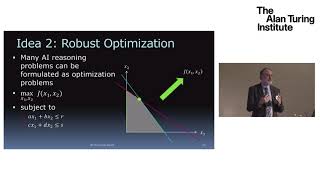
Steps Toward Robust Artificial Intelligence - Thomas G Dietterich, Oregon State University
Explore methods for developing robust AI systems capable of handling known and unknown threats in high-stakes applications, including probabilistic inference, anomaly detection, and causal modeling.
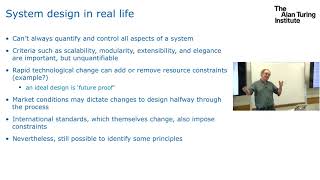
Systems and Security - Advanced
Explore advanced system architectures, performance optimization, and security concerns in layered systems. Learn debugging techniques and architectural strategies for addressing bottlenecks and vulnerabilities.
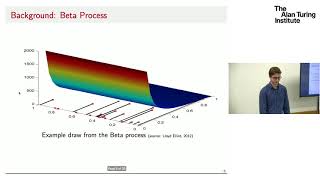
Poisson Random Fields for Dynamic Feature Models
Explore dynamic feature allocation models using Poisson random fields. Learn about the Wright-Fisher Indian Buffet Process and its application to topic modeling for time-stamped documents, with a focus on NIPS papers.
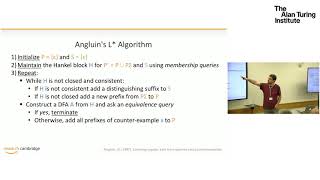
Learning Automata with Hankel Matrices - Borja Balle, Amazon Research Cambridge
Explore a unified framework for learning automata using Hankel matrices, covering query learning, spectral learning, and matrix completion algorithms with practical applications.
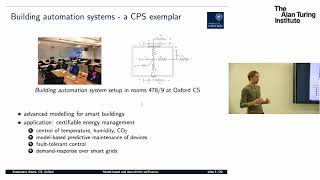
Formal Verification and Learning of Complex Systems - Professor Alessandro Abate
Exploring formal verification techniques for complex systems, combining model-based and data-driven methods to address scalability issues and provide system-level assertions in Cyber-Physical Systems.
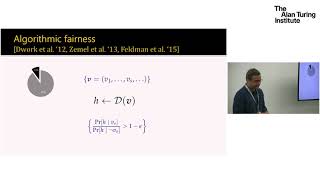
Fairness and Robustness in Machine Learning – A Formal Methods Perspective - Aditya Nori, Microsoft
Explore fairness in machine learning through formal methods. Learn techniques for verifying probabilistic properties and certifying fairness in decision-making programs using FairSquare.
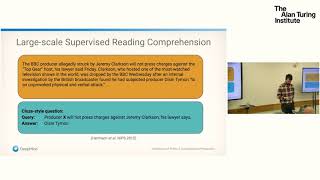
Recurrent Neural Networks and Models of Computation - Edward Grefenstette, DeepMind
Exploring recurrent neural networks and memory-enhanced architectures, analyzing their computational capabilities and efficiency in relation to traditional models of computation.

Multilevel Weighted Least Squares Polynomial Approximation – Sören Wolfers, KAUST
Explore multilevel weighted least squares polynomial approximation for high-dimensional function reconstruction, addressing the curse of dimensionality and leveraging structural assumptions for improved accuracy.
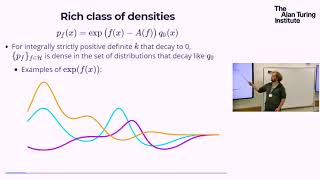
Score Estimation with Infinite-Dimensional Exponential Families – Dougal Sutherland, UCL
Explore score estimation in infinite-dimensional exponential families, covering reproducing kernel Hilbert spaces, maximum likelihood, and Nystrom approximation. Includes theoretical overview and experimental results.

Turing Lecture - AI Through the Looking Glass
AI's societal impact: opportunities, challenges, and ethical considerations. Explores job automation, socio-technical approaches, and UK's positioning in AI evolution. Emphasizes unexpected outcomes and the need for diverse perspectives.
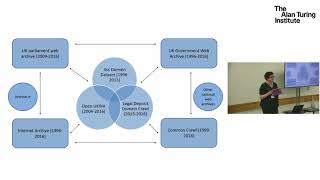
Small Data and Big Data - Web Archives and Research in the Humanities
Explore web archives' potential for humanities research, examining challenges and opportunities in using digital collections to study social and cultural phenomena.
Ground Truth - The Uses and Abuses of Human Annotation in Text Analysis - Professor Kenneth Benoit
Explores the concept of "ground truth" in text analysis, discussing annotation methods, intercoder agreement, and comparing expert vs. crowd-sourced coding for social science research.
Alan Turing and the Other Theory of Computing and Can a Machine Be Conscious?
Explore Turing's lesser-known 1948 paper on numerical computation and its impact on complexity theory. Discover how it unifies two major traditions in computational theory.

At-Scale Formal Verification for Industrial Semiconductor Designs - Professor Tom Melham
Explore formal verification techniques for complex semiconductor designs, focusing on symbolic trajectory evaluation and symmetry exploitation to enhance microprocessor reliability and efficiency.
Secure Computation with RAMs - Dr. Mariana Raykova, Yale University
Explore secure computation techniques for protecting private data, including ORAM constructions and encrypted search schemes. Learn about cryptographic advancements for efficient and privacy-preserving data processing.
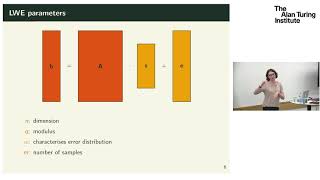
Security and Encoding in Fully Homomorphic Encryption - Rachel Player, Sorbonne Université
Explore security and encoding in Fully Homomorphic Encryption, covering Ring-LWE parameters, NIST post-quantum standardization, and efficient encoding techniques for higher-depth circuit evaluation.

Computational Semantics Evaluation - The Origins of Senseval and Evolution of SemEval
Explore the evolution of computational semantics evaluation, from Senseval's origins in word sense disambiguation to SemEval's diverse tasks. Learn about key challenges, benefits, and future considerations in semantic analysis.