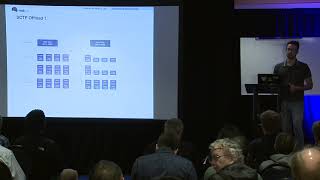
Linux SCTP is Catching Up and Going Above
Exploring SCTP's evolution in Linux: recent improvements, new features, and future developments. Compares SCTP with TCP/UDP and other systems, highlighting its unique capabilities and potential applications.
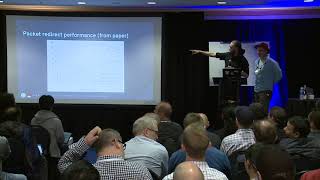
XDP Challenges & Future Work
Exploring future improvements for XDP, including user experience, driver support, performance optimization, QoS handling, and potential extensions to accelerate other parts of the networking stack.

Linux Kernel VxLan with Multicast Routing for Flood Handling
Explore VxLan multicast routing in Linux kernel, addressing challenges and solutions for dynamic environments. Covers deployment scenarios, patches, and future developments.

LAG and Hardware Offload to Support RDMA and IO Virtualized Interfaces
Exploring LAG implementation for RDMA and virtualized interfaces, focusing on active-backup mode, flow-based active-active mode, and a new active-active mode for virtual functions.

Future IPv4 Unicast Extensions
Exploring IPv4 address space expansion by utilizing reserved and obsolete ranges, aiming to make hundreds of millions of additional addresses available for global unicast routing.

XDP - The Distro View
Explore XDP challenges in Linux distributions, including enablement, security, user support, and future extensions. Discuss current solutions and potential improvements for seamless integration.

Dynamic Encapsulation Using eBPF
Explore advanced network encapsulation techniques using eBPF, enhancing packet processing and network performance in Linux systems.
Translating IPv4 to IPv6 Without NAT
Explore innovative techniques for seamless IPv4 to IPv6 translation without NAT, featuring system call interception, complex sequence diagrams, and performance analysis.
Bringing TSO/GRO and Jumbo Frames to XDP
Explore advancements in XDP networking: TSO/GRO implementation and Jumbo frame support. Learn about performance improvements and challenges in high-speed packet processing.

Machine Readable Description for Netlink Protocols
Explore machine-readable descriptions for netlink protocols, focusing on YAML implementation. Gain insights into enhancing network communication efficiency and standardization in Linux systems.
Easy, Secure and Fast - Using NATS for Data Streams and Services
Explore NATS for flexible, secure data sharing in distributed systems. Learn messaging patterns, design principles, and how NATS solves cloud-native communication challenges across various deployments.
CoreDNS for Hybrid and Multi-Cloud
Explore CoreDNS configurations for hybrid and multi-cloud environments, including cloud vendor integration, secure DNS protocols, and multi-cluster service discovery across clouds.
Go? Bash! Meet the Shell-operator
Explore Shell-operator for automating Kubernetes tasks using bash and jq. Learn to create simple operators, subscribe to resource changes, and extend Kubernetes functionality efficiently.

Failure Stories From the On-premise Bare-metal World
Real-world challenges and solutions for setting up large on-premise Kubernetes clusters, covering network design, traffic management, and common failure scenarios in bare-metal environments.

Deep-Dive - Packet-level Debugging of Bridged and Non-bridged CNI Plugins
Explore packet-level debugging techniques for Kubernetes connectivity issues, focusing on bridged and non-bridged CNI plugins, NAT, iptables, and network policies.
Communication Is Key - Understanding Kubernetes Networking
Explore Kubernetes networking concepts through hands-on labs. Learn about DNS, iptables, routing, and more to gain a deeper understanding of cluster communication and troubleshooting techniques.
Kubernetes DNS Horror Stories - And How to Avoid Them
Explore Kubernetes DNS challenges and solutions at scale, covering load handling, connection tracking, resolver implementations, and performance optimization techniques for robust cluster management.
Building Secure & Decentralized Global Applications on Kubernetes with NATS
Learn to build secure, decentralized apps spanning multiple Kubernetes regions using NATS. Covers global NATS cluster setup across 4 clouds, decentralized authorization, and implementing a Slack-like terminal clone.
Production Multi-node Jobs with Gang Scheduling, K8s, GPUs and RDMA
Explore distributed execution of DL/ML jobs in Kubernetes, covering gang scheduling, GPU acceleration, and high-speed networking for improved performance and scalability.
Introduction to NATS Streams and Services on Kubernetes
Learn to architect distributed applications using NATS Streams and Services on Kubernetes. Explore multi-region deployments, security, and tooling for efficient data flow and multi-tenancy in cloud-native environments.

How Niantic Switched Pokémon GO to Use Envoy
Discover how Niantic transitioned Pokémon GO from NGINX to Envoy, addressing scaling challenges, extending protocols, and implementing service mesh for improved performance and reliability at a global scale.