
Stability and Singular Limits in Plasma Physics
Explore effective theories in classical and quantum particle systems, focusing on stability and singular limits in plasma physics.
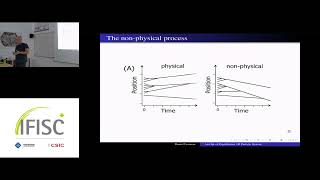
An Out-of-Equilibrium 1D Particle System Undergoing Perfectly Plastic Collisions
Explore a 1D particle system with perfectly plastic collisions, analyzing out-of-equilibrium dynamics and complex system behavior in physics.
Ray Casting, Basic Lighting, and Vision in Game Programming - Lecture 13
Explore ray casting fundamentals and practical applications in 2D game lighting, visibility systems, and line segment intersection calculations for creating dynamic lighting effects.

The State of Unreal Automotive - From Visualization to HMI Development
Explore the latest advancements in automotive visualization and HMI development with Unreal Engine 5.5, including current achievements and future roadmap insights for automotive technology innovation.
Game Programming: Cameras, Views, and Viewports in SFML - Lecture 14
Master game camera fundamentals, from 2D and 3D implementations to SFML views, viewports, and parallax effects for creating dynamic visual perspectives in game development.

State of Virtual Production in Unreal Engine 5.5
Discover the latest virtual production advancements and upcoming features in Unreal Engine 5.5, including visualization tools, in-camera VFX, and post-production innovations.

Augmented Reality Development with ARKit Framework
Dive into augmented reality development with Apple's ARKit framework, learning essential techniques and practical implementations for creating immersive AR experiences and interactive applications.

From Procedural Game Assets to Generative Art - Modern Tools and Unconventional Approaches
Explore the evolution from procedural game assets to generative art, discovering innovative approaches that merge modern tools with unconventional creative methodologies for digital artistic expression.
Joining SUMO and Unreal Engine to Create a 360-Degree Narrow Passage Driving Simulator
Discover how to create an advanced driving simulator by combining SUMO and Unreal Engine, focusing on realistic narrow passage scenarios with intelligent vehicle behavior and immersive 3D graphics.

The History of Computer Art
Explore the evolution of computer art from 1960s LSD-fueled hacking to modern digital galleries, discovering how programming transformed into a powerful medium for artistic expression and creativity.
Hazel Game Engine Code Review
Explore the architecture and implementation of Hazel game engine, covering project structure, core systems, rendering, and editor functionality. Gain insights into game engine development.

Minecraft Clone in C++ - Code Review and Optimization
Explore a Minecraft clone in C++, covering project structure, code organization, math concepts, ray casting, and shader techniques. Gain insights into game development practices.
C# Game Engine Code Review - Building a 3D Renderer at 16
Comprehensive code review of a C# game engine, offering insights on architecture, rendering techniques, and optimization strategies for aspiring game developers.

Making a Game in One Hour Using a Custom Engine
Develop a game in one hour using a custom engine, covering 3D modeling, scripting, environment design, particle effects, audio integration, and gameplay refinement.

Optimizing Ray Tracing Performance - Code Review
Optimize ray tracing performance through code review, exploring multi-threading, and implementing efficiency improvements for faster rendering in C++.

Basic 3D Game Engine Based on Hazel - Code Review
Learn to create a basic 3D game engine with cube rendering, normals, scaling, and matrix transformations. Explore the general structure and implementation details of a simple graphics engine.

Font Rendering - How to Make a Game Engine
Explore font rendering techniques in game engine development, covering text drawing, texture atlases, UV rendering, and character packing for efficient and visually appealing text display.

Texture Arrays - How to Make a Game Engine
Learn to implement texture arrays in game engine development, covering setup, texture slots, shader integration, and practical testing for efficient rendering of multiple textures.

Window - Sparky Engine - How to Make a Game Engine
Learn to create a game engine from scratch, focusing on initial planning, setting up GLFW, and creating an OpenGL window in C++. Gain practical insights into the foundational steps of game engine development.
3D Game Programming - High Resolution Rendering
Learn to implement high-resolution textures and apply them to ceilings in 3D game development using Java, enhancing visual quality and realism in your projects.

Material Systems - Game Engine Series
Explore game engine material systems, covering shaders, uniforms, coding, instances, render sorting, and textures for efficient and visually appealing game development.