Pendulum Dynamics in Phase Space - Damped Driven Pendulum Simulation
Explore damped driven pendulum behavior through phase space plots, with coding examples in VPython to visualize complex motion and periodic forces.
Pendulum Simulation - Breaking Simple Harmonic Motion
Explore pendulum motion beyond simple harmonic approximations through coding, visualizing how small angle assumptions break down as amplitude increases.
Wave Function Evolver: Lennard-Jones Simulation Analysis - Episode 10
Explore Lennard-Jones simulation behavior by modifying potential energy minimum locations. Augment code to analyze changes and generate insights for physics enthusiasts and programmers.
Gravity Simulator - Double-Planet System - Episode 3
Explore double-planet and trinary star systems using a gravity simulator. Learn to code physics simulations and visualize complex celestial interactions in VPython.
Gravity Simulator - Sun and Earth Orbital Motion - Episode 1
Explore gravitational motion simulation using VPython, focusing on Sun-Earth dynamics. Learn about Euler-Cromer method, indices tracking, and Earth's scale in space.
Bouncy Balls Simulation - Temperature and Pressure Calculations - Episode 5
Explore temperature, pressure, and the Ideal Gas Law through bouncy ball simulations using VPython. Calculate and visualize ensemble properties in this engaging physics coding tutorial.
Bouncy Balls Collision Math - Episode 3
Explore elastic collision math for bouncy balls, covering conservation of momentum, parallel axis, and unit vectors. Practical application in coding physics simulations.
Quantum Mechanics for High School Teachers - Modeling Spin with Arrays in Python - Module 2
Explore quantum mechanics using Python arrays to model spin, measurements, and strange experiments, with hands-on challenges for high school physics teachers.
Training People to Teach with Computation
Strategies for integrating computation into physics courses, including expanding the circle of instructors, creating space for computational content, and exploring CS pathways for effective teaching.
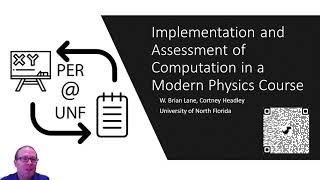
Implementation and Assessment of Computation in Modern Physics Teaching
Explore innovative computational methods for teaching modern physics, focusing on dynamic visualizations and hands-on investigations to enhance student understanding of complex quantum concepts.
Recap of Simple Harmonic Motion - Beyond Simple Harmonic Motion 1
Comprehensive review of simple harmonic motion, covering key concepts, graphs, and energy behavior. Introduces more complex oscillating systems and provides coding resources for further exploration.
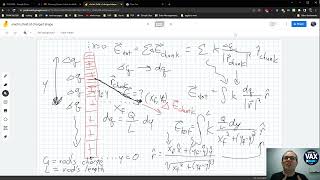
E-Field of Charged Shapes - Calculating Electric Fields for Complex Geometries
Learn to calculate the electric field of charged shapes by dividing them into small pieces. Explore techniques for various configurations, including dipoles, using Python code.
Stationary States and the Shooting Method in Quantum Mechanics
Explore stationary states in quantum mechanics using computational modeling and the shooting method to solve the Schrödinger equation.
Compact Representations of Excited States from QMC, as Data for Low-Energy Models
Explore compact wave function representations for excited states in quantum mechanics, focusing on variational Monte Carlo methods and their applications in effective model development.
Computational Challenges with Modeling Core Collapse Supernovae - IPAM at UCLA
Explore computational challenges in modeling core collapse supernovae and gravitational wave emission, covering recent progress, physics requirements, and future directions in multi-dimensional simulations.
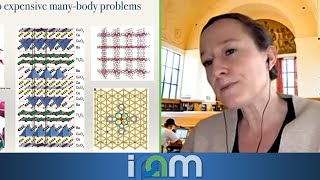
A Physical-Chemical Motivation Behind Quantum Embedding Theories - IPAM at UCLA
Explore quantum embedding theories, their physical motivations, and applications in many-electron problems. Learn about Green's function embedding and other approaches for accurate, controlled approximations.
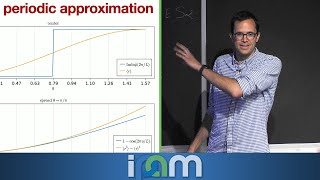
Localization Methods - Perspectives on Initialization and Optimization - IPAM at UCLA
Explore Wannier localization in quantum mechanics, its mathematical formulation, challenges, and new approaches for efficient orbital localization in condensed matter systems.
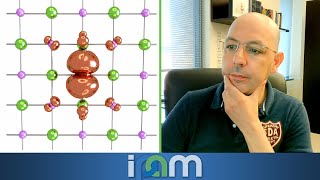
Methods and Software for Electron-Phonon Physics - IPAM at UCLA
Explore electron-phonon physics with advanced methods and software. Learn about spectral density functions, Green's functions, and polarons in materials, with real-world examples and computational challenges.
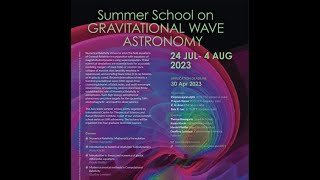
Introduction to Numerical Relativistic Hydrodynamics - Lecture 1
Explore numerical relativistic hydrodynamics, essential for modeling high-energy astrophysical phenomena like black hole mergers and supernovae, crucial for gravitational-wave astronomy advancements.
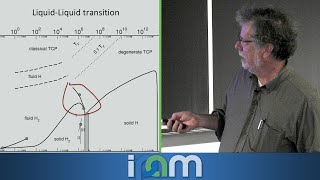
Quantum Monte Carlo and Machine Learning Simulations of Dense Hydrogen
Explore advanced quantum simulations of dense hydrogen using Quantum Monte Carlo and machine learning techniques, focusing on electronic energies, proton distributions, and novel solid structures.
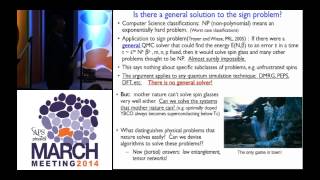
Numerical Studies of Strongly Correlated Systems - Beating the Exponential Growth in Computation Time
Explore numerical approaches to tackle strongly correlated systems, focusing on entanglement entropy, matrix product states, and recent advancements in 2D systems and the TJ model.