Introduction to Theory and Numerics of Partial Differential Equations - Lecture 4
Explore advanced concepts in partial differential equations, focusing on theory and numerical methods for solving complex mathematical problems in physics and engineering.
Poseidon: Efficient Foundation Models for PDEs - Tutorial 1
Explore efficient foundation models for PDEs with Poseidon, focusing on innovative techniques and applications in computational science.
Numerical Approaches to Modelling Curved Surfaces
Explore numerical methods for modeling curved surfaces, focusing on applications in physics and biology.

New Recipe for Pi - A Novel Approach to Calculating Pi
Discover a groundbreaking approach to calculating pi, featuring insights from physicists Sinha and Saha on their innovative method that connects string theory to this fundamental constant.
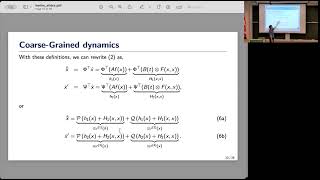
Learning Coarse-Grained Dynamics on Graphs
Explore coarse-grained dynamics on graphs with John Harlim, delving into advanced machine learning techniques for dynamical systems analysis and modeling.
Numerical Methods and Quantum Many-Body Dynamics I - July 4
Explore numerical methods and quantum many-body dynamics with Frank Pollmann. Gain insights into advanced physics concepts and computational techniques for studying complex quantum systems.
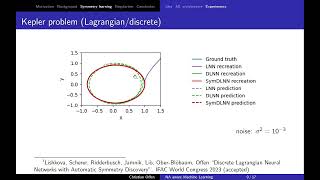
Learning Discrete Lagrangians for Variational PDEs from Data and Detection of Travelling Waves
Explore discrete Lagrangians for variational PDEs, focusing on data-driven approaches and techniques for identifying travelling wave solutions.
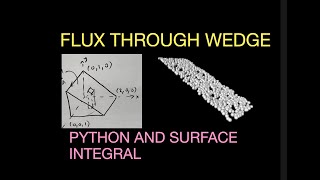
Calculate the Flux Through the Surface of a Wedge - Two Methods
Learn to calculate flux through a wedge surface using traditional integration and Python-based random number methods, enhancing your vector calculus and computational skills.

ME3255 - Quantitative Descriptions on Monte Carlo Models
Explore Monte Carlo models through quantitative descriptions, enhancing understanding of statistical simulation techniques and their applications in engineering and science.
Introduction to Lattice Quantum Chromodynamics (QCD) - Class 1
Discover the fundamental principles of Lattice QCD through an advanced physics lecture exploring quantum chromodynamics, nuclear physics, and few-body systems in particle interactions.
Lattice QCD - Class 2
Delve into advanced concepts of Lattice QCD, exploring quantum chromodynamics calculations and their applications in nuclear physics through expert insights from UNC Chapel Hill research.

Wolfram's Hypergraphs - A New Approach to Unified Physics Theory
Explore how Stephen Wolfram's revolutionary approach using hypergraphs and computer code could potentially unify fundamental physics laws and resolve conflicts with Einstein's theories.
Lattice QCD - Class 3
Delve into advanced Lattice QCD concepts and computational methods for nuclear physics, exploring quantum chromodynamics applications in few-body systems and nuclear structure calculations.
Lattice QCD - Class 4
Delve into advanced Lattice QCD concepts with expert Amy Nicholson, exploring quantum chromodynamics applications in nuclear physics and few-body systems through computational methods.
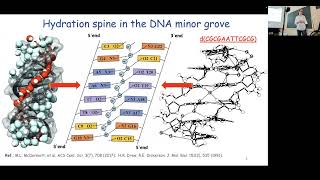
Specific Effects of Alkali Metal Ions on the Vibrational Dynamics of DNA Ion-Hydration
Explore the intricate relationship between alkali metal ions and DNA hydration dynamics through advanced computational physics and vibrational analysis techniques.
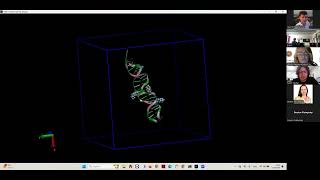
Using ChatGPT in Molecular Dynamics Simulations - Applications to Nucleic Acids
Discover how to leverage ChatGPT for molecular dynamics simulations, focusing on nucleic acids analysis and computational physics applications in DNA research.
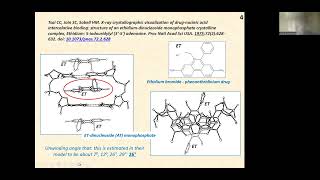
Computer Simulations of DNA-Ligand Intercalation Complexes - Special Features
Dive into advanced computational methods for studying DNA-ligand intercalation complexes, exploring simulation techniques and key molecular interactions in biophysical research.
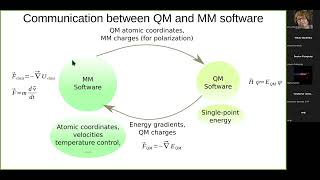
Hybrid Quantum-Mechanics/Molecular Mechanics Simulation Methods and Their Applications to Studying Charge Transfer Processes in Redox Proteins
Dive into advanced QM/MM simulation methods and their practical applications for analyzing charge transfer processes in redox proteins through computational physics approaches.
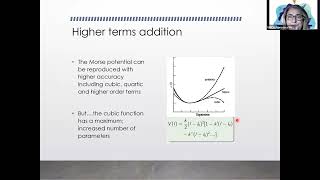
Force Fields and Molecular Dynamics Simulations - Applications to Nucleic Acids
Dive into molecular dynamics simulations and force fields, exploring their practical applications in nucleic acid research through advanced computational physics methods and theoretical frameworks.
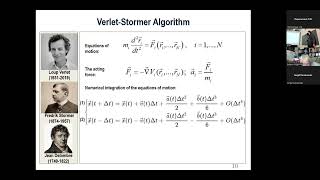
Molecular Dynamics: From the Problem of Hard Spheres to the DNA Macromolecule
Explore molecular dynamics principles and applications, from basic hard sphere models to complex DNA macromolecular structures in this comprehensive physics workshop lecture.
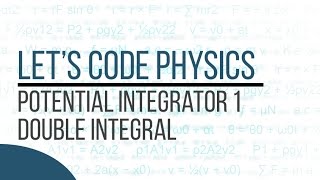
Electric Potential Calculation Using Double Integral - Part 1
Explore numerical integration to calculate electric potential of charged shapes using Scilab, with code examples and practical applications in physics.