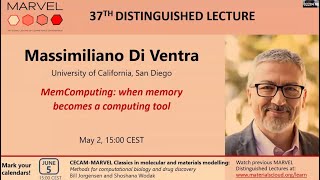
MemComputing: When Memory Becomes a Computing Tool - Lecture 37
Explore MemComputing, a revolutionary approach where memory acts as a computing tool, presented by Prof. Massimiliano Di Ventra from UC San Diego.
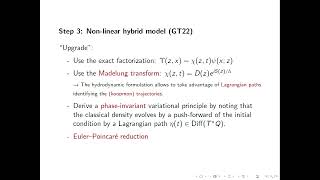
Madelung Transform and Variational Asymptotics in Born-Oppenheimer Molecular Dynamics
Explore variational asymptotics and Madelung transform in Born-Oppenheimer molecular dynamics, enhancing understanding of quantum chemistry principles.
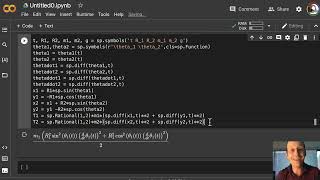
Modeling the Double Pendulum with Python and SymPy
Explore Python and sympy to model the double pendulum, from deriving equations to creating a 3D visualization.
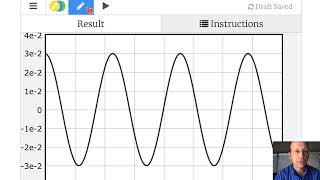
Simple Harmonic Motion with Python - Including 3D Motion
Explore numerical calculations for mass-spring systems using Python, including 3D motion simulations and interactive code examples.
Normal Modes of Oscillation for the Double Pendulum
Explore normal modes of oscillation for a double pendulum with equal masses and lengths, including Python code for plotting and visualization.
Colliding Clay Pendulum Balls with Springs and Python
Model colliding clay pendulum balls using Python and springs to solve a physics problem numerically.
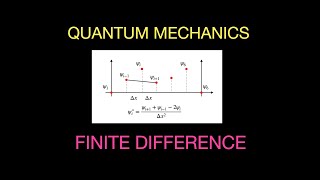
1D Infinite Square Well Solution Using Python and Finite Difference Method
Explore quantum mechanics using Python to solve the 1D infinite square well problem with finite difference method and visualize results through animations and graphs.
Modeling a Wave on a String - Finite Difference in Python
Model a wave on a string using finite difference calculations and Web VPython. Learn Python coding techniques for physics simulations and data visualization.
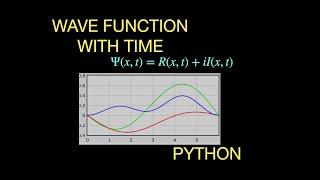
Solving the Time-Dependent Schrödinger Equation with Finite Difference Method in Python
Explore numerical solutions to the time-dependent Schrödinger equation using Python's finite difference method for 1D quantum systems.
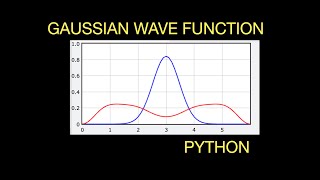
Time Evolution of a Wave Function in a Square Well with Superposition of States Using Python
Explore quantum mechanics through Python, simulating wave function evolution in an infinite square well using Gaussian initial conditions.
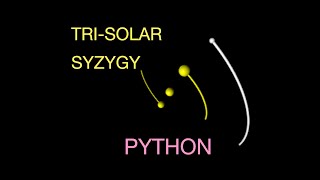
Modeling the Tri-Solar Syzygy with Python
Explore Python modeling of the Tri-Solar Syzygy from "The 3 Body Problem," simulating stable orbits and planetary positions in a three-star system.
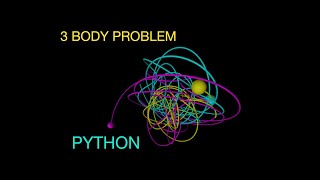
Calculate the Three-Body Problem Just Like the San-Ti
Explore the physics of the 3-body problem, its significance in "The Three-Body Problem" media, and learn computational methods to solve it.
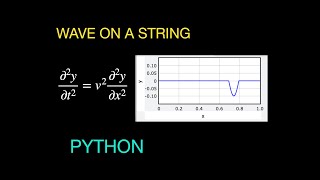
Modeling a Wave Pulse on a String with the Finite Difference Method and Python
Model wave pulses on strings using finite difference method and Python with Web VPython. Gain hands-on experience in computational physics and wave mechanics.
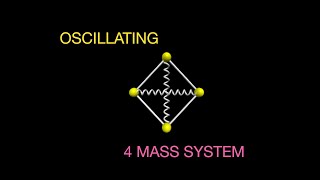
Three Ways to Solve a 4-Mass Oscillator: Energy, Python, and Lagrangian - Lecture
Explore three approaches to solving a complex 4-mass oscillator problem: energy analysis, Python simulation, and Lagrangian mechanics using SymPy.
Predicting the Magnetic Ground State with VASP
Explore techniques for predicting magnetic ground states using VASP. Learn about cluster multipole expansion, SDFT energy landscapes, and practical tips for first-principles calculations in magnetism.
MaZe: A New Approach for Simulating Adiabatic Systems - Lecture
Explore MaZe, a novel approach for simulating adiabatic systems in physics. Learn about its applications in first principles simulations, polarizable systems, and ionic transport studies.
Lessons Learned Developing Performance-Portable QMCPACK
Explore strategies for developing performance-portable scientific applications, focusing on QMCPACK's redesign for GPU and CPU compatibility in materials property prediction.
Taking HACC into the Exascale Era - New Code Capabilities and Challenges
Explore HACC's evolution for exascale systems, new capabilities, and performance optimization in cosmology simulations.
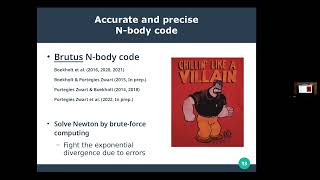
Fundamentally Unpredictable Three-Body Systems
Explore chaotic gravitational three-body systems and their unpredictability, delving into groundbreaking research on irreversibility to the Planck length.
Machine Learning for Quantum Applications - Part 1
Explore machine learning applications in quantum physics, focusing on cutting-edge techniques and their impact on quantum systems research.
Simplifying the Simulation of Local Hamiltonian Dynamics
Explore advanced techniques for simplifying simulations of local Hamiltonian dynamics in quantum systems, enhancing understanding of complex quantum behaviors.