Deep Learning for Quantum Physics and Astronomy
Explore deep learning applications in quantum physics and astronomy, uncovering innovative techniques for data analysis and scientific discovery.
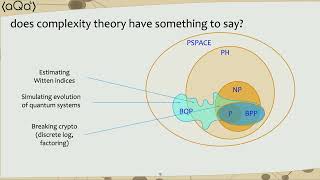
Provable Quantum Learning Advantages for Physics Data
Explore quantum learning advantages for physics data, uncovering provable benefits and applications in scientific research and analysis.

Physics-Informed Neural Networks in Medicine
Explore physics-informed neural networks' applications in medicine, focusing on innovative technologies combining data assimilation and machine learning.
Computational Physics in the Classroom
Explore three approaches to integrating computational physics in education, using modeling techniques to illustrate key principles and functions.
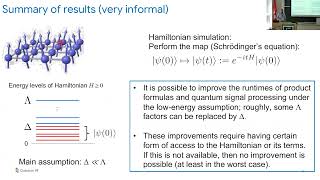
Hamiltonian Simulation for Low-Energy States
Explore advanced quantum techniques for simulating low-energy states in Hamiltonian systems, with insights from Google researcher Rolando Somma.
Machine Learning for the String Theory Landscape
Explore machine learning applications in string theory landscapes using Landscapia, a powerful tool for analyzing high-dimensional data in theoretical physics.
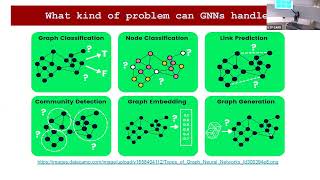
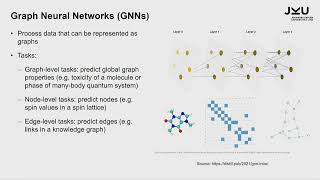
Cosmology with Graph Neural Networks
Explore cutting-edge applications of graph neural networks in cosmology, uncovering new insights into the universe's structure and evolution.
Tensor Network for Machine Learning Applications - Part 2
Explore advanced tensor network techniques for machine learning, focusing on applications and recent developments in the field.
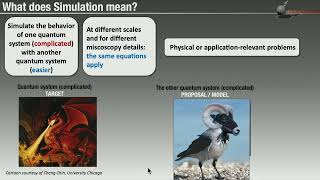
Quantum Simulations - Lecture 1
Explore quantum simulations with expert Francesca Ferlaino, delving into advanced concepts and cutting-edge research in this field of condensed matter and statistical physics.
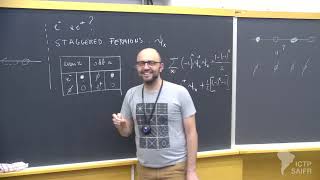
Quantum Simulation of Lattice Gauge Theories - Class 3
Explore quantum simulation of lattice gauge theories in this advanced lecture, focusing on emergent phenomena in non-equilibrium quantum many-body systems.
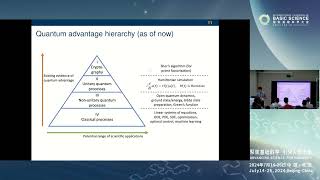
Quantum Advantage in Scientific Computation - ICBS 2024
Explore quantum computing's potential in scientific challenges, focusing on open quantum system dynamics and criteria for quantum advantages.
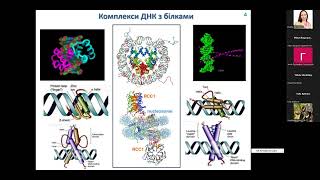
Computational Methods of Structural Bioinformatics in Studies of Protein-Nucleic Recognition
Explore computational methods in structural bioinformatics, focusing on protein-nucleic recognition mechanisms and their applications in DNA physics through advanced analytical approaches.
Bridging Quantum Computation and Practice with Wolfram Language
Explore quantum computing concepts and their practical applications using Wolfram Language. Learn about tensor networks, phase space, and stabilizer formalism in this informative livestream for researchers and practitioners.
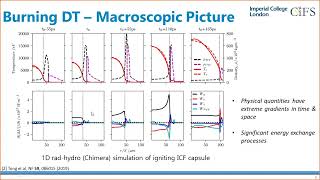
Investigating the Physics of Burning Thermonuclear Plasma
Explore the physics of burning thermonuclear plasma through cutting-edge research and advanced experimental techniques in high-energy density science.
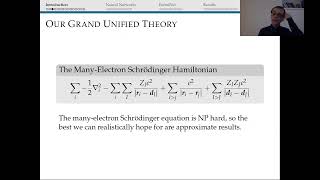
Solving the Many-Electron Schrödinger Equation with Deep Neural Networks
Explore deep neural networks for solving complex quantum mechanical equations in many-electron systems, advancing computational physics and materials science.
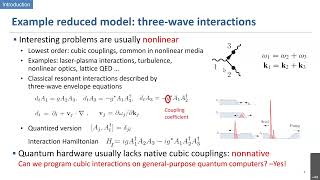
Using Quantum Computers to Simulate Laser-Plasma Interaction - A Toy Problem
Explore quantum computing applications in simulating laser-plasma interactions, focusing on a toy problem to demonstrate potential advancements in high-energy density science.
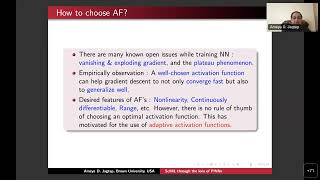
Scientific Machine Learning through the Lens of Physics-Informed Neural Networks
Explore physics-informed neural networks (PINNs) as an alternative to traditional scientific computation, addressing limitations and showcasing applications in solving complex physical problems.
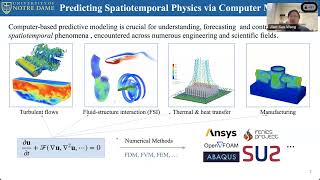
Neural Differentiable Physics: Unifying Numerical PDEs and Deep Learning for Data-Augmented Computational Physics
Explore Neural Differentiable Physics, unifying numerical PDEs and deep learning for enhanced computational modeling of complex physical systems. Learn innovative SciML approaches integrating physics principles with AI.
Revisiting the Classics: Turning Old Ideas into New Methods with Tensor Networks
Explore innovative approaches to high-dimensional problem-solving by combining classic methods with tensor networks, unlocking new possibilities in quantum simulations and differential equations.
Can a Solid State Quantum Simulator Help Us Understand Materials?
Explore quantum simulators' potential in understanding materials, comparing experimental results to classical computation and discussing future implications for condensed matter physics.
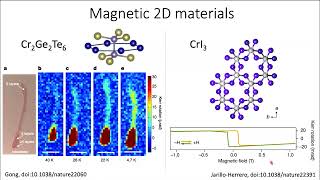
Materials Science and Discovery Powered by Machine Learning
Explore machine learning applications in materials science, focusing on innovative discovery techniques and computational advancements in the field.