Personalized Brain Network Models Augment Individual Differences
Explore personalized brain network models: simulating individual brain activity, predicting stimulation effects, and investigating structural and functional differences.

What Do We Want to Know and How Will a Connectome Help Us Know It?
Explore the potential of connectome analysis in neuroscience with Gwyneth Card, discussing its applications, limitations, and future directions in understanding brain function and behavior.
How to Simulate a Connectome - Predicting Neural Activity from Connectivity
Exploring how connectivity measurements of neural networks can predict neural activity and inform understanding of neural computation, with experimentally testable predictions across multiple studies.

The Effect of Network Connectivity on Population Neural Dynamics
Explore how network connectivity shapes population neural dynamics, focusing on low-dimensional manifolds and their role in neural computation and cortical function.
Visual Processing During Navigation
Explore visual processing mechanisms in navigation, focusing on neural pathways and computational models for spatial orientation and movement through environments.
Architectural Constraints on Recurrent Network Dynamics
Explore how network architecture influences and constrains dynamics in recurrent neural networks, focusing on threshold-linear models and their implications for understanding connectomes in neural computation.
The Cost of Brain State Transitions
Explore the energetic costs of brain state transitions and their implications for connectome analysis in this insightful presentation on cutting-edge neuroscience research.
How the Brain Shapes Reality - With Andy Clark
Explore how the brain acts as a prediction engine, shaping our perception of reality and its implications for well-being, mental health, and society. Delve into the concept of perception as 'controlled hallucination'.
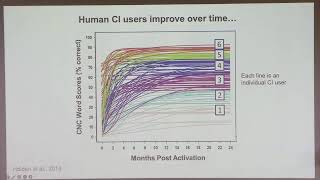
New Models of Human Hearing via Machine Learning
Exploring machine learning models to understand human auditory abilities and brain function, with implications for auditory prosthetics and behavioral insights.
Characterizing the Impact of Noise on Neural Computation
Exploring noise in biological and artificial neural networks, its impact on computations, and new methods for analyzing stochastic network representations and trial-to-trial variability.
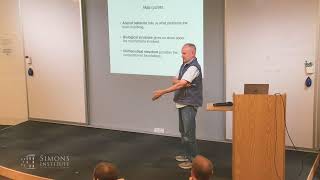
Neural Computations for Geometric Reasoning
Explore neural computations enabling animals to represent and process geometric structures in 3D environments, focusing on robust, low-power circuits for survival and navigation.
System of Interacting Neurons with Short-Term Synaptic Facilitation
Explore interacting neurons and short-term synaptic facilitation in this comprehensive lecture by experts from renowned French universities.
Neural Fields with Rebound Currents: Novel Routes to Patterning
Explore novel patterning routes in neural fields with rebound currents, uncovering innovative approaches to understanding brain dynamics and neural networks.
Topological Insights in Neuroscience
Explore topological approaches in neuroscience, uncovering insights into brain structure and function through mathematical analysis.
Multi-scale Modeling of Vesicular Release at Neuronal Synapses
Explore multi-scale modeling techniques for vesicular release in neuronal synapses, focusing on advanced computational approaches to understand synaptic transmission.
Self-Organized Criticality in Hierarchical Modular Networks of Galves-Löcherbach Neurons
Explore self-organized criticality in hierarchical modular networks, focusing on Galves-Löcherbach neurons and their implications for complex systems.

Inferring Monosynaptic Connections from Cross-Correlograms of Neuronal Spike Trains
Explore techniques for inferring monosynaptic connections from neuronal spike train cross-correlograms, enhancing understanding of neural network structures.
A Neural Mass Model for Abnormal Beta-Rebound in Schizophrenia
Explore a neural mass model examining abnormal beta-rebound in schizophrenia, presented by experts from the University of Nottingham at Institut Henri Poincaré.
A Multiple Time Renewal Equation for Neural Assemblies with Elapsed Time Model
Explore neural assemblies through a multiple time renewal equation, focusing on the elapsed time model and its implications for understanding brain dynamics.
Fokker-Planck Equations of Neuron Networks: Understanding Time Periodic Solutions
Explore Fokker-Planck equations in neuron networks, focusing on time periodic solutions and their implications for neural dynamics.
The Non-Linear Dynamics of Retinal Waves
Explore the complex dynamics of retinal waves, uncovering their non-linear behavior and implications for visual system development.