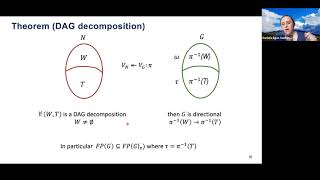
Nerve Theorems for Fixed Points of Neural Networks
Explore how network connectivity shapes neural activity using combinatorial threshold-linear networks. Learn about nerve theorems and their application in understanding fixed points of large neural networks.
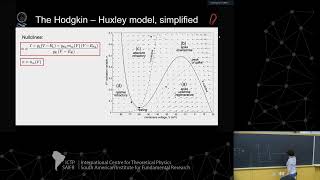
Nonlinear Dynamics of Neuronal Models with Applications to Bird Song Dynamics - Class 2
Explore nonlinear dynamics of neuronal models and their application to bird song dynamics, focusing on advanced concepts and real-world examples.
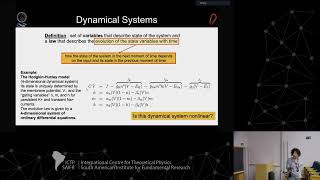
Nonlinear Dynamics of Neuronal Models with Applications to Bird Song Dynamics - Class 1
Explore nonlinear dynamics in neuronal models, focusing on bird song dynamics. Gain insights into complex neuroscience concepts and their applications.
PDEs for Neural Assemblies - Analysis, Simulations, and Behavior
Explore PDEs for neural assemblies, analyzing their behavior through simulations and mathematical techniques with Professor Benoît Perthame from Sorbonne University.
Graph Rules and Topological Insights for Inhibitory Network Dynamics
Explore graph rules and topological insights for inhibitory network dynamics, uncovering mathematical principles behind neural networks.
Marked Point Process Modeling and Estimation Problems in Neural Data Analysis
Explore marked point process modeling and estimation techniques for analyzing neural data, focusing on advanced statistical approaches in neuroscience research.

How Your Brain Organizes Information
Explore cognitive maps and how the brain organizes information for flexible behavior. Learn about hippocampal neurons, non-spatial mapping, graph theory, latent spaces, and factorized representations in neuroscience.
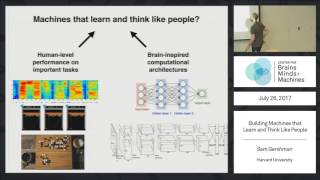
Building Machines that Learn and Think Like People
Explore computational neuroscience and AI inspired by human cognition, covering intuitive theories, compositionality, and learning to learn for more human-like artificial intelligence.
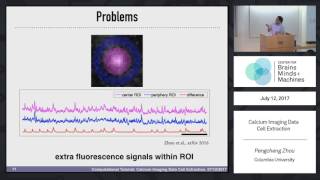
Calcium Imaging Data Cell Extraction
Learn advanced techniques for extracting neuronal signals from calcium imaging data using CNMF-E, a matrix factorization approach. Improve signal quality and detection in microendoscopic recordings of deep brain activity.
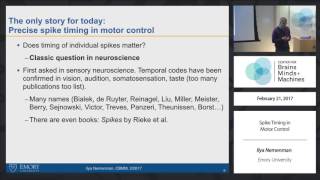
Spike Timing in Motor Control
Explore spike timing in neural motor codes, focusing on vocalization and breathing in songbirds. Learn about information encoding in neurons and its impact on animal behavior.
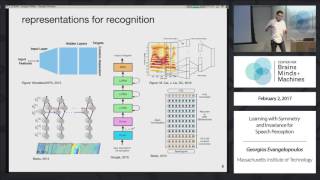
Learning with Symmetry and Invariance for Speech Perception
Explore symmetry and invariance in speech perception, focusing on acoustic variability, feedforward models, and invariant representations. Learn about word orbits, phone representations, and acoustic modeling techniques.
Learning in Recurrent Neural Networks
Explore recurrent neural networks, covering continuous and spiking models, effective connectivity, and philosophical implications in computational neuroscience.
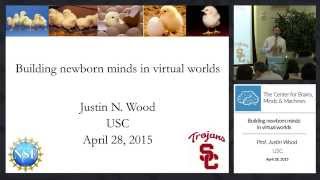
Building Newborn Minds in Virtual Worlds
Explore the development of high-level vision in newborns through innovative controlled-rearing experiments, revealing insights into invariant object recognition and computational models of visual cortex.
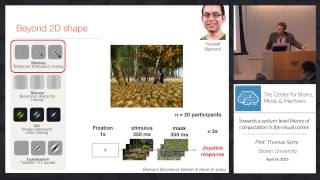
Towards a System-Level Theory of Computation in the Visual Cortex
Explore computational models of visual processing in primate cortex, combining neuroscience and AI to understand perception and develop advanced computer vision systems.
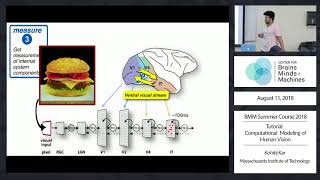
Computational Models of Human Vision - Part 2
Explore computational approaches to human vision, focusing on encoding, decoding, and behavioral metrics in the ventral stream and identity manifold.
Liquid Time Constant Networks
Explore time-continuous neural networks, focusing on Liquid Time Constant Networks and their stable state, expressivity, and performance in dynamic causal modeling.
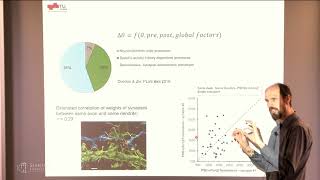
Dynamic Neural Network Structures Through Stochastic Rewiring
Explore stochastic rewiring in neural networks, covering plasticity, noise, and reward-based learning, with insights into parameter dynamics and experimental findings.

The Prefrontal Cortex as a Meta-Reinforcement Learning System
Explore the prefrontal cortex's role in meta-reinforcement learning, connecting neuroscience and AI through recurrent neural networks and cognitive tasks like Harlow's experiment.
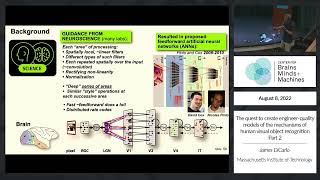
The Quest to Create Engineer-Quality Models of the Mechanisms of Human Visual Object Recognition - Part 2
Explore advanced neural models and mechanisms of human visual object recognition, including linear decoders, adversarial attacks, and individual variability in visual processing.
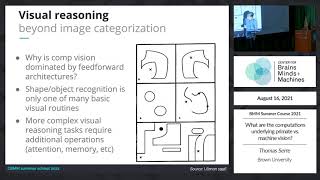
What Are the Computations Underlying Primate vs. Machine Vision?
Explore primate and machine vision computations, comparing face recognition, image processing, and neural networks. Gain insights into computational neuroscience and visual perception illusions.
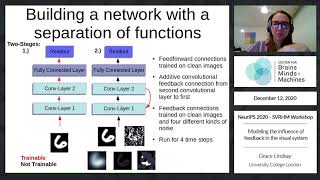
Modeling the Influence of Feedback in the Visual System
Explore how feedback influences visual processing, using masking studies and network modeling to understand its impact on classification accuracy and neural activity.