Convergent Evolving Surface Finite Element Algorithms for Geometric Evolution Equations
Explore convergent evolving surface finite element algorithms for geometric evolution equations, presented by Prof. Christian Lubich from University of Tübingen.
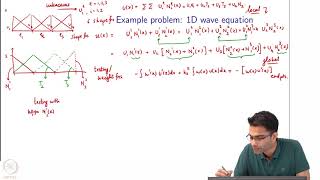
1D Finite Element Method: Wave Equation Basis and Testing Functions - Lecture 1
Explore basis and testing functions for 1D Finite Element Method in solving the 1D Wave Equation, enhancing understanding of numerical methods in computational physics.
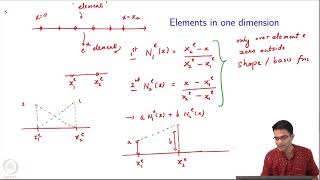
Introduction to the Finite Element Method: 1D Basis Functions
Explore 1D basis functions in finite element method. Learn key concepts and applications for numerical analysis and engineering problem-solving.
Randomized Numerical Linear Algebra - Overview
Explore randomized numerical linear algebra techniques for efficient matrix computations, covering sampling methods, error bounds, and applications to least-squares problems and SVD.
Stabilizing the Unstable Output of Persistent Homology Computations
Explore stabilizing techniques for persistent homology computations, focusing on generating cycles and their applications in topological data analysis.
On the Role of Data Structure in High-Dimensional Learning
Explores high-dimensional learning challenges, focusing on geometric function classes, optimization aspects, and computational hardness. Discusses algorithmic approaches and implications for deep learning.
Computing Persistent Homology - Introduction
Explore the fundamentals of persistent homology computation, covering key concepts, intuition, and practical applications in topological data analysis.
Gunnar Carlsson - Local to Global Principles in Persistent Homology
Explore persistent homology's local-to-global principles, computational methods, and applications in topology and data analysis with expert Gunnar Carlsson.

GPU Accelerated Computation of VR Barcodes in Evaluating Deep Learning Models
GPU-accelerated computation of VR barcodes for evaluating deep learning models, focusing on Ripser++ software and its applications in measuring data distribution shifts and analyzing attention graphs in BERT models.
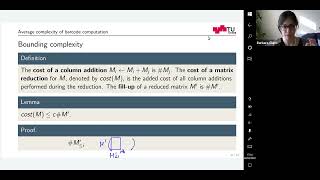
Barbara Giunti - Average Complexity of Barcode Computation for Vietoris-Rips Filtrations
Explore algorithmic complexity of persistent homology in random Vietoris-Rips filtrations, focusing on boundary matrix fill-up and its implications for computational efficiency.
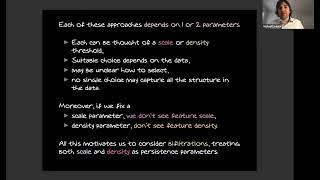
Stability of 2-Parameter Persistent Homology
Explores stability results for 2-parameter persistent homology, covering multicover bifiltration, subdivision bifiltrations, and degree bifiltrations. Discusses computational aspects and implications for practical applications.
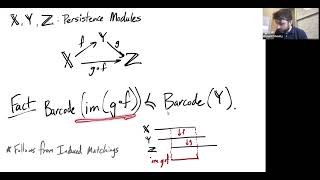
Don Sheehy - Persistent Homology of Lipschitz Extensions
Explore persistent homology of Lipschitz functions, analyzing sublevel set filtrations and barcodes from sample data. Learn about sub-barcodes and their theoretical guarantees in topological data analysis.
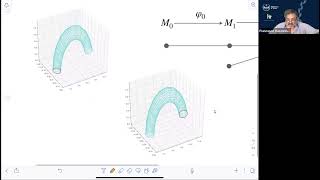
Parallel Decomposition of Persistence Modules Through Interval Bases
Explore parallel decomposition of persistence modules using interval bases, enhancing Topological Data Analysis with distributed computation and Hodge decomposition techniques.
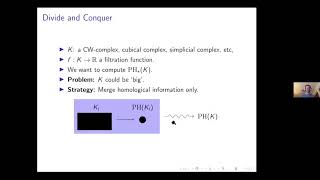
The Persistence Mayer-Vietoris Spectral Sequence
Explore the persistent Mayer-Vietoris spectral sequence, its applications in parallelizing persistent homology computations, and its ability to provide locality-enriched persistence barcodes.
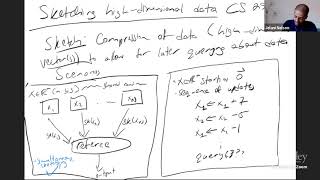
Sketching High-Dimensional Data
Explore techniques for efficiently summarizing and analyzing large datasets in high-dimensional spaces, focusing on probability, geometry, and computational methods.
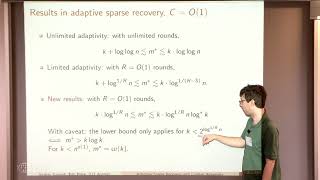
Adaptive Sparse Recovery with Limited Adaptivity
Explore techniques for efficient sparse signal recovery using limited adaptive measurements, with applications in sublinear algorithms and nearest-neighbor search.
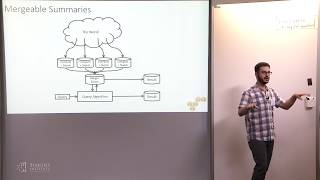
Mergeable Summaries and the Data Sketches Library
Explore mergeable summaries and the Data Sketches Library, focusing on mathematical and computational challenges in real-time decision making for big data analytics.
Novel Computational Perspectives of Persistence
Explore innovative computational approaches to persistence in algebraic topology, focusing on advanced techniques and their applications in data analysis and topological research.
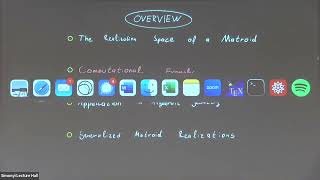
From Matroids to Moduli Spaces
Explore the mathematical foundations of matroids and their applications in OSCAR software, focusing on hyperplane arrangements, particle physics, and algebraic geometry applications.
Computer-Assisted Global Analysis of Non-Smooth Impact Dynamics Inspired by Energy Harvesting
Delve into advanced mathematical analysis of vibro-impact dynamics, exploring computational methods for energy harvesting systems and non-smooth impact phenomena through novel return map approaches.
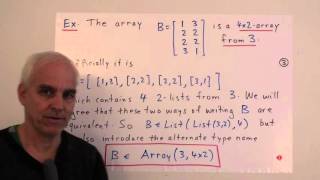
Arrays and Matrices - Data Structures in Mathematics Math Foundations | NJ Wildberger
Introduction to arrays and matrices as 2D data structures, exploring definitions, examples, and extending to 3D arrays. Distinguishes between arrays and matrices, offering a novel approach to linear algebra.