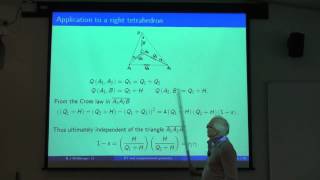
Towards a More Computational Mathematics - Rational Trigonometry and New Foundations for Geometry
Explores a computational approach to mathematics using rational numbers, introducing rational trigonometry and its laws. Covers applications in geometry, spread polynomials, and projective trigonometry.
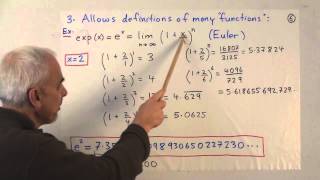
Difficulties With Real Numbers as Infinite Decimals - Real Numbers + Limits Math Foundations
Explores challenges in defining real numbers as infinite decimals from a computational perspective, highlighting technical obstacles in algorithms, arithmetic operations, and number equality recognition.
Computations with Homogeneous Coordinates - Universal Hyperbolic Geometry
Explore algebraic definitions of points and lines in hyperbolic geometry, learn key theorems, and understand their applications in computational geometry and Cartesian coordinates.
The Power of Sampling by Peter W. Glynn
Explore sampling methods in statistics, computation, and engineering. Learn about their history, applications, and advantages in overcoming dimensional challenges and creating scalable algorithms.
Computer-Assisted Proofs in the Arithmetic of Quadratic Forms - IPAM at UCLA
Explore computer-assisted proofs in quadratic forms arithmetic, covering equivalence, representation, local-global principles, and modular forms. Gain insights into complex computations across mathematics.
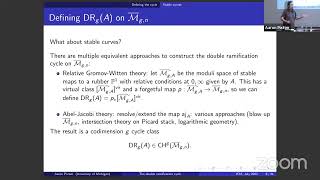
Aaron Pixton- The Double Ramification Cycle
Explore divisorial conditions, dual graphs, and tautological generators in algebraic geometry. Gain insights into computing DR(A) and multiplying Hain's formula.
Ulrich Bauer: Ripser - Efficient Computation of Vietoris–Rips Persistence Barcodes
Explore efficient computation of Vietoris-Rips persistence barcodes using Ripser software. Learn about matrix reduction algorithms, persistent cohomology, and discrete Morse theory applications in topological data analysis.
A Coupling Strategy for Nonlocal and Local Models With Applications
Explore nonlocal-local model coupling in elasticity through optimization, analyzing well-posedness and implementation. Includes numerical tests and applications in peridynamics and classical elasticity.
Derek Holt- Algorithms for Finitely Presented Groups III
Explore advanced algorithms for finitely presented groups, including Todd-Coxeter coset enumeration, Reidemeister-Schreier algorithm, and automatic structures. Learn applications in group theory and computational methods.
Reinhard Kahle- How Computations Entered in Mathematical Foundations
Explore how computation became central to mathematical foundations, from Hilbert's Programme to the distinction between syntax and semantics in formalization and recursive theories.
Standard and Less Standard Asymptotic Methods - Lecture 9
Explore advanced asymptotic methods for evaluating infinite sums and recognizing sequence patterns. Learn techniques from standard to unconventional, with practical examples and applications in mathematics.

New Results in Computing Zigzag and Multiparameter Persistence
Explore new advancements in computing zigzag and multiparameter persistence, including efficient conversion methods and improved algorithms for 2-parameter persistence modules.
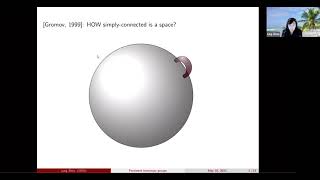
Persistent Homotopy Groups of Metric Spaces
Explore persistent homotopy groups of metric spaces, their stability, and advantages over persistent homology. Learn about tree-like structures and ultrametrics in fundamental groups.
Breakthroughs - A Refined Laser Method and Faster Matrix Multiplication
Explore advanced techniques in matrix multiplication, including the refined Laser method, to enhance computational efficiency and speed in mathematical operations.
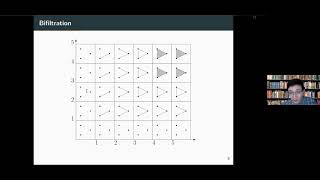
Efficient Approximation of the Matching Distance for 2-Parameter Persistence
Explore efficient algorithms for approximating matching distance in 2-parameter persistence modules, focusing on quad-tree refinement and local adaptive bounds for improved computational performance.
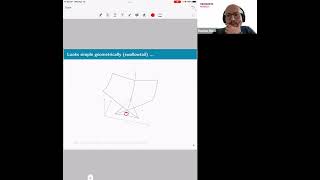
Two Methods of Efficiently Approximating Semi-Algebraic Sets Up to Homotopy
Explores efficient methods for approximating semi-algebraic sets, focusing on singly exponential complexity algorithms and their applications in algebraic geometry.
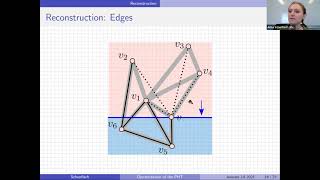
A Faithful Discretization of the Persistent Homology Transform
Explore a faithful discretization method for the Persistent Homology Transform, enhancing computational efficiency in topological data analysis and shape recognition.
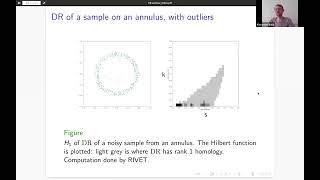
Homology Inference for the Degree-Rips Bifiltration
Explore density-sensitive degree-Rips bifiltration, its homology inference framework, and applications to annular point clouds with outliers. Analyze homotopy types and explanatory power in topological data analysis.
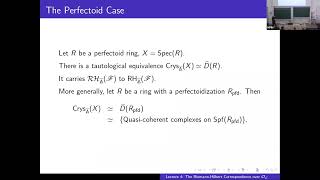
Jacob Lurie: A Riemann-Hilbert Correspondence in P-adic Geometry
Explore p-adic geometry and the Riemann-Hilbert correspondence, covering perfectoid spaces, crystals, and spectral methods in this advanced mathematics lecture.
Standard and Less Standard Asymptotic Methods - Lecture 12
Explore advanced techniques for evaluating infinite sums and recognizing asymptotic patterns in numerical sequences, with practical examples and applications in various mathematical fields.
Standard and Less Standard Asymptotic Methods - Lecture 11
Explore advanced techniques for evaluating infinite sums and recognizing asymptotic patterns in numerical sequences, with practical examples and applications in mathematical analysis.