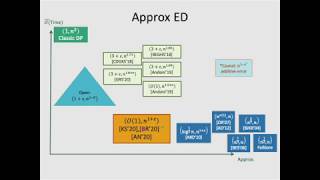
Constant Factor Approximations to Edit Distance in Nearly Linear Time
Explore efficient algorithms for approximating edit distance in near-linear time, merging insights from two papers to tackle dense and sparse graph scenarios.
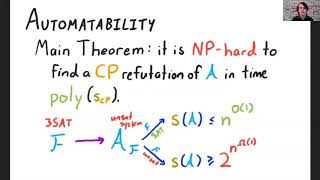
Automating Cutting Planes is NP-Hard
Explore the complexity of automating cutting planes in computational geometry, covering historical context, algorithmic challenges, and proof systems.
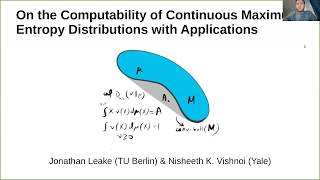
On the Computability of Continuous Maximum Entropy Distributions with Applications
Explore computability of continuous maximum entropy distributions, their applications in quantum entropy and interior point methods, and implications for SDP rounding algorithms.
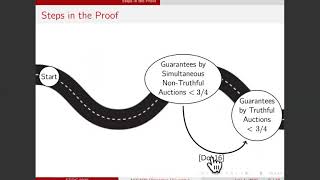
The Communication Complexity of Truthful vs Non-Truthful Combinatorial Auctions
Explore communication complexity in combinatorial auctions, comparing truthful and non-truthful mechanisms through theoretical analysis and proof techniques.
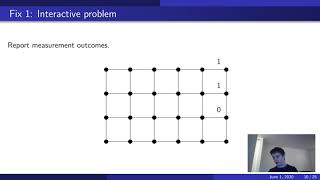
Interactive Shallow Clifford Circuits- Quantum Advantage Against NC and Beyond
Explore quantum advantage in interactive shallow Clifford circuits, examining their superiority over classical NC¹ computations and beyond through innovative problem-solving approaches.
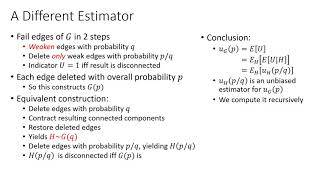
A Phase Transition and Quadratic Time Estimator for Network Reliability
Explore network reliability estimation, including a novel quadratic-time approach, phase transitions, and unbiased estimators for efficient analysis of complex networks.
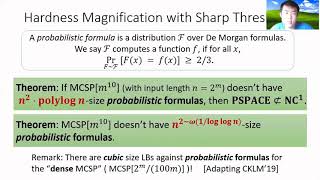
Sharp Threshold Results for Computational Complexity
Explore cutting-edge research on computational complexity, focusing on sharp threshold results, hardness magnification, and probabilistic formulas in this advanced theoretical computer science talk.
Computational Barriers in Statistical Estimation and Learning
Explore statistical estimation challenges, information theory, and computational barriers in high-dimensional settings with Stanford's Andrea Montanari in this Richard M. Karp Distinguished Lecture.

The Power of Random Quantum Circuits
Explore the complexity of random quantum circuits, their potential for quantum supremacy, and challenges in computing noisy circuit probabilities.
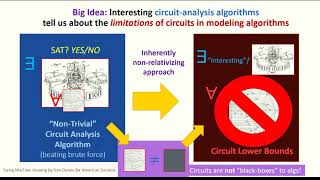
Circuit Lower Bounds from Algorithm Design - An Overview I
Explore circuit lower bounds in computational complexity, focusing on algorithm design techniques and their implications for NP problems and Boolean functions.
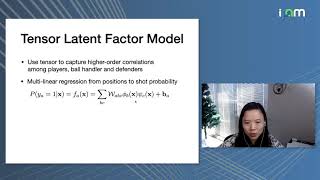
Multiresolution Tensor Learning for Efficient and Interpretable Spatial Analysis
Explore efficient and interpretable spatial analysis using multiresolution tensor learning, with applications in geology, sports, and climate science. Discover improved methods for handling complex spatial data.

Understanding, Interpreting and Designing Neural Network Models Through Tensor Representations
Explore tensor representations for neural networks, enhancing interpretability, expressive power, generalization, and robustness in deep learning models through spectral methods and innovative architecture design.
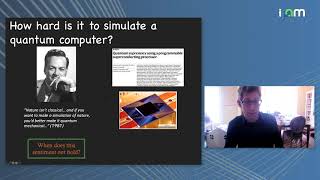
Phase Transitions in the Complexity of Simulating Random Shallow Quantum Circuits
Explores phase transitions in simulating random shallow quantum circuits, discussing computational complexity, tensor network contraction, and mapping 2D circuits to 1D processes with implications for quantum computing.
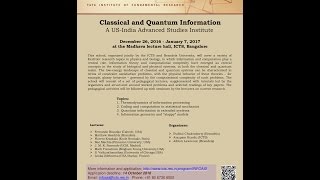
From Information Theory to Learning via Statistical Physics - Introduction
Explore connections between information theory, statistical physics, and learning. Delve into classical statistics, high-dimensional problems, and Bayesian approaches, with applications in signal processing and regression.
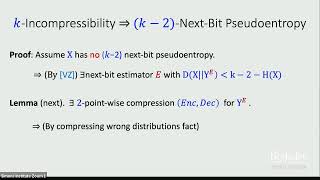
Incompressibility and Next-Block Pseudoentropy
Explores the relationship between incompressible distributions and next-block pseudoentropy, advancing understanding of computational entropy and its implications for cryptographic hardness assumptions.
Constant-Round Arguments from One-Way Functions
Explore constant-round argument systems for log-space uniform circuits, achieving almost-linear verification time using only one-way functions, advancing cryptographic protocol efficiency.
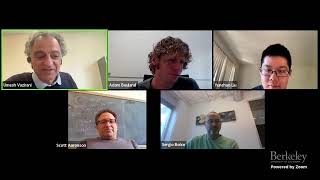
A Polynomial-Time Classical Algorithm for Noisy Random Circuit Sampling
Explores polynomial-time classical algorithm for noisy random circuit sampling, challenging quantum supremacy claims. Discusses computational complexity, experimental implications, and recent progress in quantum computing.
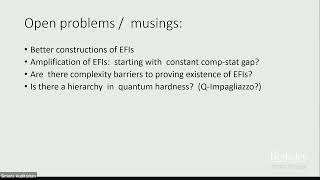
On the Computational Hardness Needed for Quantum Cryptography
Explores EFI pairs as essential for quantum cryptography, comparing their role to one-way functions in classical cryptography and demonstrating their necessity for various applications.
Max-Flow and Friends, In Almost Linear Time
Explore cutting-edge algorithms for max-flow problems and related graph theory concepts, focusing on recent breakthroughs in achieving near-linear time complexity.

Verifiable Quantum Advantage Without Structure - Quantum Colloquium
Explore groundbreaking research on verifiable quantum advantage without relying on structured problems, challenging traditional approaches in quantum computing.
Hidden Symmetries of Computational Problems
Explore hidden symmetries in computational problems, uncovering geometric methods for optimization and sampling with insights from experts in mathematics and quantum computing.