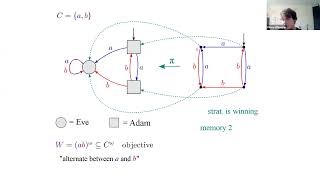
Games on Graphs - Memory Requirements and Strategy Analysis
Explore the theoretical foundations of graph-based games, focusing on strategic approaches, memory requirements, and applications in parity and mean-payoff scenarios.
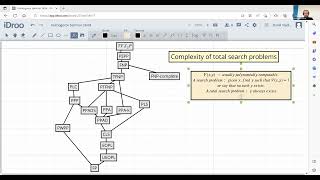
Different Classes of Search Problems in Computational Complexity - April 2023
Explore the hierarchy and classification of search problems in computational complexity, from Sperner's lemma to modern algorithmic challenges in triangulation coloring.

Automatic Complexity and Block-Entropy Coding - Preparations for Lempel-Ziv Analysis
Explore the mathematical foundations of string complexity through three equivalent measures: block entropy, finite-state transduction, and superadditive functions, leading to Lempel-Ziv compression analysis.

Lempel-Ziv Algorithm: Complexity Analysis and Automaton Conversion
Delve into the Lempel-Ziv algorithm's complexity analysis, exploring its relationship with superadditive functions and automaton conversion principles in computational theory.

Improving Solovay's Theorem in Computational Complexity - Part 1
Delve into computational complexity theory and explore improvements to Solovay's theorem through advanced mathematical analysis and theoretical frameworks.

Improving Solovay's Theorem - Part 2
Delve into advanced computational complexity theory through an examination of Solovay's theorem improvements, focusing on mathematical proofs and theoretical foundations.

Полудуплексная Коммуникационная Сложность: Разные Виды Adversary
Dive into the intricacies of half-duplex communication complexity, exploring different adversary types and their impact on complexity measures through concrete examples and theoretical analysis.

Computing Majority of N Using Majority-K Circuits with Logarithmic Depth
Delve into probabilistic constructions and computational complexity, exploring Valiant's theorem on majority functions using Maj-k circuits and their depth analysis.
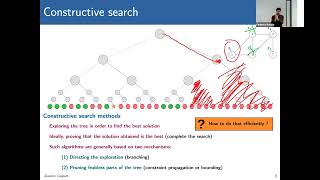
Learning to Bound Using Decision Diagrams and Reinforcement Learning
Explore decision diagrams and reinforcement learning for tighter bounds in discrete optimization, enhancing branch-and-bound algorithms with improved variable ordering techniques.
How to Use Mean-Field Control for Restless Bandits and Weakly Coupled MDPs
Explore mean-field control techniques for resource allocation in weakly coupled MDPs and restless bandits, focusing on LP-based relaxations and asymptotic optimality.
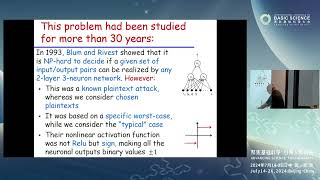
Polynomial Time Cryptanalytic Extraction of Neural Network Models
Explore polynomial-time techniques for extracting neural network parameters, improving upon previous methods and demonstrating practical efficiency on a CIFAR10 classifier.
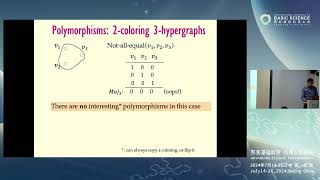
When and Why Do Efficient Algorithms Exist for Constraint Satisfaction and Beyond
Explore the mathematical structures behind efficient algorithms for constraint satisfaction problems and beyond, focusing on polymorphisms and their role in computational complexity.
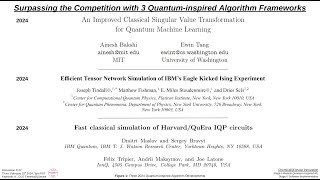
Surpassing the Competition with 3 Quantum-Inspired Algorithm Frameworks
Explore cutting-edge quantum-inspired algorithms for machine learning, including dequantized algorithms, tensor networks, and quantum algorithms. Gain insights into their strengths, weaknesses, and potential applications.

Declarative Programming via a Relational Algebra - PhD Defense
Explore declarative programming through relational algebra in this PhD defense presentation, delving into advanced concepts and research findings.
Randomness and Complexity - Lecture 1
Explore the intersection of randomness and complexity in mathematics, delving into key concepts and their applications in discrete mathematics and computer science.
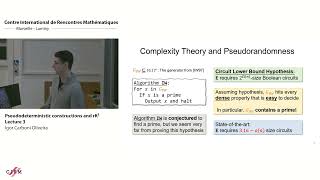
Pseudodeterministic Constructions and rK^t - Tutorial 3
Explore pseudodeterministic constructions and rK^t in this advanced mathematics tutorial by Igor Carboni Oliveira, delving into randomness, information, and complexity theory.
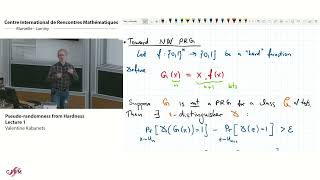
Derandomization: Pseudo-randomness from Hardness - Part 1
Explore pseudo-randomness from hardness in derandomization with Valentine Kabanets. Gain insights into this mathematical concept through a comprehensive tutorial.

Algorithms and Hardness for Attention and Kernel Density Estimation
Explore algorithmic techniques for Attention and Kernel Density Estimation, examining fast algorithms and hardness results to optimize computational efficiency in machine learning and statistical tasks.
Open Problems in the Theory of Deep Learning - Panel Discussion
Explore cutting-edge perspectives on deep learning theory with leading experts, addressing unresolved questions and future research directions in this dynamic field.
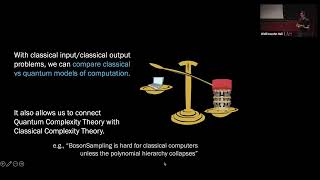
Towards a Complexity Theory for Fully Quantum Problems
Explore quantum complexity theory and its applications in solving fully quantum problems, focusing on cutting-edge research and potential breakthroughs in quantum computing.
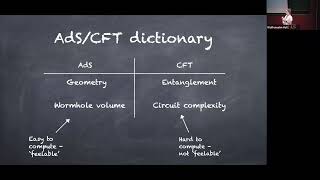
Complexity and Gravity
Explore the intricate relationship between complexity theory and gravitational physics in this advanced workshop, delving into cutting-edge research at the intersection of quantum information and theoretical physics.