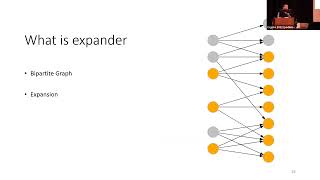
Zero Knowledge Proofs - Advances and Applications
Explore cutting-edge developments in zero-knowledge proofs and their applications in cryptography at this advanced Crypto 2022 conference session.
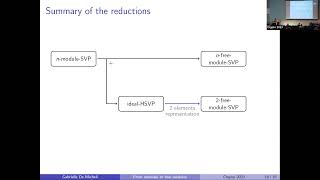
Lattice Problems and Their Complexity - Lecture 1
Explore lattice problems and their complexity in cryptography, focusing on recent advancements and theoretical foundations presented at Crypto 2023.
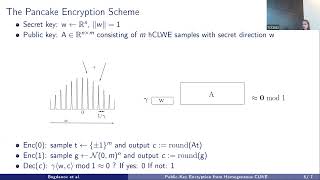
Lattice-Based Cryptography Session - TCC 2022
Explore cutting-edge research and developments in lattice-based cryptography at this Theory of Cryptography Conference session.
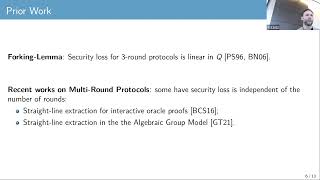
Interactive Proofs in Cryptography - TCC 2022 Session
Explore cutting-edge developments in interactive proof systems and their applications in cryptography and theoretical computer science.
AI and Cryptanalysis - GHTC 2023 Round Table 2
Explore the intersection of AI and cryptanalysis in this expert roundtable discussion from the Glowing Hot Topics in Cryptography workshop, examining cutting-edge developments and future implications.
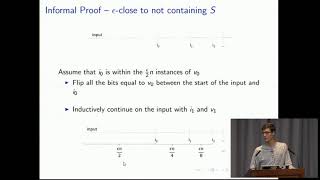
Sublinear Time Property Testers - Algorithms for Efficient Function Analysis
Explore sublinear time property testers for efficient algorithm design. Learn about relaxed decision problems, fast testers, and applications in graph theory and string processing.
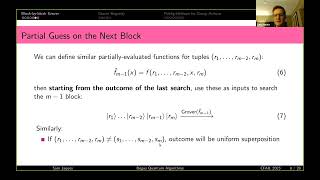
Bogus Quantum Algorithms and the Grover Algorithm - CFAIL 2023 Talk
Opening remarks and talk on quantum algorithms, focusing on Grover's algorithm and group actions, exploring in-place vs out-of-place implementations and their implications.
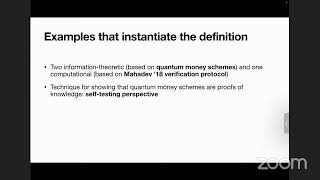
Quantum Constructions and Proofs - Session 193
Explore quantum constructions and proofs, delving into advanced concepts and methodologies in quantum computing and cryptography.
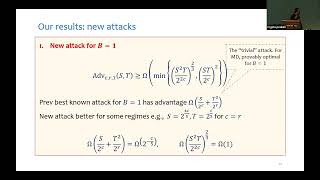
Lower Bounds in Cryptography
Explore cutting-edge research on computational complexity and cryptographic lower bounds in this advanced session from Crypto 2022, featuring expert insights and theoretical discussions.
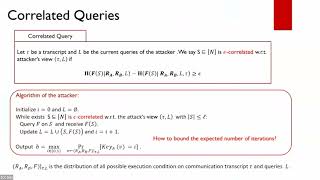
Lower Bounds in Cryptography - TCC 2023 Session
Explore cutting-edge research on lower bounds in theoretical cryptography, presented at TCC 2023. Gain insights into the latest advancements and challenges in this critical area of study.
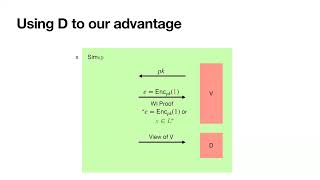
Zero-Knowledge Proofs - Foundations
Explore the foundational concepts of zero-knowledge proofs in this comprehensive session from Asiacrypt 2023, chaired by renowned cryptographer Moti Yung.
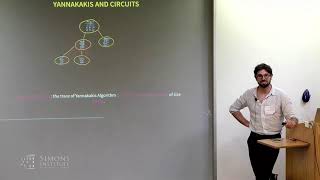
Direct Access for Conjunctive Queries with Negation
Explores efficient direct access techniques for signed conjunctive queries, extending tractability results to queries with negative atoms using circuit-based approaches.
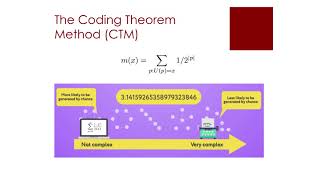
Computing the Uncomputable: The Coding Theorem Method - Unit 6, Module 2
Explore the Coding Theorem Method for computing uncomputable functions, delving into algorithmic information dynamics and its applications in causality and living systems.
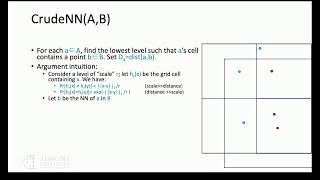
A Near-Linear Time Algorithm for the Chamfer Distance
Explore a groundbreaking near-linear time algorithm for computing the Chamfer distance, a crucial metric in computer vision and image processing.
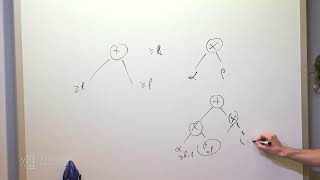
Lower Bounds for Tractable Arithmetic Circuits
Explores techniques for proving size lower bounds on tractable arithmetic circuits, focusing on structural restrictions and their impact on circuit complexity in probabilistic reasoning.
Fundamental Limits to Quantum Computation
Explores quantum computing's potential and limitations, discussing learnability, error mitigation, and non-unital noise impacts on near-term devices and fault-tolerant systems.
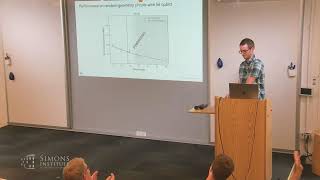
Probing the Limits of Classical Computing with Arbitrarily Connected Quantum Circuits
Explore the computational gap between classical and quantum computers through random circuit sampling in highly connected geometries, focusing on limitations and potential improvements.

Learning Shallow Quantum Circuits and Quantum States in Polynomial Time
Efficient algorithms for learning shallow quantum circuits and states, extending to polylog depth. Key techniques involve reconstructing low-complexity quantum systems from local observables.
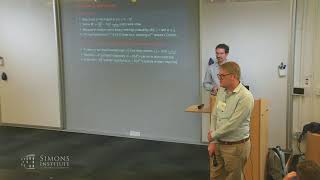
A Quantum Speed-Up for Approximating the Top Eigenvector of a Matrix via Improved Tomography
Quantum algorithm for approximating top eigenvectors of matrices, offering polynomial speedup over classical methods. Introduces efficient quantum tomography techniques for state and process reconstruction.
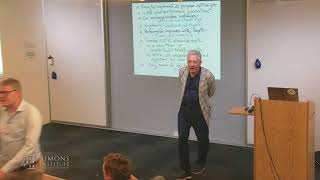
The Virtues of the Quantum Approximate Optimization Algorithm
Exploring QAOA's potential for solving combinatorial optimization problems, its performance guarantees, quantum supremacy, and practical limitations in near-term quantum computing.
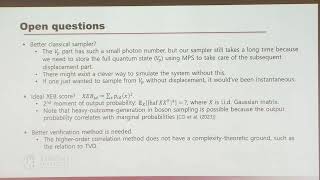
Classical Algorithm for Simulating Experimental Gaussian Boson Sampling
Explore a classical algorithm for simulating Gaussian boson sampling, challenging claims of quantum advantage in current experiments with high photon loss rates.