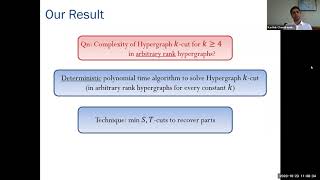
Hypergraph K-Cut for Fixed K in Deterministic Polynomial Time
Explore deterministic polynomial-time algorithms for hypergraph k-cut problems, focusing on fixed k values. Learn about structural theorems, techniques, and open questions in this field.
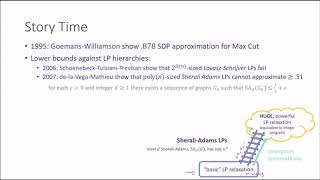
Subexponential LPs Approximate Max-Cut
Explore subexponential linear programs for approximating Max-Cut, comparing LPs and SDPs, and examining refutation in pseudorandom graphs. Gain insights into combinatorial optimization techniques.
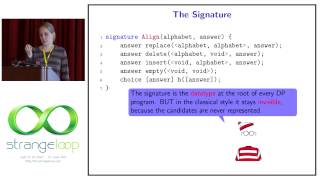
Dynamic Programming at Ease - With Grammars, Algebras, Products
Explore dynamic programming for combinatorial optimization problems using grammars, algebras, and products. Learn to efficiently solve complex problems by reusing intermediate results and reducing complexity.
Simple Sublinear Algorithms for Vertex Coloring
Dive into advanced graph theory concepts and efficient vertex coloring algorithms, exploring sublinear approaches for optimizing computational complexity.

Performance and Limitations of QAOA at Constant Levels on Large Sparse Hypergraphs and Spin Glass Models
Delve into quantum algorithm analysis, exploring QAOA's performance limitations on large hypergraphs and spin glass models through theoretical frameworks and mathematical proofs.

Solving Scheduling Problems with Constraint Programming and Graph Neural Networks
Explore innovative approaches combining constraint programming and graph neural networks to tackle complex scheduling challenges.
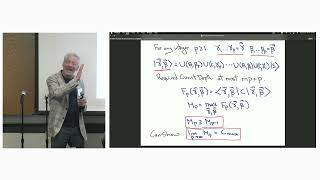
Quantum Approximate Optimization Algorithm (QAOA) - Recent Advances and Performance Updates
Delve into quantum optimization through QAOA, exploring its performance guarantees, supremacy capabilities, and recent breakthroughs in parameter selection for MaxCut problems on 3-regular graphs.
Operational Research for Fairness, Privacy and Interpretability in Machine Learning
Explore responsible AI through operational research, focusing on fairness, interpretability, and privacy in machine learning. Learn to leverage Integer Linear Programming for optimal, fair rule lists.
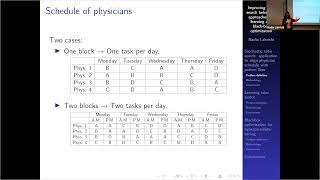
Stochastic Tabu Search and Improvements - Application for Physician Scheduling
Explore stochastic tabu search for physician scheduling, including hyperparameter tuning and learning algorithms to enhance efficiency in radiotherapy centers.

Fast Exact Algorithms for Interdiction Problems - Coffee Talk
Explore fast exact algorithms for interdiction problems, focusing on knapsack and minimum spanning tree variants. Learn about Stackelberg games and branch-and-bound techniques for optimization.
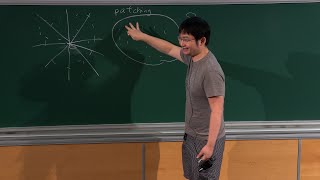
Euclidean Capacitated Vehicle Routing in Random Setting - A 1.55-Approximation Algorithm
Explore a 1.55-approximation algorithm for Euclidean capacitated vehicle routing in random settings, presented by Zipei Nie.
High-Dimensional Prediction for Sequential Decision Making
Explore efficient algorithms for online high-dimensional predictions, enabling no-regret guarantees, fairness, and uncertainty quantification in multiclass settings for improved decision-making.
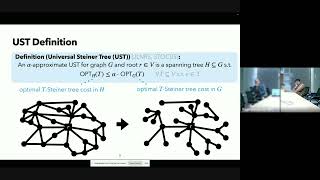
One Tree to Rule Them All: Polylogarithmic Universal Steiner Trees and Strong Sparse Partition Hierarchies
Explore polylogarithmic universal Steiner trees and strong sparse partition hierarchies. Learn about new constructions improving approximation guarantees and matching logarithmic lower bounds.
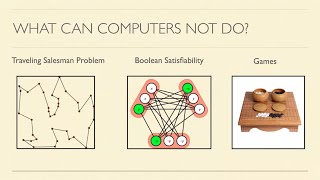
Are Neural Networks Optimal Approximation Algorithms for Constraint Satisfaction Problems?
Explore neural networks' capability to solve NP-hard optimization problems, focusing on constraint satisfaction and their potential as optimal approximation algorithms.

Computing Small Rainbow Cycle Numbers with SAT Modulo Symmetries
Explores computing rainbow cycle numbers using SAT modulo Symmetries, enhancing understanding of envy-freeness in fair division of indivisible goods and improving EFX allocation feasibility guarantees.
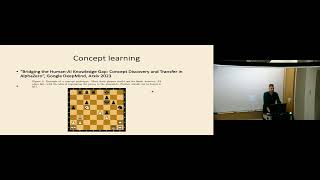
Towards Reverse Algorithmic Engineering of Neural Networks
Explore the algorithmic decision-making process of neural networks through NeuroSAT case study, examining how ML models learn and apply combinatorial features and confidence-based variable selection in SAT solving.

Learn Backtracking with Examples - Design and Analysis of Algorithms
Master backtracking algorithms through practical examples. Enhance problem-solving skills and optimize algorithmic design for efficient solutions in computer science and programming.
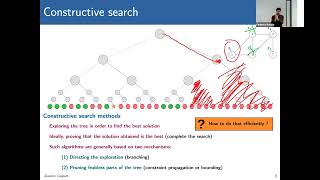
Learning to Bound Using Decision Diagrams and Reinforcement Learning
Explore decision diagrams and reinforcement learning for tighter bounds in discrete optimization, enhancing branch-and-bound algorithms with improved variable ordering techniques.
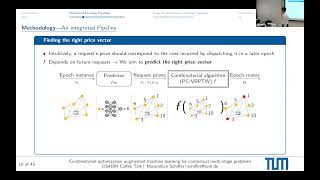
Combinatorial Optimization Augmented Machine Learning for Contextual Multi-Stage Problems
Explore combinatorial optimization augmented machine learning for contextual multi-stage problems, focusing on industrial applications and dynamic stochastic optimization challenges.
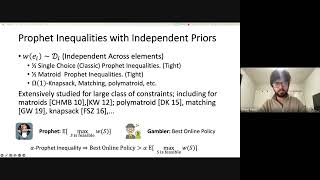
Limitations of Stochastic Selection with Pairwise Independent Priors
Explore stochastic selection problems with pairwise-independent priors and matroid constraints, examining limitations and optimal bounds for contention resolution and prophet inequalities.

Sharp Isoperimetric Inequalities on the Hamming Cube
Delve into advanced isoperimetric problems on the Hamming cube, exploring Talagrand's interpolation theory and two-point inequalities in mathematical analysis.