On Sparse Linear Programming and Simple Neural Networks
Explores connections between sparse linear programming and neural networks, focusing on overparametrized learning and sparse inference from computational perspectives.
Simple and Fast Rounding Algorithms for Directed and Node Weighted Multiway Cut
Explore efficient algorithms for directed and node-weighted multiway cut problems, focusing on simple rounding techniques and integrality gap analysis in graph theory and combinatorial optimization.

Embedding as a Tool for Algorithm Design
Explore embedding algorithms for structured data prediction, combinatorial optimization, and dynamic network processes. Learn innovative approaches to algorithm design using latent variable models and mean field techniques.

Berkeley in the 80s - Richard Karp and the Theory of Computing
In-depth interview with Turing Laureate Richard Karp, exploring his groundbreaking research on computational theory at Berkeley in the 1980s and its lasting impact on computer science.

Beating the Integrality Ratio for S-T-Tours in Graphs
Explores a novel algorithm for the s-t-path graph TSP, achieving a 1.497 approximation ratio and surpassing the known integrality ratio of 3/2 through innovative techniques.

A 1.5-Approximation for Path TSP
Explores a 1.5-approximation algorithm for the Metric Path Traveling Salesman Problem, introducing novel techniques to handle larger s-t cuts and achieve a simplified approach matching Christofides' TSP algorithm.
Approximation Algorithms for Hard Augmentation Problems
Explore advanced network design techniques for increasing graph connectivity, focusing on augmentation problems and recent developments in combinatorial optimization.
Money, Circuits, Mythic Figures, and More - Theory in the Allen School
Diverse theoretical computer science research: algorithms, data structures, complexity, combinatorics, and economics. Insights from UW Allen School's theory group on cutting-edge topics.
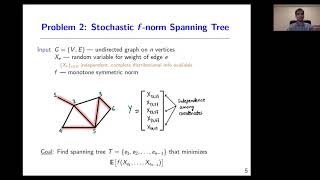
Approximation Algorithms for Stochastic Minimum Norm Combinatorial Optimization
Explore advanced techniques for solving stochastic minimum norm combinatorial optimization problems, focusing on approximation algorithms and their applications in complex decision-making scenarios.
Do Quantum Computers Have Applications in Machine Learning and Combinatorial Optimization
Explores quantum computing's potential in machine learning and optimization, discussing recent developments, comparative power, limitations, and future prospects in these fields.
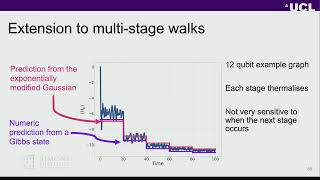
Continuous-Time Quantum Walks for MAX-CUT Optimization
Explore quantum walks for MAX-CUT optimization, linking Hamiltonians to thermalization. Discover novel insights into unitary dynamics for combinatorial problems using multi-stage walks and Floquet systems.

The Virtues of the Quantum Approximate Optimization Algorithm
Exploring QAOA's potential for solving combinatorial optimization problems, its performance guarantees, quantum supremacy, and practical limitations in near-term quantum computing.

N-Queens Problem Using Backtracking - Design and Analysis of Algorithms
Learn to solve the N-Queens problem using backtracking, focusing on the 4-Queens case. Explore algorithmic techniques for efficient placement of queens on a chessboard without conflicts.

0/1 Knapsack Problem Using FIFO Branch and Bound - Design and Analysis of Algorithms
Comprehensive tutorial on solving the 0/1 Knapsack problem using FIFO Branch and Bound method, with practical examples and step-by-step explanations for efficient algorithm implementation.
Extension Complexity of Random Polytopes
Explores extension complexity of random polytopes, discussing results for fixed-dimension convex hulls of random points on unit sphere or ball. Joint work with Kwan and Zhao.

0/1 Knapsack Problem Using Least Cost Branch and Bound - Design and Analysis of Algorithms
Learn to solve the 0/1 Knapsack problem using Least Cost Branch and Bound method, with a step-by-step example demonstrating the algorithm's application in Design and Analysis of Algorithms.

Efficiently Exploring Combinatorial Perturbations From High Dimensional Observation
Explore efficient methods for analyzing combinatorial perturbations in high-dimensional data, focusing on innovative approaches and practical applications.
Neural Set Function Extensions: Learning with Discrete Functions in High Dimensions
Explore neural set function extensions for integrating discrete functions into neural networks, focusing on continuous domain extensions and high-dimensional representations for combinatorial optimization.

Local Search GFlowNets - Enhancing Sampling Quality for Drug Discovery
Explore Local Search GFlowNets, a novel algorithm enhancing sampling quality for structured sequence generation in drug discovery and other fields through improved targeting of high-reward regions.
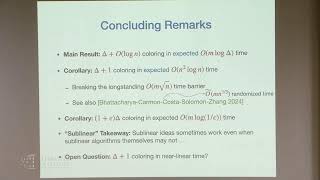
Sublinear Insights: A Faster Classical Algorithm for Edge Coloring
Explores a novel randomized algorithm for near-linear time graph edge coloring, improving on decades-old methods. Discusses implications for Vizing's theorem and dense graph coloring efficiency.
Shaving Logs by Weighing Coins - Extroverted Sublinear Algorithms
Explore innovative sublinear algorithms for efficient data analysis, focusing on log-shaving techniques and coin-weighing problems in computational complexity.